In a land of grand cathedrals, the Church of St Andrew, in the village of Greensted-juxta-Ongar in Essex, UK, is a modest church – smaller than some country chapels I’ve seen in back country Georgia. Greensted Church has that eclectic mix of architectural styles common to buildings that have seen centuries of fashions come and go. Some of the brickwork is Victorian, while the clapboard tower rose in the early 1600s. Bricklayers constructed the chancel in the 16th century.

But none of those antiquarian details drew me down narrow country lanes in the remnants of Epping Forest; it was the nave that brought me here. Originally constructed of split tree trunks, each standing on end, Greensted Church is classified as a palisade church — an early version of a construction technique which evolved into the stave churches still found in Scandinavia. Sections of these ancient walls remain in Greensted. These logs can be aged based on dendrochronology.

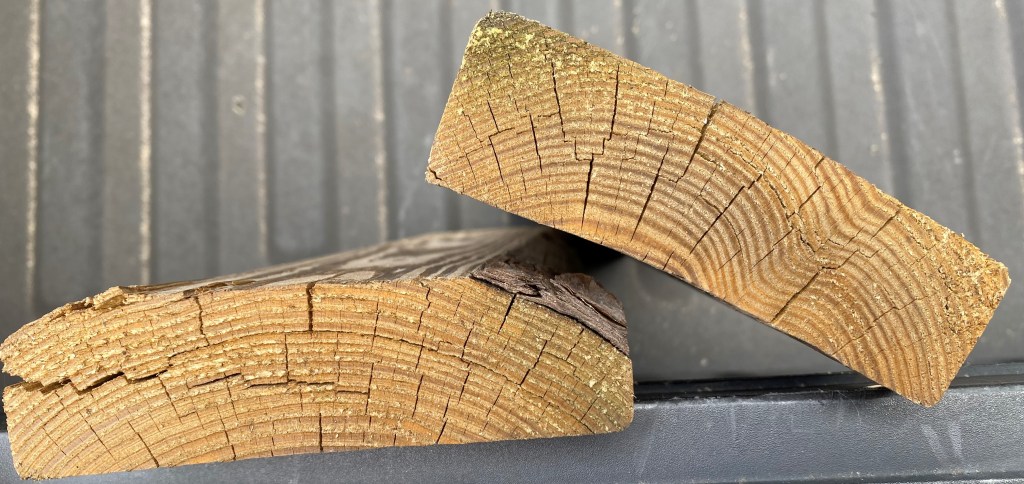
Dendrochronology? Yes, scientists love their Greek and Latin, and in Greek this technical term means “Study of Tree-Time”. Dendrochronology is a way to determine when a log was a living tree, and this works pretty well in temperate zones with distinct growing seasons. Trees grow new wood just beneath the bark, so the trunk gradually expands in diameter. This growth is more rapid early in the growing season, resulting in larger cells. Later in the summer, growth slows and the new wood is denser. Thus, each year’s growth consists of two rings – one pale, one darker. You can count the years of a tree by ticking off the number of dark rings counted on a tree stump. Oak is especially consistent in laying on rings, but other species can be used for dating.
In years where there is favorable moisture and temperatures, trees will put on more wood and the rings will be wider. In dry or cold years, the rings will be narrower. And these climatic variations affect all the trees in a region. Did a given county have a wet year in 1523, followed by several drought years? The wood will show a wide ring, followed by several narrow ones. In some cases, such as when a volcanic event causes planet-wide cooling, forests on several continents mark the event.
How can this be used to determine dates? Humans have built things out of wood for millennia. When you have enough samples, you begin to see overlapping patterns. Imagine a wood panel from a manor house. It was harvested from a 180-year-old oak that was twenty years old when, say, a decade of good weather allowed it to put on wide rings. Elsewhere in the county is a bridge plank that came from a tree already growing for a hundred years when that same weather phenomenon occurred, and then was cut almost immediately. Noting where those ten unusually-wide rings occur on the boards will give you a good idea of when the trees were growing, and when they were cut. In this example, if you have records showing the mansion’s paneling was installed in 1750, you can use that information to estimate when the bridge plank was cut a little after 1590.
This is a simplified example and leaves out some of the obstacles to precise dating. You only know for certain how old the tree was when cut by looking at a complete section of heartwood and sapwood from near the base of the tree (which includes the very oldest wood). Most sawn boards do not include the whole radius of the log, so you don’t know that the last ring you see is the last one the tree put on. Further, one can’t always be sure the wood hasn’t been reused from some other structure – the mantlepiece in my new house was originally part of a barn built in the 1850s. Still, having some of the wood is useful, and by overlapping the recognizable patterns on existing wood samples, scientists can date structures going back hundreds or thousands of years.
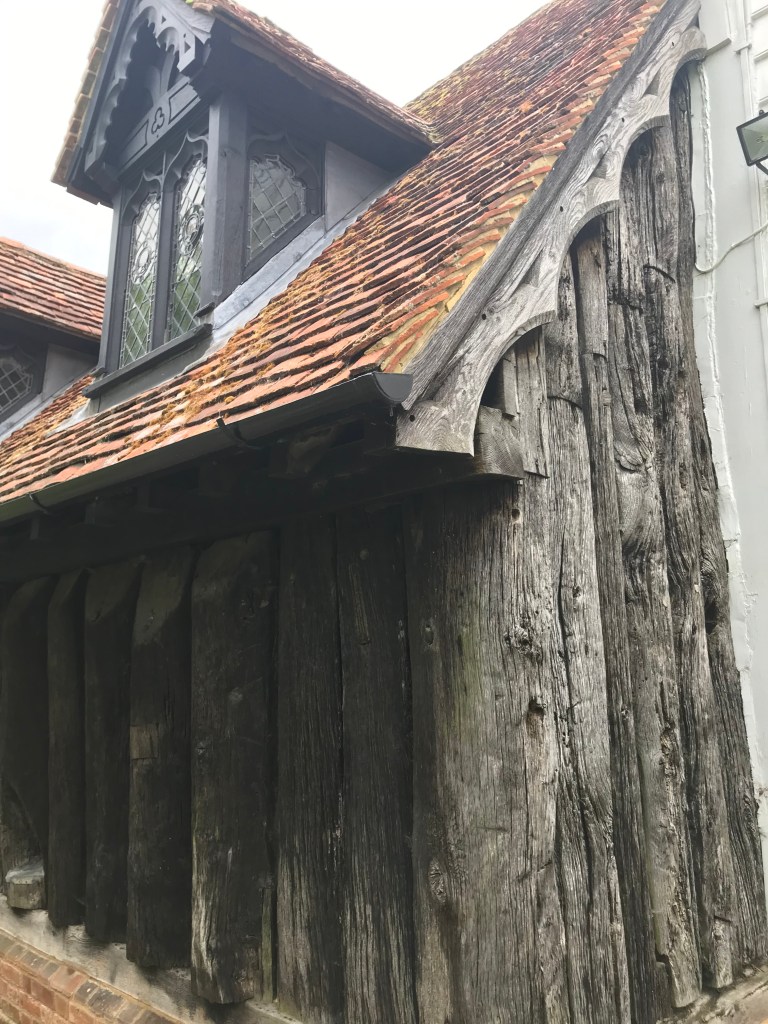
Dendrochronological analysis of the old wood on the Greensted Church suggests a minimum date of 1053, with an allowance of 10-to-55 years added for sapwood that has worn away in the intervening centuries. It may well be that the nave stood before the Norman Conquest; at any rate, the church is a contender for the title of oldest wooden church in the world, and the oldest wooden building in Europe.
Evidence points to a much older building, as is often the case on holy sites; excavations in the 1960s revealed timber structures dating to the 6th and 7th centuries — in the years when the East Saxons were newly-converted.
In a trip that saw structures both grander and far older, why spend time in an out-of-the-way little church? Because I have a historical interest in the Anglo Saxon period of Britain; I wanted to rest my hands on this timber that was likely felled and worked by Saxon craftsmen. It was coup-counting, pure and simple. But what historical enthusiast would not do the same, given the chance?

Additional Resources:
Dendrochronology from Historic Britain (a pdf)
 Towards the Moon or To the Sun