I remember getting off the school bus after a long day at elementary school. Ma was sitting on the front steps, waiting for me. She said that they had taken Booger, our old yellow cur, to the vet. He was sick, and they put him to sleep. I knew enough about doctors to understand about anesthesia during operations, so I wasn’t perturbed. “When will he wake up?” It was at this point that I learned about euphemisms, and about loss.
Since then, I have seen many, many dogs come and go. A few have gone on their own, suddenly and without warning. Most have been hard decisions. Maybe it’s a product of my own age and experiences, but I am always cognizant that my time with these dogs is finite. When I assume responsibility for a dog, be it a stray like Rufus or a pound pup like Hazel, I am aware that I will one day dig a hole for that friend. Three of our dogs are ten or older; seniors are still in good health, still eating well, still moving well. The voice in the back of my head whispers “one day…” Eventually, for each dog, the whisper will become “soon…”
I’m terribly sentimental when it comes to dogs. A sad story about a lost pup or bereaved old hound will bring a lump to my throat and send me rushing to find the nearest of my own dogs to pet. A suffering dog tears at my heart. But when it comes to my own hounds, as hard as it gets, I’m always there until the end. I can’t abide the cowards who leave their pets alone at the vet’s – or worse, take their senior dogs to a shelter or dump them on the side of the road when the animal’s infirmity becomes inconvenient.
I love my dogs more than I love most people.
And grief is the price of love.
“Having a dog will bless you with many of the happiest days of your life, and one of the worst.” –Unk.
Additional:
“The Good Death”, an essay by a veterinarian about the hardest decision the pet owner has to make. Should be required reading for any owner.
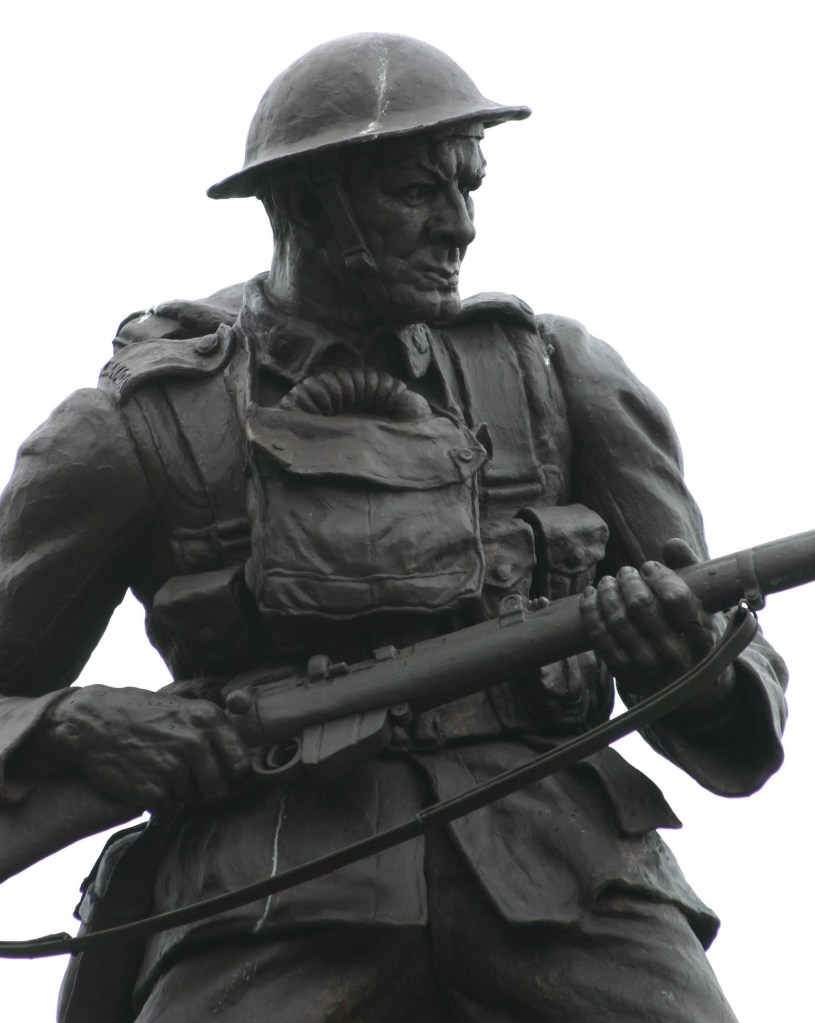
In the autumn of 1914, armies gathered, pushed, and blocked, in an effort to outflank each other. Instead, they ran into the sea. The forces were more lethal than in previous wars, producing withering rates of fire against which no amount of bravery could prevail. Standing invited death, so the men dug into the earth in order to move about with some amount of safety. Thus began the Great War, or as we would unfortunately come to call it: World War One.
For years, the armies pounded the trenches, occasionally charging across the deadly ground at great cost attempting to drive to foe back a mile or so. During this time, humanity at its most inhumane leveraged the power of chemistry, engineering, and the might of industry to create weapons that rendered the individual soldier nearly powerless to control his fate. Artillery could reach over the horizon to render the exposed man into pink mist, collapse dugouts and smother, or pummel with concussion until soldiers went punch-drunk or mad. Poison gasses could burn lungs, eyes, and exposed skin, and might persist in trenches or shell holes to blind or kill the unwary. Machine guns could send a stream of death hundreds of yards, showering bullets upon victims as they struggled to navigate the tangles of barbed wire on the churned fields of No Man’s Land. In its deadliest day, France suffered 27,000 killed, while over 19,000 Britons fell in their worst day. The war also saw the birth of tanks and fighting aeroplanes, which would only reach their deadly potential during the next world war.
This dehumanizing meatgrinder continued until the last survivor of the Triple Alliance, Germany, began to falter. The “Hundred Days” saw the men leaving the trenches they resided in for years, pushing the German army back. The butcher’s bill for this phase of the war is beyond comprehension: nearly two million dead or wounded. Consider that the current number of active-duty US military personnel, all branches, is just over two million.
November 11th, 1918. German delegates meet with the opposing military leaders in a train car in the middle of a forest, and bullied into signing a cease fire – the Armistice of Compiègne – at 5:45 in the morning. All fighting was to cease at 11:00 that morning, and with a few tragic exceptions it did.
The end of the War to End All Wars. This is where the story usually ends, all neatly tied up, fade to black, roll credits. However, an armistice is not peace, but rather a cessation of fighting for a period of time. In reality, warships remained on blockade stations and troops stayed on frontline guard for months after, while diplomats hashed out the terms of a formal peace treaty. Perhaps a quarter million German civilians died in the months between the Armistice and the peace treaty. Soldiers and civilians alike succumbed to diseases, including the so-called Spanish Flu which would kill tens of millions.
Once the ink dried on the Treaty of Versailles in June 1919, troops slowly returned to their home countries. But the impact on society went far beyond the territorial shifts or financial burdens from crippling war debts. Many millions had died; many more carried the physical and mental damage resulting from industrialized modern warfare. Some towns lost all of their fighting-aged men. The shock to societies worldwide as families lost siblings, fathers, husbands, sisters, wives, and children to the Great War can be guessed at by those have experienced such a loss personally, but at this scale the shared trauma is beyond imagination. Naturally, certain times and places would become focal points for remembering, reflecting, and grieving anew. The date and time of the Armistice became one such point in time; the Cenotaph in London and similar memorials around the world served as the places. From November 1919, many nations chose November 11 to hold Armistice Day commemorations honoring the fallen and celebrating the cause of world peace. With the onset of a new global war, Britain and the Commonwealth moved the commemoration to the nearest Sunday, reframing it as Remembrance Day (though Armistice Day is still recognized).
“The Treaty was all a great pity. We shall have to do the same thing all over again in 25 years at three times the cost.” –Lloyd George
In the United States, a similar movement to honor all veterans – living and dead – grew out of the Second World War. In 1954, Armistice Day became Veterans Day. Unlike some holidays, which are observed on Monday or Friday to extend a weekend, Veterans Day is always the 11th (although it did reside on the 4th Monday of October for a few years in the 1970s). Veterans Day is a federal holiday; apart from U.S. government workers, whether it is a holiday or not is up to individual companies, agencies or states. The nearest weekend is a time for parades and commemorations in many communities.
You smug-faced crowds with kindling eye/Who cheer when soldier lads march by,/Sneak home and pray you’ll never know/The hell where youth and laughter go. –Siegfried Sassoon, “Suicide in the Trenches”
I have my own commemoration, first enacted when there were still some veterans of the Great War living. Every year on the morning of November 11, I read poetry from the Great War or accounts from the soldiers. I listen to a playlist ranging from Arthur Fields singing “Over There” to three by Eric Bogle: “No Man’s Land,” “And the Band Played Waltzing Matilda,” and “The Gift of Years,” with a few relevant poems interspersed. Every year, on the eleventh hour of the eleventh day of the eleventh month, I pause for a silent toast to the strains of “The Last Post” and “Taps.”
I do not forget the men and women in uniform, now and in the past. But I commemorate Armistice Day for the sorrow of war and the hope for peace. May that hope not always be in vain.
They shall grow not old, as we that are left grow old:/Age shall not weary them, nor the years condemn./At the going down of the sun and in the morning/We will remember them. —Laurence Binyon, “For the Fallen”






 Towards the Moon or To the Sun
You must be logged in to post a comment.