Greensted Church (or, Walls Can Talk)

In a land of grand cathedrals, the Church of St Andrew, in the village of Greensted-juxta-Ongar in Essex, UK, is a modest church – smaller than some country chapels I’ve seen in back country Georgia.  Greensted Church has that eclectic mix of architectural styles common to buildings that have seen centuries of fashions come and go.  Some of the brickwork is Victorian, while the clapboard tower rose in the early 1600s. Bricklayers constructed the chancel in the 16th century.

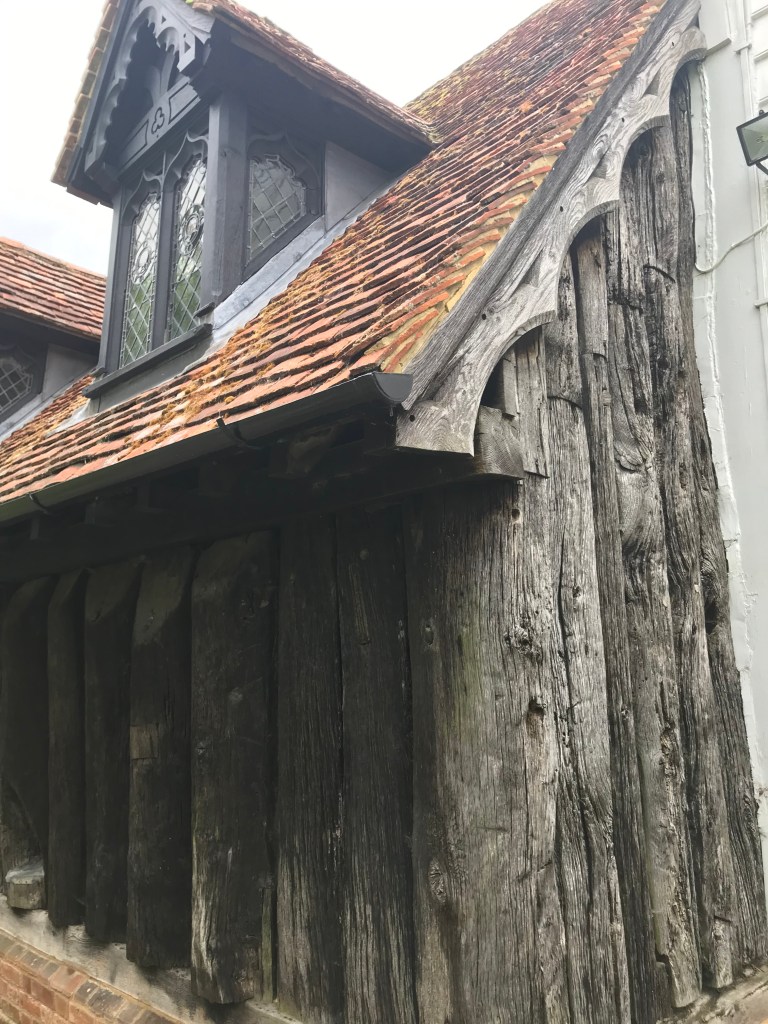
But none of those antiquarian details drew me down narrow country lanes in the remnants of Epping Forest; it was the nave that brought me here. Originally constructed of split tree trunks, each standing on end, Greensted Church is classified as a palisade church — an early version of a construction technique which evolved into the stave churches still found in Scandinavia.  Sections of these ancient walls remain in Greensted. These logs can be aged based on dendrochronology. 

Old oak log

Dendrochronology? Yes, scientists love their Greek and Latin, and in Greek this technical term means “Study of Tree-Time”.  Dendrochronology is a way to determine when a log was a living tree, and this works pretty well in temperate zones with distinct growing seasons.  Trees grow new wood just beneath the bark, so the trunk gradually expands in diameter.  This growth is more rapid early in the growing season, resulting in larger cells. Later in the summer, growth slows and the new wood is denser.  Thus, each year’s growth consists of two rings – one pale, one darker.  You can count the years of a tree by ticking off the number of dark rings counted on a tree stump. Oak is especially consistent in laying on rings, but other species can be used for dating.

In years where there is favorable moisture and temperatures, trees will put on more wood and the rings will be wider.  In dry or cold years, the rings will be narrower.  And these climatic variations affect all the trees in a region.  Did a given county have a wet year in 1523, followed by several drought years?  The wood will show a wide ring, followed by several narrow ones.  In some cases, such as when a volcanic event causes planet-wide cooling, forests on several continents mark the event. 

How can this be used to determine dates?  Humans have built things out of wood for millennia.  When you have enough samples, you begin to see overlapping patterns.  Imagine a wood panel from a manor house.  It was harvested from a 180-year-old oak that was twenty years old when, say, a decade of good weather allowed it to put on wide rings.  Elsewhere in the county is a bridge plank that came from a tree already growing for a hundred years when that same weather phenomenon occurred, and then was cut almost immediately.  Noting where those ten unusually-wide rings occur on the boards will give you a good idea of when the trees were growing, and when they were cut.  In this example, if you have records showing the mansion’s paneling was installed in 1750, you can use that information to estimate when the bridge plank was cut a little after 1590. 

This is a simplified example and leaves out some of the obstacles to precise dating. You only know for certain how old the tree was when cut by looking at a complete section of heartwood and sapwood from near the base of the tree (which includes the very oldest wood).  Most sawn boards do not include the whole radius of the log, so you don’t know that the last ring you see is the last one the tree put on. Further, one can’t always be sure the wood hasn’t been reused from some other structure – the mantlepiece in my new house was originally part of a barn built in the 1850s. Still, having some of the wood is useful, and by overlapping the recognizable patterns on existing wood samples, scientists can date structures going back hundreds or thousands of years.
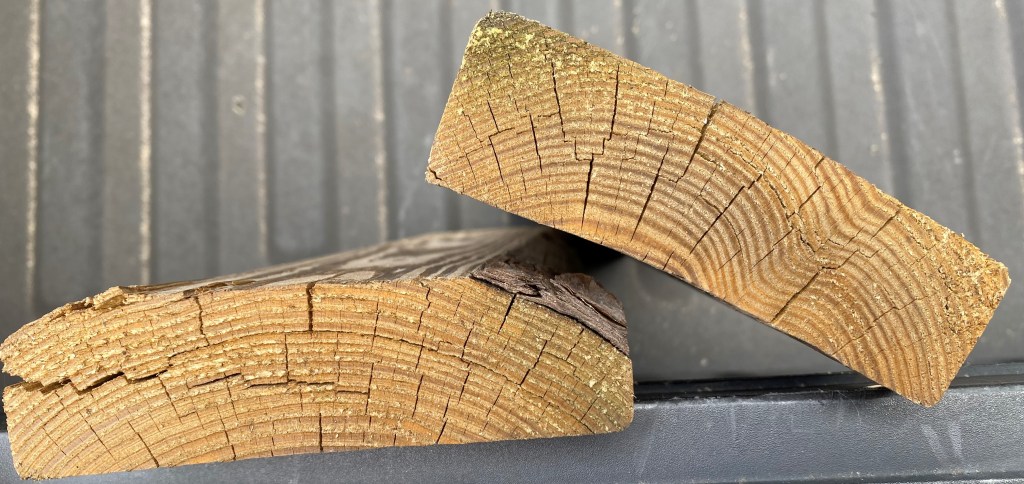
Rings in old pine boards. The final tree ring is beneath bark on the lower board

 Dendrochronological analysis of the old wood on the Greensted Church suggests a minimum date of 1053, with an allowance of 10-to-55 years added for sapwood that has worn away in the intervening centuries.  It may well be that the nave stood before the Norman Conquest; at any rate, the church is a contender for the title of oldest wooden church in the world, and the oldest wooden building in Europe.

Evidence points to a much older building, as is often the case on holy sites; excavations in the 1960s revealed timber structures dating to the 6th and 7th centuries — in the years when the East Saxons were newly-converted.

In a trip that saw structures both grander and far older, why spend time in an out-of-the-way little church? Because I have a historical interest in the Anglo Saxon period of Britain; I wanted to rest my hands on this timber that was likely felled and worked by Saxon craftsmen.  It was coup-counting, pure and simple.  But what historical enthusiast would not do the same, given the chance?

Additional Resources:

Dendrochronology from Historic Britain (a pdf)

Bog Oak

I’m contemplating doing some carving on bog oak.  Have you heard of it?  “Bog Oak” is a bit of a misnomer; it is likely to be oak, but could be another species such as pine or yew.  What is for sure is that it’s old, as in hundreds to several thousands of years old.

How can wood be that old?  Whether it’s a punky log in the woods or a plank that can no longer bear your weight, wood rots.  Fungi break down the structure of the wood cells to utilize the stored nutrients within.  Insects speed the process by boring through dead wood on a macro scale.  But these processes require two things: moisture and oxygen.  Take away one of these and the wood resists decay.  Wooden structures in arid or semi-arid locations can remain for hundreds of years, while those in temperate conditions collapse and crumble in a generation or so.

How can wood survive in very wet conditions?  Through a combination of factors.  The tannins in oak inhibit decay to begin with; the waterlogged wood, covered over time with earth, receives very little exposure to oxygen.  The boggy soil is generally acidic as well.  These factors all work together to inhibit fungal action (Incidentally, these same conditions are responsible for the preservation of “bog bodies”).

With time, the tannins in the wood react with iron salts and other minerals dissolved in the acidic soil and water, darkening and hardening the wood. The high mineral content makes bog oak difficult to carve; it dulls tools like no other wood I’ve worked.  The mineralization also makes the wood more resistant to burning, making bog oak an attractive material for tobacco pipes.  Bog oak is known as morta in the pipe industry.

Excavating the wood is a tricky process; most times, the wood already began to decay before being submerged or buried.  The salvageable bog wood must be stabilized and dried carefully before being milled.  As a result, bog oak is a very expensive lumber, and is most often used for small decorative objects such as pens, knife handles, or pendants (it was in demand during Victorian times for black mourning jewelry). 

Bog oak is most commonly found in Great Britain, Northern and Eastern Europe, and Russia. My source for bog oak is in Ukraine.  I won’t be ordering more wood from them for a while, because I expect they have other things to occupy them at the moment.

A Tale of Tourist Attractions

What do a mound, an arch, and a bottle of catsup have in common?

When my family drove to Ohio to visit some dear old friends,  I convinced wife and son to detour through western Illinois.  You see, I had recently learned of Cahokia, and was bent on visiting.  Cahokia is the site of the largest known urban settlement of the Mississippian culture.  The population exploded in the mid-11th century; between its ritual center and outlying settlements, estimates put the local populace at nearly 40,000 during the 13th century.  If accurate, that would make the greater Cahokia landscape the largest urban population in North America until the late 18th century!  At its center was a platform mound rising 100 feet and covering 14 acres, formed by earth and sod carried one basket at a time.  Over a hundred smaller mounds rose across the local area.  Archeological finds point to Cahokia as a major center of trade, and likely a social and religious center as well, with complex social structures.

Given the dense population, it is easy to assume that supplying food and firewood, and disposing of waste, would have been increasingly difficult.  It is likely that poor nutrition and polluted water lead to rampant disease and short lifespans.  This further suggests that regular immigration was necessary to maintain the population level, though such inflows couldn’t last (the city was abandoned in the 14th century).  It is not too much to assume that traders, emissaries, pilgrims and perhaps simple tourists came to witness the center of Mississippian culture.  And here I was, a tourist of echoes, visiting the ruins whose builders and rulers have long since vanished, unable to our modern homage. I wonder how they would process the fact that people in a land they couldn’t conceive of would deem the ruins of their city of worldwide cultural significance (UNESCO World Heritage Site, one of only 1,154 worldwide).

The visit was all that we had expected. The interpretive displays in the museum were excellent, and my boy was at the point where he would actually read and appreciate the panels of text accompanying the artifacts and reconstructions.  We climbed the great mound and explored the nearby reconstructed timber circle (“Cahokia Woodhenge”) in the warm sunshine. I could have spent a leisurely day there.  Instead, we hopped in the car before noon and headed west across the Mississippi River and a more modern place of tourist pilgrimage.

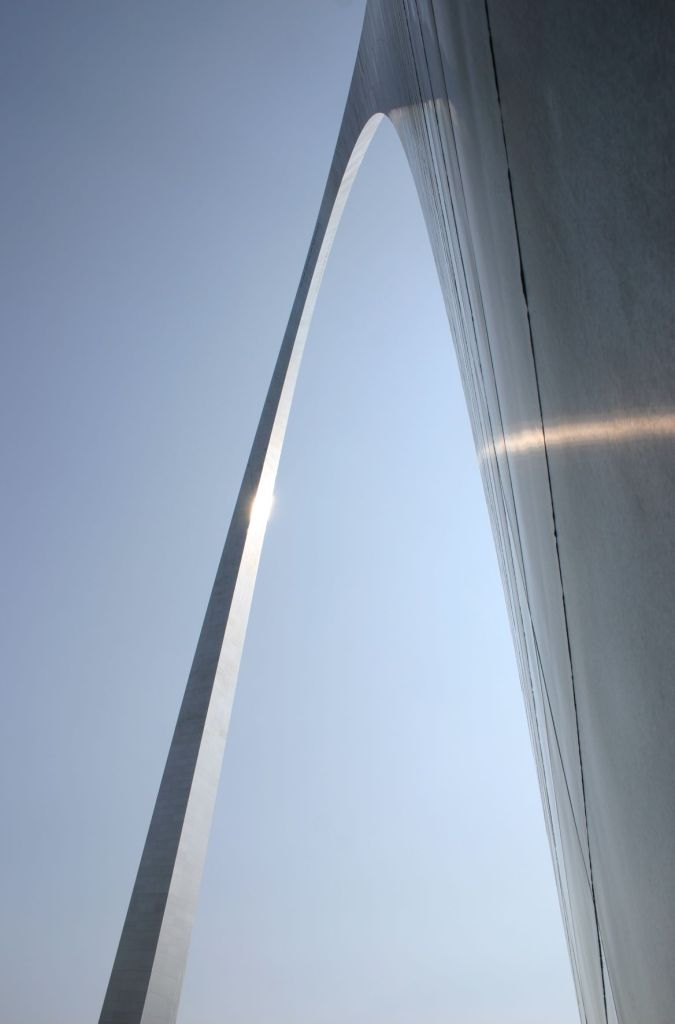
St. Louis’ Gateway Arch is considerably younger than the mounds we recently quitted, being built in the 1960s. It is also far taller (over 600 feet).  The arch segments are triangular in cross section, constructed of carbon steel covered by stainless steel.  It is an engineering marvel.

It was also expensive and crowded.  We stood in a long line in the warming late-May sunshine, before descending into the cool darkness of the visitor center.  This was followed by a two hour wait for our turn to actually enter the arch, during which we ate overpriced snacks, wandered through the museum, and sat listlessly against a wall.  I imagine boredom and expensive rations were experiences we shared in common with ancient Mississippian tourists.  But we thought, if nothing else, the boy could say he’d been to the top of the world’s tallest arch.

A little more walking, another 15-minute stand-around, and then we crammed into small tram capsules that slowly raised us several hundred feet in the arch.  Then we walked the last bit to the apex, where we vied with the crowd to look through the windows.  Thankfully, the wind wasn’t rocking the top!  It was certainly a view, with the city laid out on one side and the river and ancient floodplains stretched out on the other. After a couple of minutes, the height-shy young’un was ready to vacate.  And so this family of introverts headed groundward within ten minutes of our arrival, and left the crowd behind with all speed.

We were tired, but there was one stop to go.  It was admittedly the silliest coup to count, but we were a little punchy by this point. 

You see, when we checked in at our motel in Collinsville, the desk clerk asked what our plans were.  When we spoke of the UNESCO World Heritage Site four miles down the road, she confessed she wasn’t familiar with Cahokia Mounds.  However, she said we “absolutely have to see the Giant Catsup Bottle!” and gave explicit directions to said marvel.

Yes, friends, she was referring to the Brooks Catsup Bottle water tower, a bit of novelty architecture from 1949 that is, indeed, shaped like a bottle of catsup.  The faux condiment container supplied water to the Brooks catsup plant. The tower needed significant restoration by the 1990s, and those needs were met by volunteer fundraising, to the tune of $80,000.  It isn’t on UNESCO’s radar, but it does hold a coveted slot on the National Register of Historic Places.

So, as no doubt many pilgrims of roadside attractions have before us, Mom and Dad took Junior to gaze upon a slice of novel Americana.   I remarked that I was now ready to go see the world’s largest ball of twine and maybe get our dinner from a hotdog-shaped restaurant, before turning in at a motor lodge shaped like a tipi.  Or, to make a Lord of the Rings reference, “I just came back from the ruins of Amon Sul, but please, I’d love to go see the largest pumpkin in the Shire.”

To summarize: Spent the morning in a world-famous archeological site that even locals haven’t heard of. Spent the afternoon standing in lines with crowds to do “the done thing” and count coup.  Finished up with roadside kitsch. Clearly, the mounds ruled the day.

Yet, they were all tourist attractions.  The city of St. Louis is proud of the stainless steel arch.  The town of Collinsville is proud of their water tower.  And the enigmatic people of 900 years ago were likely quite proud of the great ritual mound at the center of their own metropolis.

The Immortal Complaint

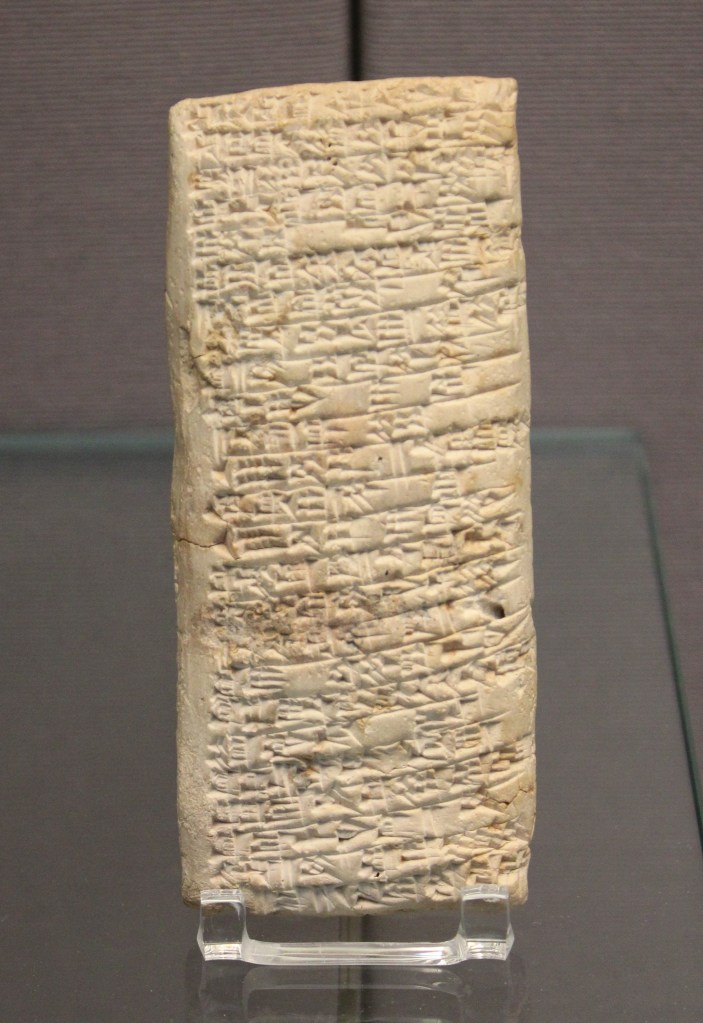
This is a tale of two fellows linked by a letter of complaint: from Nanni the disgruntled customer, and Ea-nasir the merchant.  It seems Nanni paid good money for products, and when his assistant went over to collect the items, he was offered third-rate merchandise and treated rudely.  The irate customer wrote on every bit of the complaint form, detailing his many injuries at the hands of this shameful purveyor of shoddy goods. He made it absolutely clear that in the future the goods would be brought to Nanni’s  own yard, and they’d better be top notch or he wasn’t paying.

The letter was found in Ea-nasir’s house along with some others, but we don’t know if Nanni got satisfaction.  We can’t ask him, because Ea-nasir has vanished, along with his business, like dew on a desert breeze. 

The letter was written on a clay tablet in Akkadian cuneiform, around 1750 BCE.

My son, who does his best to keep his old man appraised of all the geek things, sent me a meme involving Ea-nasir.  It turned out to be but one of many, framed around “The World’s Oldest Complaint Letter”.  There are also quite a few videos of variations of the same joke: Customer service hasn’t changed in four thousand years.

By Zunkir – Own work, CC BY-SA 4.0

While I can appreciate the humor (such that it is), this isn’t what struck me about this artifact.  It was the names.  The further back you look in time, the fewer individuals can be seen.  A thousand years back, we have records of the heads of state or notable churchmen and nobles whose names graced deeds or court records archived in stone buildings.  Two thousand years ago, writing was perhaps more common in some locales but still available to a minuscule fraction of the general population, and almost no parchment or papyrus survived the ages; even the names of the mighty which were chiseled on stone  are now too often weathered to obscurity.

Farther still, when writing was necessary for civilization to function yet still mystic enough to be wielded by specialists,  a powerful man at the apex of a city-state would use some of his power to immortalize his likeness and his name on a stone tablet, or perhaps have the embellished story of his military victories drawn on baked clay; like as not such mementos would be destroyed or lost when the next big man came to power.

Yet the astoundingly short list of identities to survive the rise and fall of kingdoms, countries, languages and cultures, include two folks who were not great warriors, not great lords, not godspeakers.  No, they were tradesfolk, strictly middle-tier. 

To put it in perspective, imagine that millennia from now the museum talks mention the names of folks known in the North American continent: maybe half a dozen presidents, a few prime ministers, a few military figures and one or two social leaders.  And on a shelf in one corner of museum is piece of paper – a miraculous missive to one Crazy Eddie, purveyor of used vehicles, from an angry Frank.

AlbatrossGiftsCo

I was reminded of a scene in the movie The 13th Warrior.  Buliwyf, the illiterate leader of a warband, had become intrigued by a civilized fellow’s magical ability to write (or as he put it, “draw words”).  As he lies on his deathbed, he hinted to his friend his last request: “A man might be thought wealthy if someone were to draw the story of his deeds, that they may be remembered.”  By that mark, Nanni and Ea-Nasir only have loose change in their accounts, but they remain among the richest people of the Bronze Age.

Additional Information:

See the full translation of the tablet.

Buliwyf’s request

Breaking the Shackles of Time

Over five millennia ago, a medical practitioner related how to use the pharmacological tools of his trade – resins, bark, leaves – in the healing of his people.  His specialized knowledge of healing lore may have seemed magical to the folk of Mesopotamia.  His use of advanced technology to record his knowledge, using a stylus on a hand-sized tablet of wet clay, may have seemed equally magical; however, it no longer inspires awe today, for such technology is grasped by toddlers in our own time. 

To say the written word is taken for granted is an understatement of the highest magnitude.  You are reading this now, or perhaps you skim to get the gist before moving on to some other article or blog or meme poster.  This conceptual breakthrough should not be forgotten, for almost every tool and device you use, your food, your water, your clothes, your vehicles – almost everything you have or use or know is only available because someone wrote down instructions or information of some sort. We’re talking about the deceptively simple process of converting concepts into language, and then representing the sounds of language into written symbols.  Then – and this is the real magic – the process is done in reverse, by other people, perhaps in other times.

Writing appeared independently in several places around the globe, but the proto-writing of Mesopotamia was arguably the first.  The writing system evolved over the centuries in the cities between the Tigris and Euphrates Rivers.  Simple drawings representing simple concepts – “ten sheep” for instance – appeared around the mid-4th millennium BCE.  These representations become increasingly abstract until the symbols became tied to sounds in the Sumerian language rather than ideas. As Sumerian power waned and other peoples rose to take their place, the writing system was adapted to work with the completely unrelated Akkadian language (imagine the Japanese katakana syllabary being reworked to represent German).  Cuneiform tablets written in the Elamite, Hurrian, and Hittite languages show the flexibility of the technology, or perhaps the limited desire for innovation in the face of an adequate method of recording information.

Tablets from a display at the British Museum

Time passed, the fortunes of kingdoms and empires shifted, and cuneiform-based languages gradually slipped from power and thus popularity. The last known cuneiform tablet was imprinted in the 1st century BCE, by which time the Library of Alexandria, hundreds of miles from the lands of the Sumerians and Akkadians, was already in decline.  From pictographs to the highly stylized scripts, this earliest of writing systems was in use over three thousand years.  By comparison, the common writing system for much of the Old World and most of the New World evolved from the script first used by the Phoenicians some three thousand years ago.  Before rag paper, before parchment made from animal skins, the people of Mesopotamia used a stylus to draw patterns of wedges on soft clay tablets.  Some of the tablets were baked on purpose, and others survived to this day through calamity, as fires in the libraries hardened the tablets.  A combination of durable material, dry climate, and lack of disturbance allowed far more written material survive from the Bronze and Iron Age Middle East than in all the time before the early Middle Ages in Europe or around the Mediterranean.  

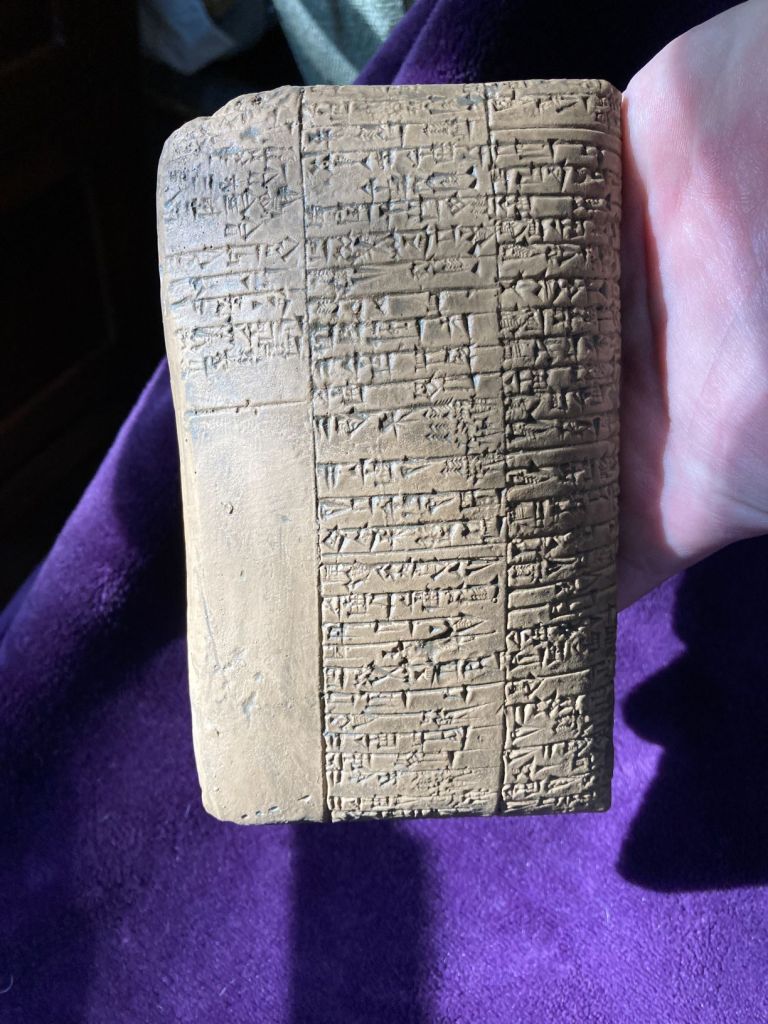
For this year’s gift-giving season, I had a very short list. Apart from some books, there wasn’t much in the way of stuff that I desired to add to the general clutter.  Knowing that I would be pestered by the relatives for more, I decided to ask for something quite unusual – a replica of a cuneiform tablet

This one, composed of lines in three columns on the front and back, was written in the ballpark of the 24th century BCE.  During a subsequent period of neglect, this tablet and tens of thousands of others were buried in rubble, where they remained until excavated in the late 19th century in Nippur.  The face of it is badly damaged, but the reverse is legible.  I plan on giving this replica relic a place of prominence in my library, to remind myself and all visitors that the impulse to gather and preserve knowledge has been around a long, long time.

I will end here with a quote from Carl Sagan, who eloquently expressed his thoughts on the topic some forty years ago:

“What an astonishing thing a book is. It’s a flat object made from a tree with flexible parts on which are imprinted lots of funny dark squiggles. But one glance at it and you’re inside the mind of another person, maybe somebody dead for thousands of years. Across the millennia, an author is speaking clearly and silently inside your head, directly to you. Writing is perhaps the greatest of human inventions, binding together people who never knew each other, citizens of distant epochs. Books break the shackles of time. A book is proof that humans are capable of working magic.”

Related Links:

Wiki article on cuneiform

Cuneiform entry on the Omniglot site

A short animation about cuneiform.

Irving Finkel, a genuine character from the British Museum, lectures on cuneiform

A scene from the film Black Robe illustrating the magic of writing to the uninitiated.

Carl Sagan’s “Books Are Magic” scene (the above quote comes in around 2 minutes in)