The Last Leaves of the Season

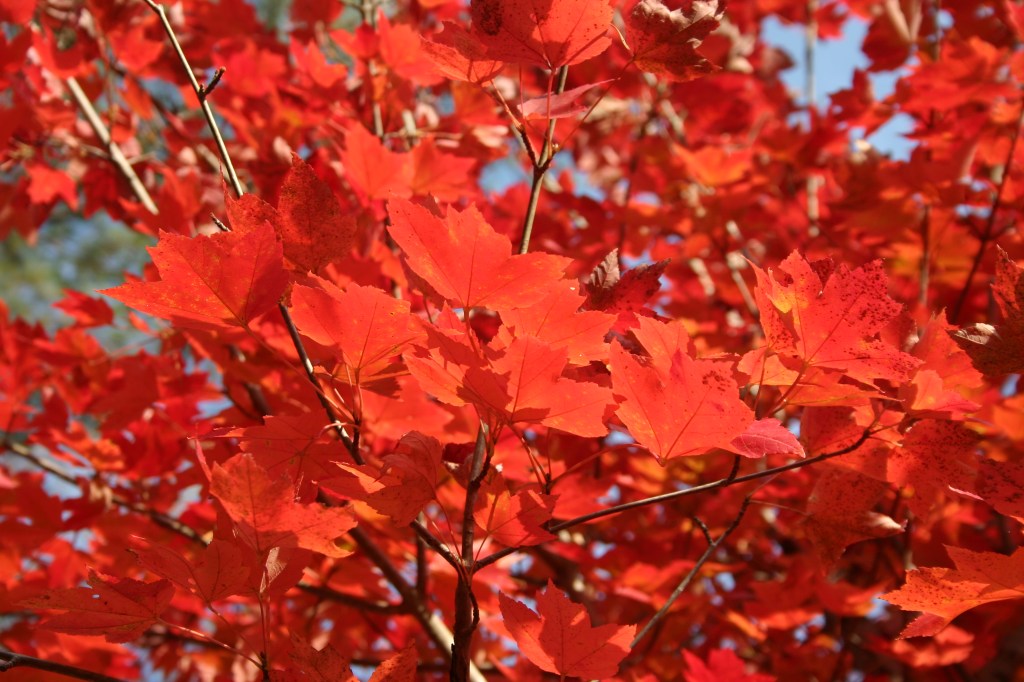
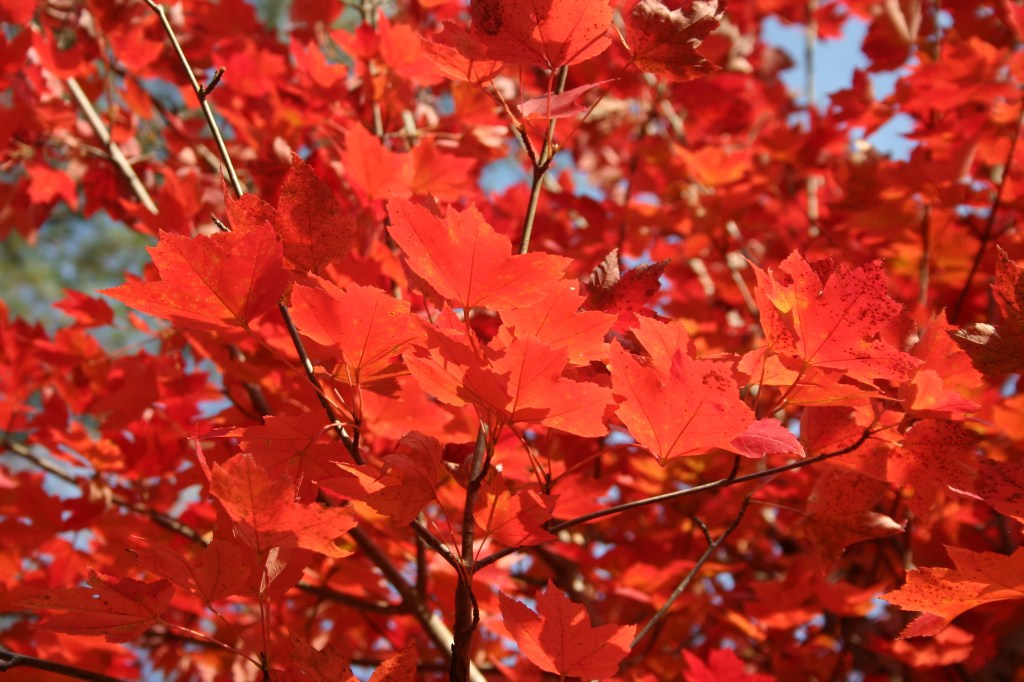
Another year has cycled through, and the canopy of colorful leaves around my house is now a carpet in different shades of brown.  From the mighty white oaks to the humble dogwoods, all sport naked limbs, awaiting the return of spring to unfurl new green leaves.  

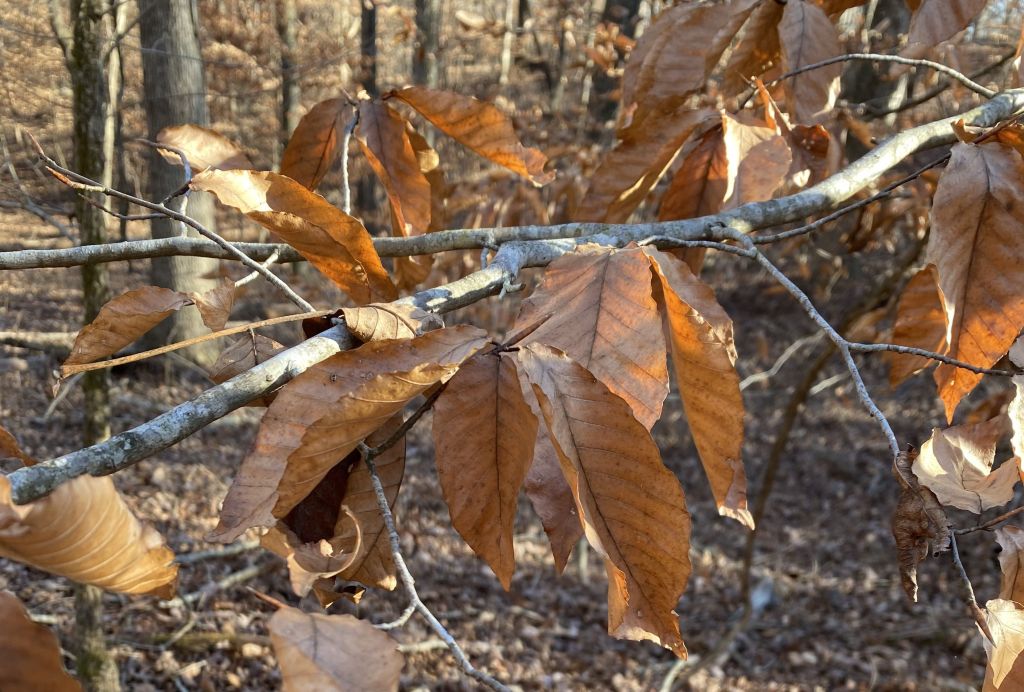
But one tree stands out in the forest.  The American Beech (Fagus grandifolia) holds on to its withered tan leaves throughout the dormant season.  This quality of holding on to dead leaves after other plants have shed them is called “marcescence”.  Studies suggest marcescence is a strategy for deterring deer and other herbivores from browsing on the more nutritious twigs and buds, or perhaps for improving the tree’s nutrient uptake by delaying leaf decomposition until spring. 

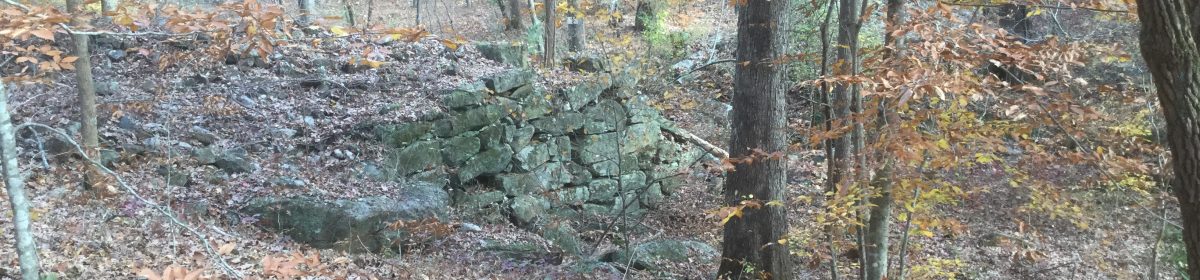
The beech is one of the most shade tolerant of trees, allowing it to spend decades holding its own beneath the forest canopy until a fallen tree gives it an opening to grow into the light.  The beech prefers moderately moist conditions, and its thin bark provides scant protection against fire.  In open woodlands of the precolonial Piedmont, oaks dominated, while beeches withdrew to the more sheltered bottomlands.  With fire removed from hardwood forests, beeches, maples, and other thin-barked trees advanced into the uplands as forest canopies closed.  They are firmly part of the climax forest community.   

Beechnuts are a much-sought-after food for birds and mammals, from blue jays to black bears.  It was a primary fall food source for the long-vanished passenger pigeon. Humans make vegetable oil from beechnuts, or roast them to eat or to make a caffeine-free coffee substitute.  Unfortunately, a seedling will grow for several decades before putting on the first beechnuts, and thereafter produce at intervals ranging from two to eight years. Beeches can live for 400 years, assuming they aren’t cut for lumber or high-quality firewood, or succumb to one of several introduced disease-causing pests.

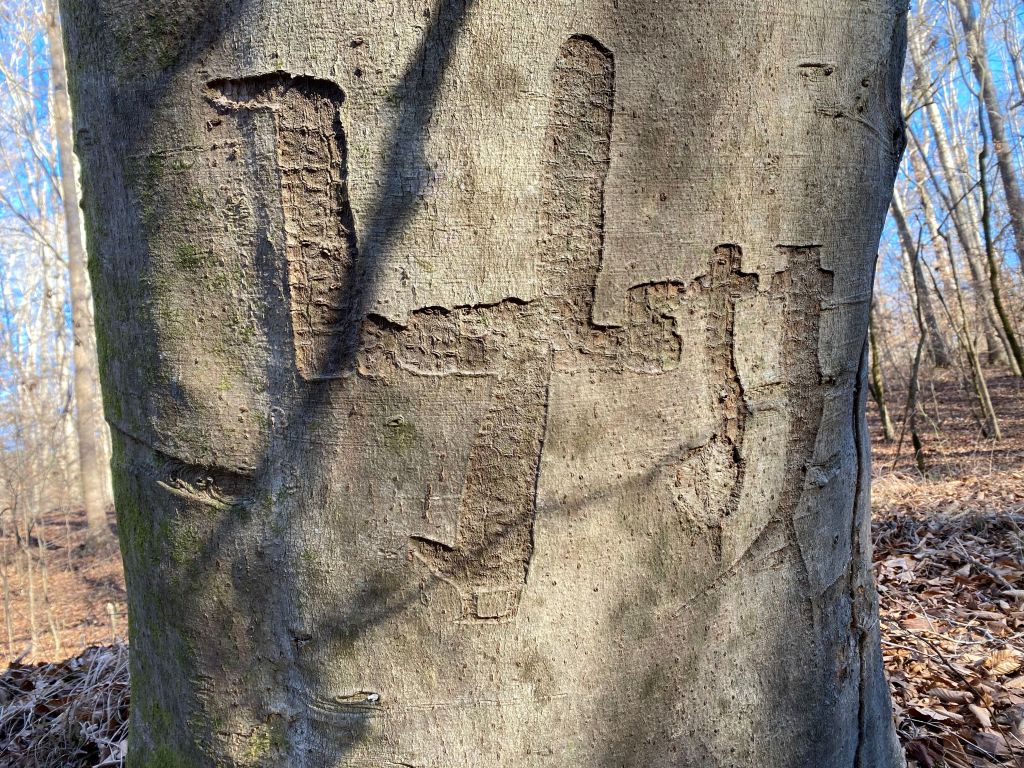
The bark of the beech is relatively smooth and pale gray, making it a tempting canvas on which folks may carve their initials, dates, or other sentiments.  I don’t recommend the practice — cutting the bark allows pathogens to attack the tree, and it’s rude to future visitors — but don’t be surprised to see the declarations of love, territory or simple presence written across a trunk. Yesterday, I walked downstream a short way to a beech tree I remember from my youth; decades ago, a local with the surname Inglett took knife to bark, staking his claim on that patch of woods.  I don’t know how long ago this bit of vandalism occurred, but the scars were old when I was a kid, and they have stretched to near illegibility since then.

When you pass through the woods this winter, Keep an eye out for marcescent leaves of beeches.

The Richest Man in the World

I met Dr. Walter Cook over three decades ago.  In his Forest Engineering course, I learned how to (among other things) properly lay out a trail in the woods; in Forest Recreation, he taught me why these trails were important.  He was an important mentor for my Eagle project, which involved constructing a stretch of trail at Sandy Creek Park in Athens.

I reconnected with my professor at his 90th birthday celebration.  Fittingly, it was in a park pavilion.   During the gathering, nature-lovers lauded his tireless work in developing, coordinating, and building trails and paths on over 130 projects across both private and public lands.

Last week, I went to lunch with Dr. Cook to catch up.  He has read this blog, and agreed to share some of his thoughts here.  This is the first of his essays which I post with his permission.

The Richest Man in the World

By Dr. Walter Cook

Who among us has not occasionally wished to be rich?  As Tevye sang in Fiddler on the Roof, “If I were a Rich Man…” he would no longer have to work.  Some people have other reasons for wanting to be rich – to have a big car (or maybe two), to have a big house (or maybe two), to travel the world, to send their children to the best university, or merely not to worry about their monthly bills.  Many times in the literature of myth, characters who have unlimited riches are depicted as having large chests overflowing with jewels, surrounded by the utmost beauty of colorful paintings, with everything touched by gold.

On a fall day several years ago, I discovered that I, too, was rich – not in the sense of Tevye’s longings, not in the sense of a carefree life, but rich in the sense of a mythical king.  As I was walking down the Middle Oconee River (near my hometown of Athens, Georgia) I enjoyed the many colorful red and sugar maples, dogwoods, blackgums, and poison ivy along the river’s levee.  Many leaves had fallen, and I recalled that when I was a young boy, I would gather a half dozen of the prettiest leaves as I walked home from school to bring home to share their beauty with my mother.  But as I looked at the leaves lying ankle-deep on the ground, I realized it would be impossible to choose the six best leaves – there were so many!  How could anyone make such a choice.  They were like jewels, even better than jewels, for no jewel could match the dazzling spectrum of colors in even one leaf, much less all the leaves.  And, as I looked up at the trees that had produced these super jewels, they were like paintings, only far surpassing any human-made work of art.

So, there I was, ankle-deep in the world’s most beautiful jewels, surrounded by superb works of art, and all the while being entertained by the music of songbirds.  What more could one possibly wish for?  I was a rich man, and I didn’t even have to work for it.  Tevye would have liked that.

[Since that long ago day in 1993, I have walked in a lot of forests, along many riverbanks, and in other interesting environments.  In the past few years, I have enjoyed exploring the back country while flagging new trails in the Jocassee Gorges in South Carolina.  Compared with the quiet beauty of the Oconee River in Georgia, the scenery in Jocassee is simply spectacular. The tremendous cliffs (not all cliffs are in state parks!), the numerous waterfalls, the natural gardens of wildflowers, and the views of endless mountains rolling to infinity, all certainly qualify as beautiful.]

But don’t be fooled!!  The nice thing about nature is you don’t have to wait until fall or go to a special place to enjoy its beauty. Nature is, almost by definition, beautiful.  We rightly enjoy the special shows of fall colors, spring and summer flowers, winter ice and snow, and the beautiful landscape of the Southern Appalachians.  But even without these spectaculars, nature – the undisturbed environment – is beautiful.  All we need to enjoy it is to open our minds to its presence.  Then we can all be as rich as a mythical king.

Article on Cook and Trails

Falling Acorns

Although summer has continued its fierce rearguard action well past a reasonable concession date, autumn is here.  True to the colloquial name, “fall”, the trees are divesting themselves. But I’m not talking about leaves; there is still a lot of green in the trees at the moment.  I’m looking at acorns, specifically white oak acorns.

The white oak (Quercus alba) is an all-around excellent tree.  Large, long-lived, and handsome, much can be said about this species and its lumber (including being crucial for bourbon barrels and earning USS Constitution its “Old Ironsides” nickname).  But on this October day I want to talk about the nut of the oak. 

White oaks are the flagship of a cluster of species known as the white oak group (which include English oak, burr oak, post oak, overcup oak, and scores of others), as opposed to the red oak group (locally represented by the southern red oak, northern red oak, water oak, pin oak, and others). White oaks produce acorns on a one-year cycle – that is, spring blooms will develop into acorns in the early autumn, while red oaks take two years to produce.  Red oak acorns tend to drop later in the season, and are much more bitter due to the higher tannin content.  On the plus side, red oak acorns will be available to deer during the hungry months before green-up, while white oak acorns germinate soon after hitting the forest floor.

White oak acorns have been falling in prodigious quantities for a couple of weeks now.  The tree which stands closer to the house than the deer like to venture has carpeted the ground with the leathery brown nuts. This is definitely a good mast year (“mast” is the collective term for nuts, berries and seeds from trees that are eaten by wildlife) for white oaks.  You see, oak mast production is hit-and-miss; several years may go by before there is a bumper acorn crop for a given locale and species.  Acorns are sought after by a great many birds and mammals, so on an average year few if any acorns will actually make it to germination.  Periodically, a super-abundant crop of acorns will flood the market as it were, providing more nuts than wildlife can consume or stockpile, and increasing the chance that a tree’s attempt at reproducing will be successful.  Naturally, the extra food is welcomed by turkeys, deer, squirrels, jays, and other hungry critters.  It’s good for wildlife when there are several oak species in the local forest – if the northern red oak is a bust this fall, perhaps the scarlet oak will be a boom. 

This is a good year for the critters to fatten up on white oak acorns.  We’ll soon see if the red oaks will call, raise, or fold.

The Cusp of Fall

Though I work in the outdoors at all times of the year, autumn is my favorite season; summer is my least.  After a week of mornings with doors open and air conditioning off, I believe we are at the turning of the temperature tide. Although the heat index briefly rallied a final time, the sun is in full retreat southward.

That’s not to say that summer is altogether evil!  As a season, it has much to offer.  But, having lived most of my adult life in the outdoor sauna that is southern Georgia, northern Florida, and Louisiana, I can be forgiven for thinking that one of autumn’s virtues is in succeeding summer, just as spring’s chief fault is in giving way to it.

I post this on the Autumnal Equinox, the official start of fall.  Having now gained elevation and latitude since the last time I discussed this date, I am pleased to be in a place where “First Day of Autumn” may mean something more than just a promise on a calendar.

In a week or two, leaves will begin to turn.  The air will grow crisp.  Old bucks will overindulge on hormones, losing their wits and their guile.  Some creatures will go to earth, others will take to the sky.  And I will quietly immerse myself in the season, and hope to use well the restless energy that always rises as the leaves fall.

When autumn came, he knew that part at least of his heart would think more kindly of journeying, as it always did at that season. – J.R.R. Tolkien, The Fellowship of the Ring

Autumn Equinox

The Autumnal Equinox is officially the first day of Fall, but such hard demarcations have little relevance in the natural world.  The temperatures always lag behind the changes in angle and duration of sunlight that create the differences in season to our tilted Earth.  For months the Georgia air grew more oppressively hot even though the sun has been easing southward since late June.  For the past month or so, I’ve watched as the daily temperatures crept down; highs solidly in the 90s have given way to the 70s.  Warm evenings, thick and heavy with moisture and the distant rumble of thunder make me feel sluggish, and ready to shelter in a climate controlled room. But tonight is pleasantly cool, and I think we are safely done with summer temperatures.  A scattering of trees are showing their colors, but it will be late October or so before the wave of reds and yellows that has already begun north of the border will sweep into Georgia.  The changing of the seasons, and the turning of the leaves, is more abrupt and decisive around Athens than it was in Waynesboro; mark it down to a difference of 70 miles of latitude and 400 feet of elevation. My seasons are muted and indistinct by comparison to, say, New England, with their long summer days, long winter nights, and winters as brutally cold as ours are brutally hot.  

Of course, as we look towards shorter days, the inhabitants of the Southern Hemisphere have had their first official day of Spring as their days lengthen.  People in their temperate zones are enjoying the warming air and breaking buds as we did 6 months previously.

Spring is nice. but Fall is my favorite season, and the promise whispered on every cool puff of air whets the anticipation.  

The Country Mouse Replies

Around 15 years ago, I was conversing electronically with a friend who resides in southern California. Although we grew up  around the large town/small city of Athens, our paths took us in opposite directions – hers led westward into bright lights and urban sprawl, while mine headed south and east to more rural landscapes.  When I mentioned in passing the “perks of living in the boonies,” she admitted being stumped on what those could be.  Although she managed to come up with a few — such as being able to play the stereo as loud as one likes — they paled against ordering takeout at will or reliable and fast internet.

The following day, I had mused on the subject, waxing exceptionally poetic as I waited for birds to call in the chill pre-dawn air:

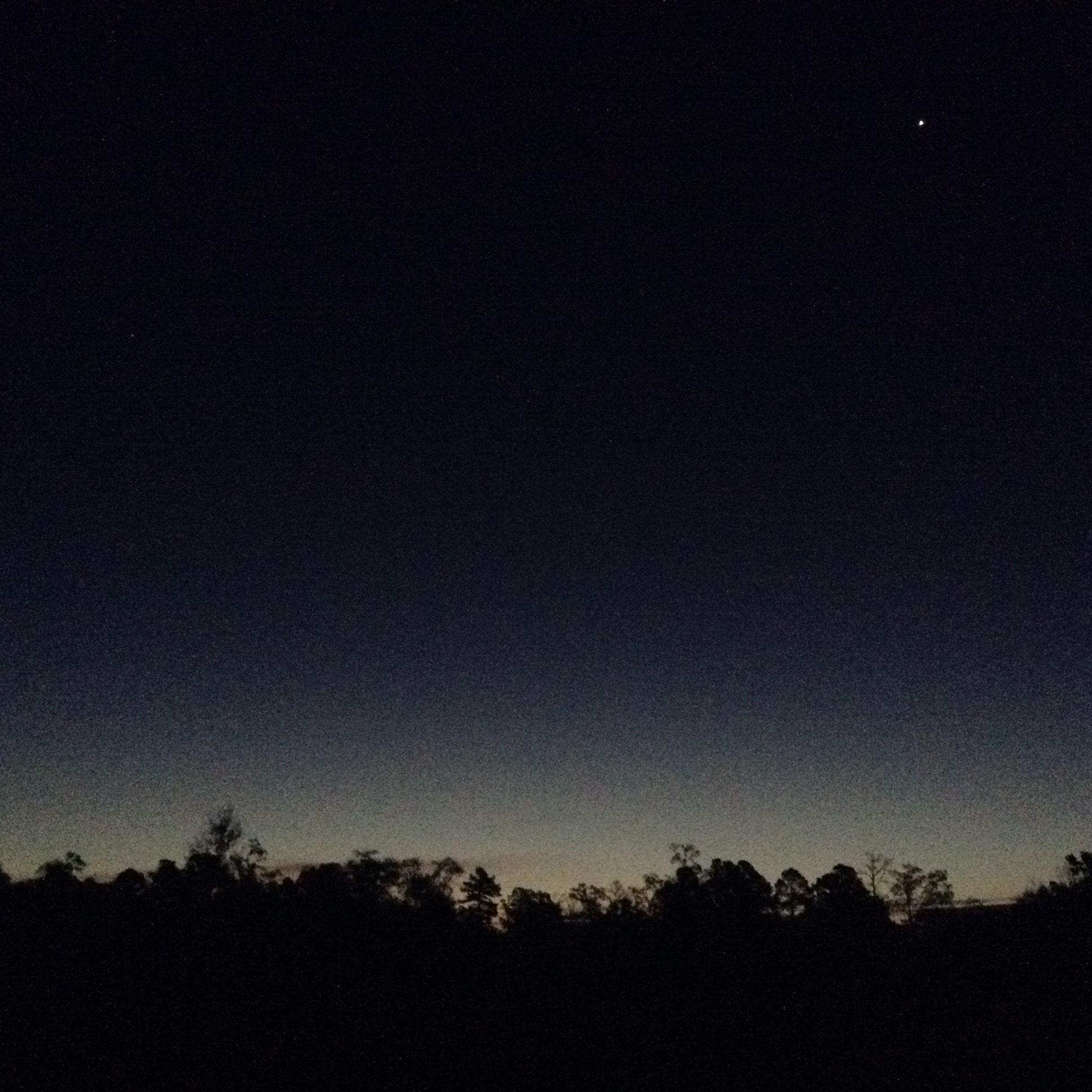
As I write (the majority of) this essay, the dawn’s light barely illuminates the page, which is further obscured by the wisps of my breath in the chill of mid November.  Overhead the larger drops of the Leonid meteor shower still burn despite the morning glow.  I was out before dawn to survey quail, but while I’m no morning person and have lacked a full night’s rest for a considerable number of days, this AM I don’t begrudge the sleep.

You bring up some fair points about life beyond the concrete Pale, and I’m favorably impressed that you spared considerably more than a passing thought in trying to understand why someone with a choice would live where the blacktop ends.  I’ve been mulling over the question, and my sleep-deprived brain has come up with this reply.

My house is about 11 miles from town (population 6000).  The city of Augusta is a good 45 minutes away (and that’s burning up the highway, not creeping through traffic).  The college town of Statesboro is an hour distant (The question of when distance became measured in units of time I’ll leave for another day).  This means that seeing a show at the multiplex is a fair trip in itself – and indie films are out of the question.  The closest bookstore is Amazon.com.  No specialty coffees can be had in this county, at least nothing more exotic than what BiLo carries.  In town, sit-down meal options consist of a diner, Mexican, country buffet, a sandwich shop, two Chinese restaurants and several BBQ joints.  McDonalds is here but BK hasn’t made it yet.  The farm equipment dealers outnumber auto lots.  And you already know the trials of TV and internet access. So by the City Mouse standard – the measure of manufactured conveniences – this haystack just doesn’t cut it.

Luckily, there are other measures and other standards.  You have thought of a few, though it is clear they pale by comparison to life on one pole of the LA-NYC-DC axis.  Still, I’ll list just a few of the conveniences and opportunities:

–Having neighbors close enough to summon in an emergency, but otherwise out of sight and out of mind.
–Letting your dogs bark themselves hoarse without being threatened with legal action (I speak from personal experience).
–Practicing katas in the yard with a real katana without being reported and arrested.  For that matter, walking around in public places with a knife on my hip and not being reported or arrested.
–Clean air.
–Being able to step outside at night and seeing more than the two dozen stars which are bright enough to punch through the haze of pollution and city lights.
–Hearing a car pull up and knowing they’re here to see you, because there’s nobody else around.
–Maintaining the yard at whatever level you want, not whatever the anal neighbors want.
–Don’t underestimate the mental health value of being able to blare the stereo while you’re working outside.
–Exchanging waves with strangers on the road.
–Driving above speed limit most anywhere because traffic is so light.
–Being able to cook over a hickory fire in the front yard.
–Having staring contests with a coyote, surprising a fox, stopping so wild turkeys can cross the road, and shooing spotted fawns out from under your truck.
–Hearing quail whistling to the north, barred owls hollering to the south, coyotes howling to the west, and wood duck wings whisper overhead.
–Anticipating what kinds of critters you’ll see on the way to work, whether deer or bobcats or hunting raptors, or maybe even otters.
–Having people react with interest rather than revulsion when you collect your steaks the old fashioned way.
–Having a job where I can feel the wind on my face outside almost as much as I spend basking in the glow of computer screens.

I know that there are many other ways of viewing the world.  While it is important to me that city folks have some understanding of the value of a rural life, by no means do I advocate they take it up.  The last thing I want is for urbanites to get a hankering for elbow room!  As crammed together as they are, by spreading out they’d take up the whole country. Already my heart sinks every time I visit my old stomping grounds, seeing fields once mantled in wheat now sprouting crops of three bedroom houses.  The Atlanta sprawl has metastasized and now Athens is growing beyond its charm.

I’ll end this reflection with a quote from Leopold:

“There are some who can live without wild things, and some who cannot. These essays are the delights and dilemmas of one who cannot. Like wind and sunsets, wild things were taken for granted until progress began to do away with them. Now we face the question whether a still higher ‘standard of living’ is worth the cost in things natural, wild, and free. For those of us in the minority, the opportunity to see geese is more important than television, and the chance to find a pasque-flower is a right as inalienable as free speech.

”These wild things, I admit, had little human value until mechanization assured us of a good breakfast, and until science disclosed the drama of where they come from and how they live. The whole conflict thus boils down to a question of degree. We of the minority see a law of diminishing returns in progress; our opponents do not.”

Here then is a partial answer to your honest inquiry.  I think it is safe to say that we both are more or less where we belong; were our locations reversed, you would go nuts with sensory and cultural deprivation, and my soul would wither.

Still, you’re welcome to visit anytime :-).
IMG_0148

Creeping Autumn

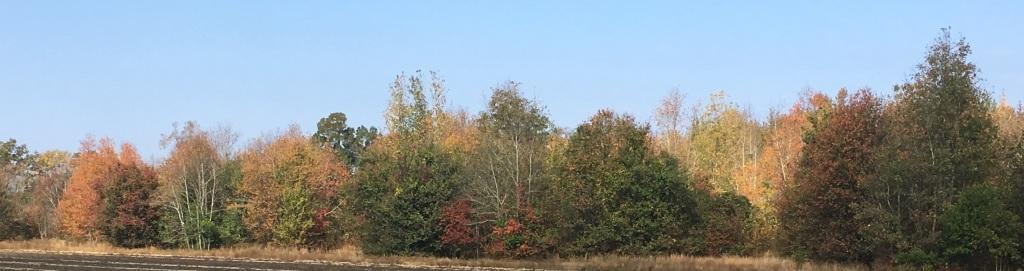
Ah, Autumn in south Georgia.  It’s taking its own sweet time, hitting the snooze button more than once.  The high here didn’t reliably drop below the 80s until after mid-October.  Something vaguely resembling a chill is in the air, but the trees seem disinclined to respond.   Driving through several counties today, I noted a distinct lack of organization in the forest.  Some leaves were changing halfheartedly; this oak was  green save for a brilliant cluster on the end of a branch, while that yellow sweetgum was surrounded by  more-or-less green cousins.  An occasional splash of red marked a sassafras that was tired of waiting.  Some don’t even try, like that persimmon that quietly darkens until it withers.  Other trees brighten only a few days before fading brown.   By and large, though, the hardwoods were as green as the pines.  Things will change in the next couple of weeks, but this isn’t the deep north woods…weak fall

Update:  what a difference a week makes. Still patchy, but more of the trees are hopping on the bandwagon.  According to the prediction maps, we are in the peak time for fall color here.  Temperatures are moderating, so that’s the important thing.

fall color 2
November 4th