If you are creeped out by snakes, you’d best move along now.
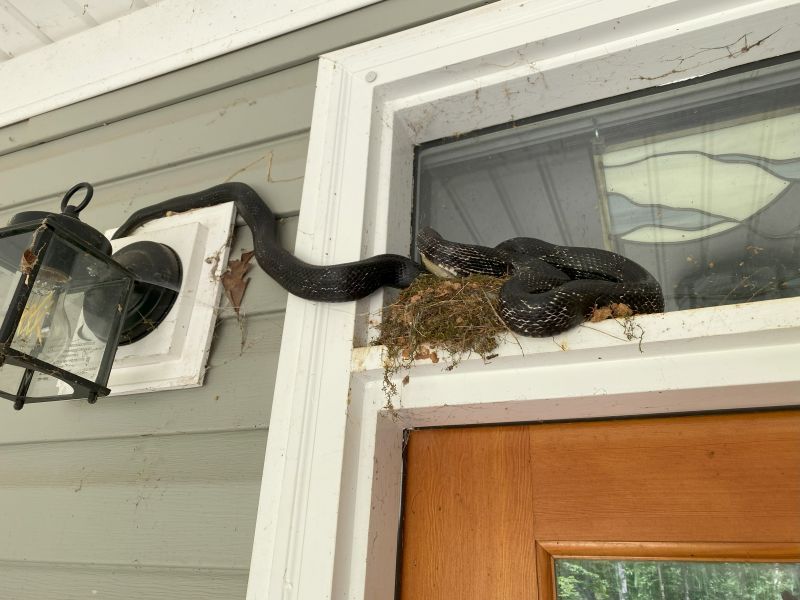
I was in the Dungeon (my basement office) when I got a text from my wife to come upstairs. She had spied a black rat snake on the porch, eyeing the bird nest above the front door. Rat snakes, which feed on eggs, birds, and small mammals, are common in Georgia. Now, I have nothing against these critters, since I don’t currently have chickens. But the nest in question, owned by a pair of eastern phoebes, has occupied the transom window all season. The nest’s proximity made me feel somewhat proprietary towards it, so I decided to intervene. Rat snakes are fairly docile, so it was easy to gather it up and deposit it in a fallowed field some 50 yards away. The snake quickly slithered away from me towards some thickets.
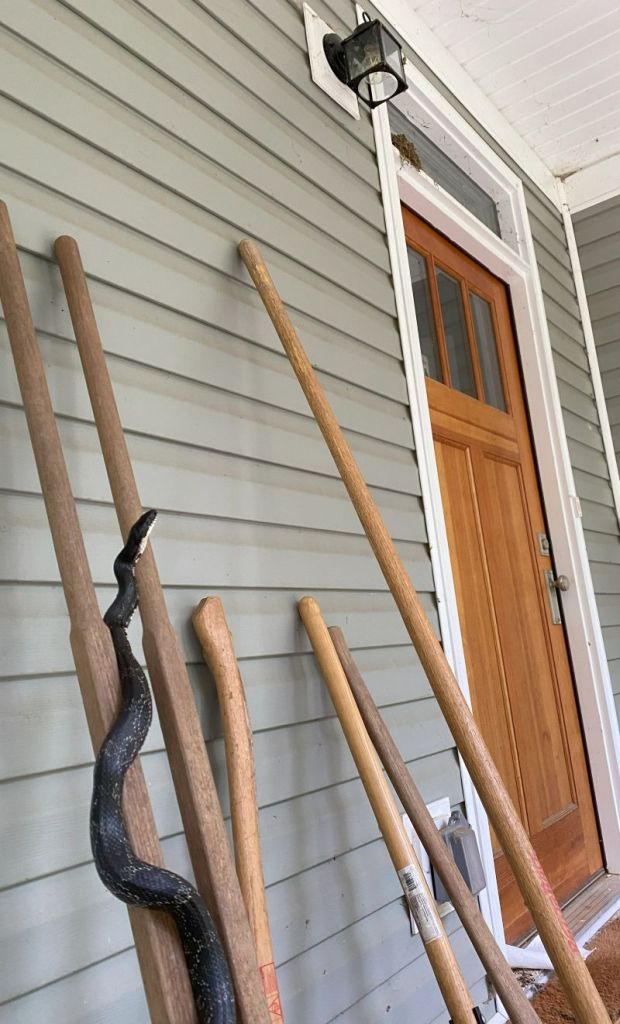
Less than half an hour later, I got another text. A rat snake, half again as long as the first one, was climbing the handle of a post-holer and aiming to get a meal. This one also went to the field, but immediately pointed its nose towards the house. I halted its determined progress after 20 yards and carried it 130 yards down the driveway and across the road.
How do rat snakes find their prey? They have a good sense of smell, although they use their tongues and an organ on the roof of their mouths (the Jacobson’s organ) rather than their nostrils. Perhaps more relevant in this case is their visual acuity and pattern recognition abilities. Rat snakes watch the songbird activity, and home in on the hub of the birds’ flights.
An hour after exiling the snake, I got ready to head to the store. On a hunch, I checked the front porch before leaving. The longer snake had returned, and was just beginning her ascent on the edge of the porch. A few minutes later, I was driving down the road, my arm out the window with a snake wrapped around it. I let it loose 500 yards away, and hoped it would be disoriented enough that the chicks would fledge before it found its way back.
That was yesterday evening. This morning, as I sipped coffee in the library, I eventually noticed the phoebes hopping back and forth anxiously, chipping and chirping. I was too late; one of the rat snakes was on the transom, head in the nest. With skill and persistence, the serpent had won, and I let it have the spoils. It fed and then slithered away. The birds raised a clutch earlier this year, and may have time for another nesting; otherwise, they can try again next spring.
You may be appalled at the fate of vulnerable young animals. Whether it be chicks being eaten by snakes, coyotes carrying off fawns, or bobcats snatching young rabbits, most juvenile critters live short lives. Animals produce more young than they need to replace themselves; most die before maturity, victims of predation, disease, or misadventure. We concern ourselves with individual critters, but in the natural world, individuals don’t matter in the scheme of things – only populations.
The first of September marks a staggeringly grim anniversary in the annals of our relationship with the natural world. One hundred and ten years ago, the last passenger pigeon died in a cage in an Ohio zoo. The extinction of any species is a solemn moment, but the reduction of the most abundant bird species in North America to a mere memory is an infamy that lies unquestionably on our heads.
The passenger pigeon (Ectopistes migratorius) was a medium-sized bird, and longer than other native American pigeons. Males were slate blue, with “metallic iridescence of bronze, green, and purple” on the neck; females were similar but duller in color. The bird was fast – estimated to reach over 60 miles per hour – and for this was nicknamed “the blue meteor”. I found one reference to the etymology of the name: “passenger” being a corruption of the French passager, which means either “swiftly passing” or “voyager” (I don’t speak 17th century French). They had a considerable range, being found east of the Rocky Mountains but most commonly in the hardwood forests of eastern United States, eating nuts, berries, seeds, and insects.
But what made this bird stand out from other pigeons – and indeed other birds – was population size. The passenger pigeon was without doubt the most abundant bird in North America, by various estimates numbering between three and five billion individuals at their peak; — accounting for between 25 and 40 percent of the total land bird population of the United States.
Extant records describing copious flocks of pigeons date back to the 16th century. In the mid-17th century, a visitor to New England described a flight of pigeons that “had neither beginning nor ending, length, or breadth, and so thick I could see no sun.” Ornithologist Alexander Wilson described an encounter with a flock in Kentucky in the early 1800s: “I was suddenly struck with astonishment at a loud rushing roar, succeeded by instant darkness, which, on the first moment, I took for a tornado, about to overwhelm the house and everything around in destruction.” His companions assured him it was only a flock of pigeons.
In 1813, naturalist and artist James Audubon described a 55-mile journey under a cloud of pigeons so thick that “the light of noonday was obscured as by an eclipse…The pigeons were still passing in undiminished numbers and continued to do so for three days in succession.”
Greenberg quotes a newspaper article about a flock passing through Columbus Ohio in 1855: “As the watchers stared, the hum increased to a mighty throbbing. Now everyone was out of the houses and stores, looking apprehensively at the growing cloud, which was blotting out the rays of the sun. Children screamed and ran for home. Women gathered their long skirts and hurried for the shelter of stores. Horses bolted. A few peopled mumbled frightened words about the approach of the millennium, and several dropped on their knees and prayed…And then the dark cloud was over the city…Day was turned to dusk. The thunder of wings made shouting necessary for human communication.” The flock took two hours to entirely pass. There are numerous similar anecdotes, but I trust you get the point.
Such mass migrations were bound to have an effect on the local ecosystem. A forest providing a roost for hundreds of thousands of pigeons would show certainly show it, in the form of broken branches (for the birds would sit on top of each other until limbs cracked under the weight) and a thick layer of white droppings. The latter would provide nutrients to the soil, and fallen limbs and trees opened the canopy, allowing sunlight on the ground to encourage new growth.
The birds also helped determine the composition of a forest. White oaks drop their acorns in the autumn and they germinate rapidly or else rot. Red oak acorns contain higher levels of tannins which make the nuts more bitter and also resistant to rot – thus, available on the ground for a longer period of time, and a more accessible target for mighty flocks of pigeons which scour the ground for food. Ecologists hypothesize that passenger pigeon foraging resulted in white oaks being dominant in eastern oak forests prior to the 20th century. The birds’ extinction, coupled with the higher value of white oak in various industries, has contributed to the rise of red oaks in our deciduous forests.
Of course, all that pigeon flesh attracted predators both feathered and furred. But the local foxes and hawks could eat only so many pigeons in the few days or weeks that a flock settled in one area before moving on, meaning the danger to an individual pigeon was infinitesimal. Even the native peoples with their tools and strategies to collect, adults, eggs, and squabs had a negligible effect on a nesting colony.
And yet, they have not blackened the sky anywhere in a century and a half. We are remarkably efficient when we can get something out of it. The pigeons weren’t exterminated out of hate; they were killed because people would pay to have them for supper.
Sure, European settlers and their naturalized descendants altered the landscape, clearing the forests that fed the migrating multitudes. But efficient tools and the determination to harvest pigeons were a greater factor. Guns and nets are more effective than clubs. Trees were chopped down to get eggs, nestlings and stunned birds; sulfur would be burned under forest canopies to gas roosting birds. What wasn’t used locally would be packed into barrels and shipped to urban centers. Birds which were captured alive could be used at trap shooting competitions or as “stool pigeons” – captives who called in wild birds to be netted or shot.
Starting in the mid-19th century, two innovations, the railroad and the telegraph, spelled the pigeon’s doom. A roosting or nesting area could be reported by wire all over the country; pigeon hunters rode trains to the location, and their kills could then be transported farther and faster.
The decade of 1870 was likely the final precipice before the fall of the species became inevitable. The last great nestings occurred during this time. Perhaps the most famous exemplar was in Petosky, Michigan in the spring of 1878. When word went out that sky-blotting numbers of pigeons were congregating in the forests of three counties near the shore of Lake Michigan, hunters and netters converged from as far away at Texas and Virginia. The local economy boomed as hotels, stores, transportation companies and opportunistic citizens earned their share of the pigeoners’ profits. Agents of the law tried to enforce what meager protections were on the books, with limited results. There is no way to accurately account for the harvest that spring and summer. A daily average of 50,000 is mentioned. One source estimated that over 1.5 million birds were shipped out by rail alone. Another gave a figure of over a billion pigeons going to market. Whatever the actual figure, large nestings dropped off sharply after this. Even then, every report of a spring gathering brought pigeoners more determined to gather all the birds they could. By this point, pigeons were easily scared off their nests by human harassment, abandoning eggs and squabs and reducing the species reproduction to nearly nil.
From there, flocks scattered. Most of our records approaching the turn of the century involve someone seeing one or two individuals, maybe a dozen – an encounter which usually ended with a dead bird and the survivors scattering. Every state has its “last spotted” report during this time (A note of interest for Georgians: Schorger says the last record in our state was a young male, shot near Augusta in 1893. The skin was kept at the University of Georgia until destroyed in a fire.).
A female was shot in March 1900 in Ohio and mounted using buttons in place of glass eyes (thus the nickname “Buttons” for this specimen). Buttons is displayed under glass in the Ohio History Museum in Columbus.
The last wild passenger pigeon which still exists as a mount was a male taken in Illinois in March 1901. It remains in Millikin University in Decatur, Illinois.
The very last collected wild passenger pigeon was a male shot on the 3rd of April, 1902 in Indiana. The bird was one of a pair. The young shooter had never seen one before, and took the newspaper-wrapped remains to the local pharmacist for identification. The professional, perhaps realizing how historic this find was, taxidermied the bird. The shooter later sold the mount, which a few years later was inadvertently ruined through poor storage and thrown away.
Chances are good the actual last wild kill ended up in a stewpot and went unmarked in the scientific literature. There were a few reports in later years of pigeon flocks over the next decade, but likely most were actually mourning doves. Authorities publicized monetary awards for verifiable sightings of birds or nests, but none were claimed, and by 1912 the scientific community largely gave up. No longer protected from predation by overwhelming numbers, the birds and their nests were easy targets for nonhuman predators. Somewhere, in the first decade of the 20th century, the last wild passenger pigeon died alone.
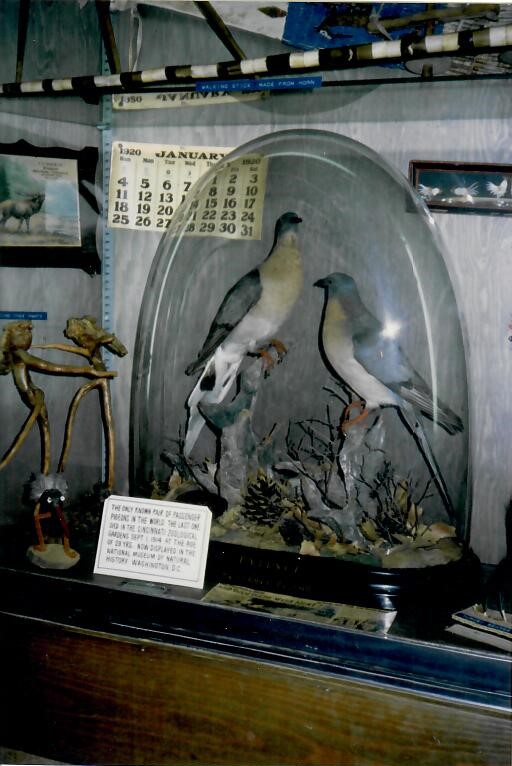
But that wasn’t the end of the story. No wild passenger pigeon would ever again stir the air beneath its wings, but there were yet captive remnants. In 1900 individuals maintained three small captive flocks. The end of 1907 saw one remaining – at the Cincinnati Zoological Gardens (although Joel Greenberg posits “that the last passenger pigeon might not have died in a modern zoo but in a ramshackle barn where a faltering old man tried to preserve a living connection to his youth.”). By 1909, the collection had dwindled to a single aged pair – named George and Martha. The male died in July of 1910, leaving Martha as the last representative of her sky-darkening species. She spent four years utterly alone, quiet and crippled: an endling in a cage, gawked at by zoo visitors. At 1 PM on September 1, 1914, she was discovered on the cage floor, lifeless.
It is probable that the passenger pigeon was in a steady decline since at least the 17th century due to habitat destruction and increased hunting. However, there is little doubt that the species was in a precipitous dive from the mid-1800s, and a death spiral by 1890. No one can deny that our drive and ingenuity, mingled with our desire for money, brought a prolific creature to extinction. As a memorial plaque in Wyalusing State Park, Wisconsin, states, “The species became extinct through the avarice and thoughtlessness of man.”
From billions to naught in a century; when profit is at stake, we can be damned efficient.
Additional Resources
There have been a number of volumes written about the passenger pigeon; here are three I consulted for this essay.
The Passenger Pigeon: Its Natural History and Extinction (1955) by A.W. Schorger. This meticulous ornithologist wrote the definitive work on passenger pigeons. Written for the scholar naturalist.
A Feathered River Across the Sky: The Passenger Pigeon’s Flight to Extinction (2014) by Joel Greenberg. Draws heavily from Schorger among others, and adds later information not available in the 1955 work. Dense with info yet readable.
A Message from Martha: The Extinction of the Passenger Pigeon and its Relevance Today (2014) by Mark Avery. Probably the most readable of the three, but not my favorite. Chapter 4 is a travelogue of his visits to several places key to the history of the bird’s decline; given my interest specifically in the birds, I failed to see the relevance of what the author had for breakfast or his opinion on racism in the American hotel industry. Still, synthesizes in a more digestible way the pigeon’s demise, other species’ endangerment, and our involvement in these fates.
As I greeted the rising moon before going to bed a few nights ago, I heard birdsong far off in the woods. It triggered a distinct memory of sitting in a pickup truck on a red-dirt gravel road, late on a warm summer night. I was supposed to be snoozing while my Dad listened in vain for running foxhounds. All I heard was the distant, rolling song of a whip-poor-will.
A couple of nights later, the whip-poor-will’s repetitive cry had been supplanted by the closer and more staccato call of the Chuck-will’s-widow.
Onomatopoetically-named, both the whip-poor-will and its larger cousin are member of a group of birds called nightjars (reportedly because their call at night is “jarring”). As far back as ancient Greece, nightjars were called “goatsuckers” for the erroneous belief that they would sneak into barns and steal milk from the livestock. An odd belief to be sure, but when one sees the small beak pop open to reveal a disproportionately large mouth, it might not be as far a stretch for an ancient pastoralist with a wild imagination. The myth may never be forgotten; the scientific Order of these birds, Caprimulgiformes, is from the Latin Caprimulgus, or “goat sucker”.
Nightjars don’t in fact drink milk. Their diet consists of insects taken on the wing, supplemented with worms and other ground crawlies. When swooping on a moth, the whip-poor-will’s deceptively minute beak snaps open, revealing a horror-show mouth that seems to split the bird’s skull wide. Their maws are edged with whiskers that prompt the birds to snap their beaks shut when their prey brushes them.
Not that you are likely to see a nightjar. From twilight until full dark – and longer if the moon cooperates – these birds haunt the woodlines and fields. They are ground nesters, but with such complete camouflage that you are likely to pass right by the unassuming pile of leaves unless your light happens to catch the bright red reflection of their eyes.
Eastern whip-poor-wills lay their eggs in phase with the lunar cycle, so that they hatch, on average, 10 days before a full moon. Perhaps this allows them more hunting light to feed their chicks.
Folks have attached quite a bit of lore to the whip-poor-will. To some, the monotonous call portended imminent death or approaching danger. For others, it foretold marriage prospects. Whip-poor-wills were nature spirits, ghosts of children, or the traveling form for shapeshifters.
Poets and singers laud or curse the calls, including Hank Williams: “Hear that lonesome whippoorwill/ he sounds too blue to fly. / The midnight train is whining low/ I’m so lonesome I could cry”
I’d be blue too if someone called me a goat sucker.
Such melancholy connotations are undeserved, as there is nothing mournful in the bird’s rapid flute-like tattoo. I suspect all the feelings of sorrow and loneliness ascribed to these night birds are merely unhappy poets projecting their own misery onto unsuspecting avians.
For many country folk, the distant lulling call is pleasant night music, while a nearby maddening shrilling banishes all hope of sleep. However you perceive the songs of nightjars, you won’t hear them as frequently as in decades past. We can probably lay the lion’s share of the blame for this on the alarming decline of insects over the last century. Less food means less night song.
Last night, I heard the dueling calls of the nightjar cousins. The whip-poor-will’s infinite loop swallowed up the Chuck-will’s-widow’s more discrete song, but with concentration I could just make out the larger bird’s contribution to the night sounds. I hope I will never have a spring or summer without these two nightjars to accompany the evenings.
If I became governor of Hell I would reserve a special room for Eugene Schieffelin and his minions in the North American Acclimatization Society, the idiots who thought it would be nice for all the birds mentioned in Shakespeare’s works to be represented in America. In the 1890’s he released around 60 starlings into Central Park. Because of one single line in Henry IV, an estimated 200 million of the aggressive little bastards currently occupy North America, wreaking havoc on native bird populations.
Why such antipathy for these morons? Why not put in Etienne Trouvelot (who introduced Gypsy Moths) or whoever shipped the wood that contained the fungus that annihilated the American Chestnut? Because Schiefflin and his cronies went out of their way to perpetrate their crime, and for a silly reason.
Humans have been bringing pests from one land to another since they first commenced to roam, and many native species and a few ecosystems have paid the price. Many are completely unintentional, from fire ants to zebra mussels. Some seemed like a good idea at the time, like kudzu or cogon grass. But Schieffelin’s crowd were whimsically Anglophilic.
Dreamers are fine. But sometimes their dreams can become nightmares.




 Towards the Moon or To the Sun
You must be logged in to post a comment.