Mylar Balloon Pollution

Here is a guest piece from Dr. Larry Marchinton, professor emeritus from UGA. I picked up balloon fragments on a landowner property this week, so this topic is top of mind for me.

Mylar Balloon Pollution

By Dr. Larry Marchinton

Since the 1970’s, we have been plagued by Mylar balloons. Mylar is made from nylon with a metallic coating.  These balloons may look shiny or colorful with designs on them.  They are not porous and the helium gas in them does not leak out easily, so they can fly very long distances before coming down.  As a result, the balloons end up littering the countryside in forests and pristine places far from where they are released.  These kinds of balloons are ugly and permanent trash and do not disappear because they are not biodegradable.

In other words, they are released as celebratory symbols in densely populated areas but become a permanent blight on places far from the cities and towns where released.  Mylar balloons are terrible trash pollution in otherwise pristine forests, farmland and even wilderness areas.  Unless picked up, they never disappear.

We have 200 acres in Jackson County, Georgia that is maintained for nature and wild things.  It is over 10 miles from any city or town but is littered with deflated balloons–an incredible blight that we cannot prevent.  Huge numbers are falling every year.

 I found on Google that at least 5 states have already made it illegal to release Mylar balloons, although mostly for other reasons such as shorting out power lines and causing fires, chemical pollution and waste of helium (which is a finite resource).

 Georgia should ban them, too!

Trails: What Good Are They, Anyway?

Here is the second essay from Dr. Walter Cook, reprinted with permission of the author.

Trails – What Good Are They, Anyway?

By Dr. Walter Cook

This is the title of an hour-long slide show I have given many times at the Len Foote Hike Inn.  Mostly, the slides show unusual things, beautiful flowers, and other curiosities one will find along trails.  My purpose is to encourage people to walk, stroll, or hike on a foot path.  Of course, the audience at Hike Inn didn’t need any encouragement, since they walked five miles to get there, but like many hikers, they may be busy talking and not notice the interesting things they pass along the trail.

My purpose in designing, maintaining, and sometimes building trails is also to encourage others, especially those who have never walked on a woodland trail. I like to open their minds to the natural world they are in.  To me, a trail is more than an exercise facility – it is an educational facility. It “educates” a first-time visitor so they can discover that the outdoors – forest, meadow, stream – is not a threatening environment. By staying on the trail, they can see nature but they don’t have to touch it, nor let nature touch them. And after that first time, when they have safely survived the new experience, they will be less reluctant to try it again – and again and again. And on each successive experience, they will discover new things, besides the fact that the natural environment is not a dangerous place. They will begin to be curious about things they see or hear.  Soon, they will enjoy the experience. They will gradually become familiar with the natural environment, and eventually, they will want to ensure the environment remains protected.

Trails also have much to offer the experienced naturalist.  I am not a birder, but I’m sure it must be easier to enjoy birds from a trail, where there is no noisy crunch of dry leaves.  I am a wildflower enthusiast, and trails do help me to enjoy them. I hope to walk each of the trails described by Hugh and Carol Nourse in their book, Favorite Wildflower Walks in Georgia.

As a trail designer, I spend a lot of time walking “off trail.” Wandering through the forest with clinometer and plastic colored flagging is my favorite recreational activity. Although I get paid for some “jobs,” it is always enjoyable to get away from where others have been (at least recently) and discover new things.

But all the while I am tying flags, I imagine people walking on the trail after it is built.  As they see things along the trail, what will be their response? Will they like what they see?  Will they be curious about things they see?  Will they notice that some trees look alike, but unlike others? Will they wonder what kind of bird is singing so conspicuously? Will they remember to tell their friends that they had a positive experience, and encourage the friends to go with them next time?

So, if you have a friend or relative, especially a young person who isn’t familiar with the natural world, encourage him or her – no, insist they go with you on a walk. Make it an easy, short walk – don’t make it strenuous, just enjoyable.  When my granddaughter was about four, we walked a mile in my woods, and at the end, she said, “That was a gooood hike.”  I was pleased.

Additional Resources:

American Trails.org: connecting people to nature

Alltrails: Find trails by location, length, and difficulty

Webinar: Building Trails On Your Property. The page leading to the webinar has links to some great resources at the bottom.

The Richest Man in the World

I met Dr. Walter Cook over three decades ago.  In his Forest Engineering course, I learned how to (among other things) properly lay out a trail in the woods; in Forest Recreation, he taught me why these trails were important.  He was an important mentor for my Eagle project, which involved constructing a stretch of trail at Sandy Creek Park in Athens.

I reconnected with my professor at his 90th birthday celebration.  Fittingly, it was in a park pavilion.   During the gathering, nature-lovers lauded his tireless work in developing, coordinating, and building trails and paths on over 130 projects across both private and public lands.

Last week, I went to lunch with Dr. Cook to catch up.  He has read this blog, and agreed to share some of his thoughts here.  This is the first of his essays which I post with his permission.

The Richest Man in the World

By Dr. Walter Cook

Who among us has not occasionally wished to be rich?  As Tevye sang in Fiddler on the Roof, “If I were a Rich Man…” he would no longer have to work.  Some people have other reasons for wanting to be rich – to have a big car (or maybe two), to have a big house (or maybe two), to travel the world, to send their children to the best university, or merely not to worry about their monthly bills.  Many times in the literature of myth, characters who have unlimited riches are depicted as having large chests overflowing with jewels, surrounded by the utmost beauty of colorful paintings, with everything touched by gold.

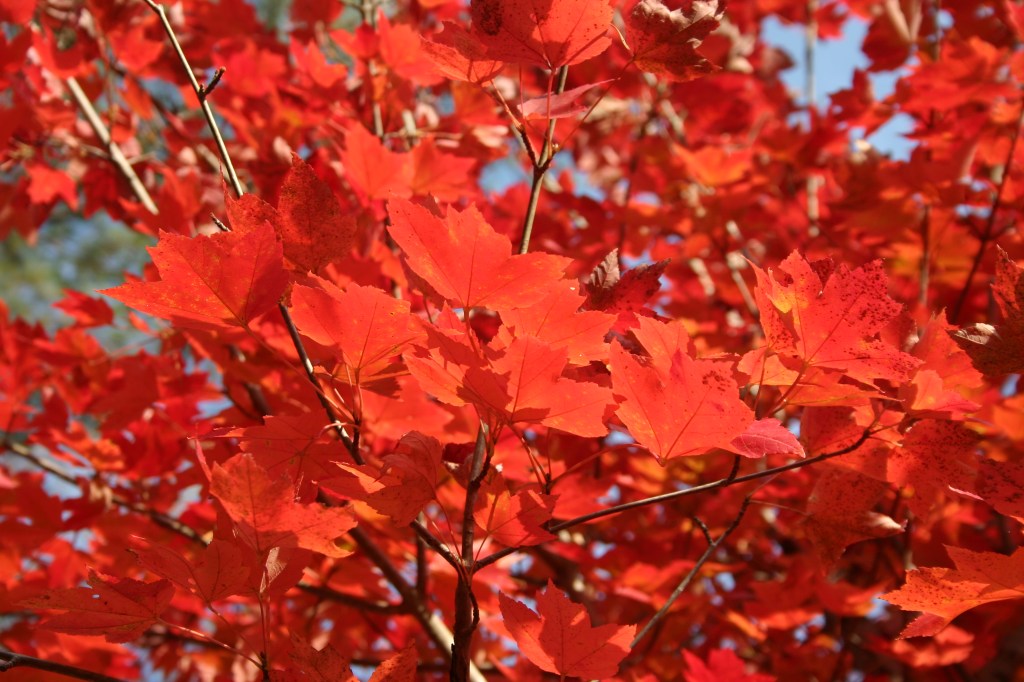
On a fall day several years ago, I discovered that I, too, was rich – not in the sense of Tevye’s longings, not in the sense of a carefree life, but rich in the sense of a mythical king.  As I was walking down the Middle Oconee River (near my hometown of Athens, Georgia) I enjoyed the many colorful red and sugar maples, dogwoods, blackgums, and poison ivy along the river’s levee.  Many leaves had fallen, and I recalled that when I was a young boy, I would gather a half dozen of the prettiest leaves as I walked home from school to bring home to share their beauty with my mother.  But as I looked at the leaves lying ankle-deep on the ground, I realized it would be impossible to choose the six best leaves – there were so many!  How could anyone make such a choice.  They were like jewels, even better than jewels, for no jewel could match the dazzling spectrum of colors in even one leaf, much less all the leaves.  And, as I looked up at the trees that had produced these super jewels, they were like paintings, only far surpassing any human-made work of art.

So, there I was, ankle-deep in the world’s most beautiful jewels, surrounded by superb works of art, and all the while being entertained by the music of songbirds.  What more could one possibly wish for?  I was a rich man, and I didn’t even have to work for it.  Tevye would have liked that.

[Since that long ago day in 1993, I have walked in a lot of forests, along many riverbanks, and in other interesting environments.  In the past few years, I have enjoyed exploring the back country while flagging new trails in the Jocassee Gorges in South Carolina.  Compared with the quiet beauty of the Oconee River in Georgia, the scenery in Jocassee is simply spectacular. The tremendous cliffs (not all cliffs are in state parks!), the numerous waterfalls, the natural gardens of wildflowers, and the views of endless mountains rolling to infinity, all certainly qualify as beautiful.]

But don’t be fooled!!  The nice thing about nature is you don’t have to wait until fall or go to a special place to enjoy its beauty. Nature is, almost by definition, beautiful.  We rightly enjoy the special shows of fall colors, spring and summer flowers, winter ice and snow, and the beautiful landscape of the Southern Appalachians.  But even without these spectaculars, nature – the undisturbed environment – is beautiful.  All we need to enjoy it is to open our minds to its presence.  Then we can all be as rich as a mythical king.

Article on Cook and Trails

Homage to Cernunos

Hunting is an often-contentious topic, and this isn’t helped by the fact the concept means different things to different people.  Say “hunting” and one may think of providing food for the family, while another may picture millionaires posing over an elephant.

In my experience, one of the broad groups that leans in the anti-hunting direction is the pagan community.  For every note on my feed that is favorable (or at least accepting) of hunting, there are dozens who see it as abominable.

The following is an article originally published in Touchstone, the journal of the Order of Bards, Ovates, and Druids.  Republished here with permission of the author. Let me know what you think.

 In Homage to Cernunos: A Modern Druid’s View of Hunting

The hunt is a common theme and a powerful symbol in Celtic mythology. How many stories are framed around hunts, finding the action “one day while he was out hunting” (or “while her husband was away hunting”)?  Even today, modern Druids and Pagans identify with, and venerate, the Horned God – as Cernunos, Herne, or in another guise.  Yet, in the Pagan community, the issue of hunting is fraught with contention.

No doubt there will be many readers who believe that hunting is wrong.  Druid opinions range from “I think hunting is great” to “hunting for sustenance is okay, but not for sport” to “killing another living thing is wrong.”  In the greater population, the hunting controversy becomes tangled up in issues of class, politics, and even nationalism.  Just as in any human community, it is easy for a group to be reduced to a negative caricature to an outsider’s eyes.

I grew up the son of a wildlife biologist in a rural part of Georgia, in the southeastern United States.  Hunting was a normal part of life.  Rifles and shotguns were stacked on the rack by the front door, and deer heads decorated the walls. My father was a hunter from youth, providing food for his family and later ours; he passed his skills and knowledge – a mixture of native field-craft and scientific study – to me.  My parents still hunt.

As a biologist myself, I can speak to reasons why, in this region and in this time, hunting deer is necessary. White-tailed deer breed without regard for either their welfare, nature, or us.  When deer overpopulate, they over-browse, removing all edibles as far up as they can reach, even eating bark off roots – not to mention the farmer’s crops.  Bringing back cougars and wolves is not feasible, so without hunting, deer numbers rise until most of the individuals suffer a lingering death due to starvation and disease.  By then, the land has lost much of its resiliency and natural diversity and takes many years to fully renew.

As one among a community of hunters, I know hunting is important to people for many reasons.  It is true that most hunters of my acquaintance feel pride at taking a particularly large deer, but a fine set of antlers is seldom the overriding reason for hunting. A deer on the ground means meat in the freezer, and among some struggling families, a successful deer season means the difference between health and hunger the rest of the year.  For those omnivores without access to organic meat, wild game is both organic and generally healthier than store-bought beef or pork.  Concerns for ethics are assuaged by comparing a factory-farmed life and stress-filled final minutes of a cow versus the quiet, free life and sudden and unexpected death of a hunted deer.  Finally, a good hunter is more immersed in and aware of nature.  I know hunters whose working knowledge of bird and beast, tree and forb, and the yearly cycles of their hunting ground would awe many Druids.  Many speak of their time on the hunt as a spiritual experience, bathed in the peace of the forest.  Through their connection with the prey, they enact a ritual known to their forebears stretching to the dawn of time.

From a broader standpoint, hunters and anglers (in the United States) fund the preservation and restoration of wildlife habitat through excise taxes and fees, helping game and nongame species alike; this funding source dwarfs the financial contribution of birders, hikers, and other “non-consumptive” users.

As someone on a Druidic path, I have pondered my own reasons for hunting. To non-hunters, I have stated all of the reasons above.  But in private reflection, I turned the notion around and looked at it in the context of a religious obligation. I eat meat, much of it factory-farmed – a situation which, if pressed, many people would say they dislike but few ever think about. These animals are raised and killed by faceless strangers, their lives sacrificed so that I may buy prepared food. But in the Autumn, I enter my sanctuary woods reverently.  I proclaim that I have not forgotten that my plastic-wrapped food was once a living animal – an animal which fed on plants which were in turn nourished by the sun – and in token of this acknowledgement I will perform the sacrifice myself, at least this one time.  I do not flinch from this symbolic duty, and I endeavor to kill swiftly. And kneeling over the animal whose life I took and whose flesh will provide nourishment for my wife and child, my friends, and myself in the coming year, I pause to wordlessly express my compounded gratitude and apology.

The hunt is a seasonal ritual, conducted in my family’s woods and in my favorite season.  I enter the woods with my code of ethics firmly in place:  I will only harvest a fully mature deer, and only if a clean, swift kill is certain.  I let many deer walk away – for these reasons, or because the spirit moves me to let them be.  I silentMOULTRIE DIGITAL GAME CAMERAly watch and learn as they interact with each other and the world around them.  I also see other hunters at work – a bobcat bringing down a rabbit, or a hawk stooping on a careless squirrel.  This day, I am like them, bound to the prey.  Lost in the hunters meditation – senses alert to  a leaf crunching,  the breeze shifting, the flicker of gray against the brown-shaded landscape – I touch both the woodland predators and my own ancestors stretching back to the dawn of our kind.  The hunting spirit in the breast of our ancient kin is surely what led them to call forth to hunter gods, to revere great hunters in  myth and legend.

Hunting is not for everyone.  Comparatively few have the opportunity, and fewer have the inclination.  Yet that spirit of the hunter is still a part of us – if often slumbering  or sublimated.  That spirit should be, if not acted on, at least acknowledged; as beings of both instinct and intellect, some part of us needs the hunting aspect to keep us closer to our true, natural selves.  My  father once said: “The prey must have the predator, just as the predator needs the prey.  One without the other eventually becomes something less.  The wolf becomes a dog.  The deer becomes a cow.  And what does Man become?”

The arts of Herne deserve respect within the Pagan community, from hunters and non-hunters alike.  For some people, hunting can provide a unique insight and a spiritual link to our ancestors and to the spirit of the Wild Hunt.  Further, it can bring a greater awareness of our place in the environment, of the cycles of nature and the delicate balance between life and death.  It can help us better understand our own natures.  On a broader scale, hunting can be a greater good, helping protect and restore wildlife habitat.  Hunting will always be controversial, but perhaps the arguments on either side of the issue aren’t as simplistic as they are made out to be.
Thoughts on Walking in the Woods

Reproduced here with the kind permission of  Jerry Knox:

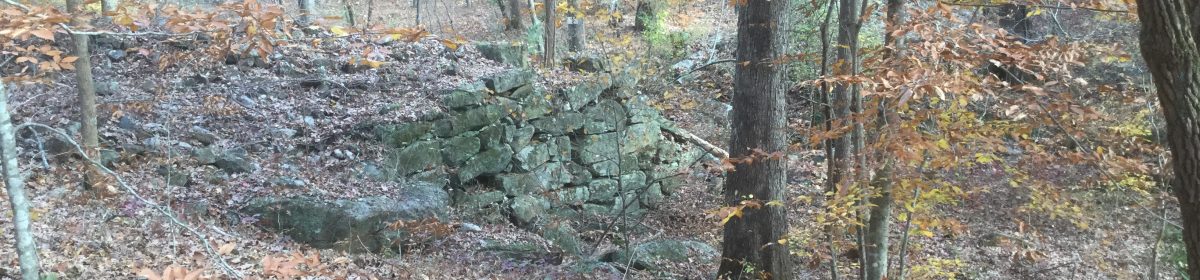
Some will say they fear the woods, for the snakes and such. I have found a different truth.  One who treads the woods with care, to do no harm to tender plants, will never be surprised by any harmful thing.  The very sense that guides your feet away from the violet, will alert you to the poison ivy there as well.  The soft, and measured, step allows both mouse and rattlesnake time to flee your path, or hide, alert and safely unafraid, as you pass by.

But one who crashes through the brushy ways carelessly and unaware will find his way perilous indeed!  Yellow jackets boil to defend their precious nest.  Thorny vines find painful lodging round ankle, neck and arm.  Ticks shower on his shoulders, chiggers cling to pants and legs.  The rattler coils and bows his neck to fight off this bold invasion.  Thrown out, repulsed by vine and fang, the intruder flees with tales of terror, and fearsome creatures lurking in the trees, and fails to see the danger in the woods was he!

22519267_1944339395592575_5945756040149729161_n(1)