It’s a common refrain: some horticulturist or botanist sees a wonderful potential in some plant and brings it across the ocean. An effort is made to establish said plant, so that their descendants could carry out a far greater effort to de-establish it.
I can begin so many essays this way. The subject today is trifoliate orange (Citrus trifoliata or Poncirus trifoliata), also known as bitter orange, hardy orange, or (in one cultivar) Flying Dragon.
The bitter orange is a shrub which can grow to nearly 30 feet tall. What gets your attention at first sight are the long (1-2”) rigid thorns arming the twisting green stems.
While the thorns are the main feature to my eyes, it gets its name from the fruit. It is flowering now (May), and in a couple of months small (around 2 ½ inches) green fruits will appear. These ripen to orange and are both very acidic and bitter (the latter from a chemical called poncirin). I’ve read that, with proper preparation, they can be turned into a marmalade or a bittersweet condiment. To me, that’s trying to make lemonade when given lemons.
It was brought over in the mid-nineteenth century to make livestock hedges. And they certainly work for that purpose, with their 2-inch thorns! The problem, as usual, is that the possible ramifications were not thought through – namely that this hardy plant will find its way to unwelcome places. Trifoliate orange has established itself in at least 17 states.
I’ve encountered it on several properties in Georgia Piedmont, but nowhere as extensively as a tract in Jackson County which, prior to mulching, was a solid thicket of bitter orange.
Solid, impenetrable thicket
Why is this pest top of mind today? I was visiting my neighbor across the creek and came across several scattered hardy oranges. I already have callery pears, another noxious plant I have special antipathy towards, advancing on me. But then, our landscape has an overabundance of foreign species that have made themselves at home here. The more one learns, the more one finds.
We have a tendency to take a proprietary view of things around us. “The deer down the road are a potential nuisance, but the one that feeds on the edge of my yard is okay because it’s familiar.” “That maple by the gate is familiar as an old friend.” “Stray cats are death on toast for birds, but I’ve named the one that creeps around my hedge.” “They can’t do that to our pledges, only we can do that to our pledges.” (Yes, Ma, that last one was a movie reference.)
As I mentioned a while back, the Joro spider – an Asian arachnid making itself at home in the Piedmont – fills up the woods in late summer, to the consternation of those who otherwise love the outdoors. As temperatures drop in the late autumn, the multitude of spiders drops away and their haphazard webbing disintegrates.
And then there was the large female residing just outside the garage. I’d see her every day, along with a few smaller Joros inhabiting that corner under the eaves. She was hanging out through the late summer and into the autumn. October…November… December… the spiders on the back porch fell away. Moths, flies, and other flying insects faded out as well. Christmas came, and the large female under the eaves remained, after cold and hunger felled all her neighbors. Was her persistence due to being the largest spider on the south-facing side of the house, protected from the worst of the winds? Regardless, at this point she’d gone from an invasive cluttering up the garage to a dogged survivor. Instead of glares, she earned appreciative glances as I walked by.
The New Year dawned with a near-freezing morning. I expected her corner to be unattended, but there she was: slowly, methodically, doggedly repairing her web with golden-tinted silk. You go, girl.
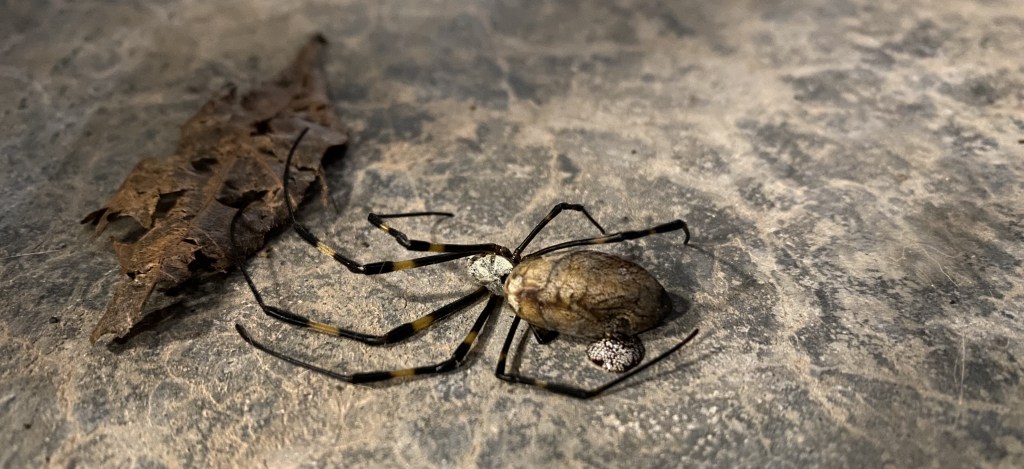
Now it’s mid-January. Atmospheric disruption at the North Pole sent a shock of subfreezing winds our way. The first morning after the hard freeze revealed a ragged, empty web. Our Joro lay on the cement floor, having finally succumbed. I wouldn’t say I had an overabundance of feeling for that critter (this was a short-lived invasive, not Charlotte), but its passing received far more attention than that of any of its brethren.
Is there a tree, a stone, an animal — any normally-anonymous thing –that you have marked with your attention? Any thing whose absence would be worthy of notice and remark? Drop a comment and let me know.
As we are a few days from Halloween and thus well into the Scary Season, I write of a vine of legendary horror. No, it isn’t Audrey II, the alien plant that devours people, but it’s close. It is kudzu, the Vine that Ate the South! <cue ominous chords>
Okay, that’s slightly overdramatic, but you can safely add it to the list of imports that “seemed like a good idea at the time.” Like many inspired catastrophes of good intention, importing this rampant leguminous vine from Asia was intended to be an easy fix for another human-caused calamity, soil erosion. And it certainly covers up the gullies and bare slopes like nobody’s business. The problem is, kudzu isn’t that great at holding soil. True, its vines lengthen at the stunning rate of a foot per day, but the thick taproots don’t spread wide and fine to hold soil as those of grass might. Once rainwater collects under the vines, there is little to keep the soil from washing away.
The climate in the South is substantially different than that of Japan, where shorter growing seasons and colder winters moderates the growth of the vine. In the land of hot summers and mild winters, the plant turns invasive, flowing over fields, over trees, over buildings…anywhere a vine can go. Kudzu crowding vines deprive everything beneath them of sunlight, killing forb, grass, shrub and tree.
Kudzu has been put to various uses in an effort to make a positive out of such an overwhelming negative. The leaves make a highly digestible cattle forage. Some people make compost; others craft baskets or wreaths from the vines. But the usage of kudzu is negligible compared to the sheer productivity of the plants. This menace has covered millions of acres across the Southeast, and as far north as Nova Scotia and westward to the Pacific coast.
Apart from seeing blankets of the weed, covering field and forest, from the safety of the family truck, my first experience with kudzu came when I was eight or nine. My Mom and I tramped through a pine stand one night, trying to connect with some foxhounds that had strayed from the pack. We lit the forest floor with wheat lamps (a powerful light used by miners and coon hunters alike) to guard against entanglement or envenomation. As we progressed, I gradually noticed a change in the vegetation around me. There were fewer briers, and most of the abundant saplings were dead and leafless. Then, our lights picked what appeared to be a fuzzy wall fifty yards ahead, stretching in either direction as far as our lights would shine. We looked up and saw the unnerving ceiling of the same gray-brown material, held up by dead pine trees like tent poles.
We reached the wall of vine and dead leaves, and I looked to Ma to see what to do. The vine tangle stood between us and the truck, and there was no telling how far we’d have to follow this dead barrier before we struck another open trail. Finally, she put down her light and reached into the wall, pushing the vines apart just enough to form a tunnel. She directed me to climb up into it and continue to dig through. I remember the dead mass supporting my weight and being thick enough that I was completely encased in dry leaves before reaching the first green ones. I broke through to the open air and tumbled out the other side before turning and helping Ma crawl through. With the green wall at our backs, we waded through a smothered field before reaching the dirt road.
My encounter with the backside of kudzu occurred a couple of weeks ago when I visited a newly-purchased hunting property. It had many of the common invasives – Chinaberry, stiltgrass, tree-of-heaven, sericea, and so on – but by far the most visible issues were the mounds of kudzu, topping the smaller trees and coiling upwards towards the tallest oaks. I think the landowner is aware that the land he bought is a “fixer-upper.” I’ll tell him the options: burning or mowing to reclaim conquered territory, followed by herbicide to strike at the roots, the only way to permanently kill this scourge. But I’ll warn him to be prepared for a multi-year campaign. And I won’t say what I’m thinking: Better you than me.
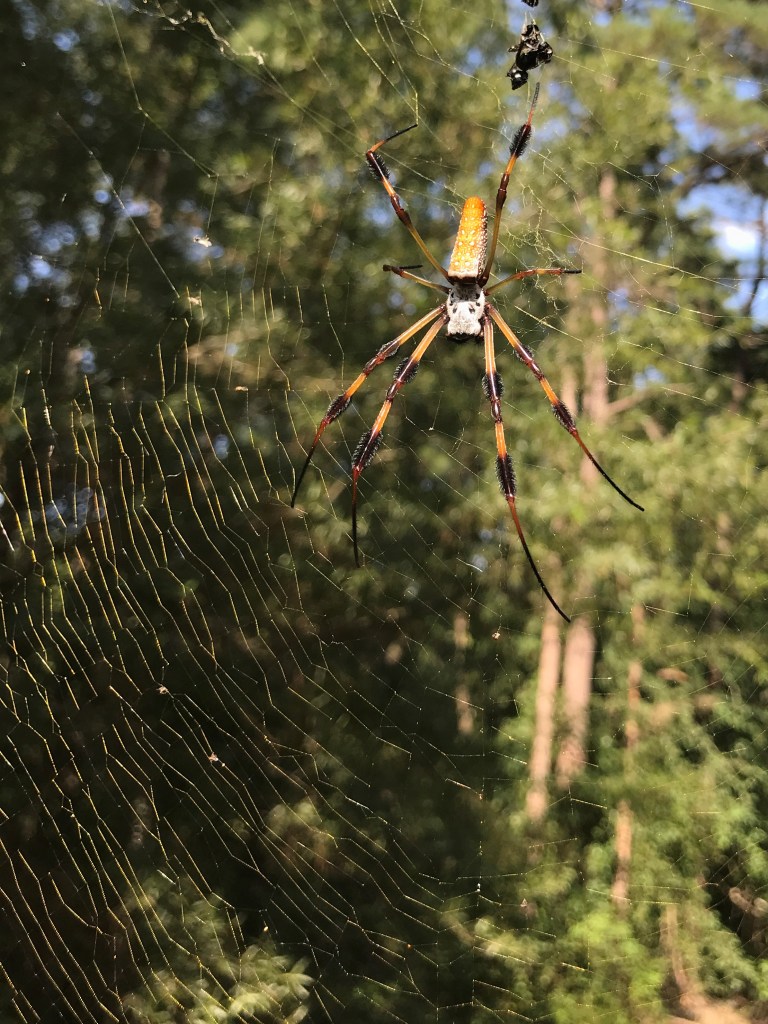
This weekend I received texted photo of a spider, with the question: “Friend or Foe?” What she meant, of course, is whether the arachnid posed a danger to her. The picture she sent was that of a Joro spider (Trichonephila clavate). I told her it wasn’t dangerous, but in truth it requires a more complex answer.
Fat and Happy Joro
Until recently, I could comfortably identify the big spiders around my house as either the garden or writing spider (Argiope aurantia) or the golden silk orb weaver (Trichonephila clavipes). When late-summer spider season hit and webs were being spun in every available tree and porch pillar, the usual suspects aren’t in attendance. Instead, the Joro spider, an Asian native, has set up shop all over Athens and throughout our woods in a neighboring county.
In the Fall of 2014, a fellow in Madison County, Georgia, sent photos of a strange spider to the Department of Entomology at the University of Georgia. This is the first record of the Joro spider in North America. They probably arrived, as so many invasives do, in packing material for goods shipped across the ocean. Since then, they have expanded their range across the Piedmont of Georgia and South Carolina. Given that the spiders lay egg sacks with hundreds of eggs (up to 1500!), it is easy to see how they overwhelm the other large orb weavers in the ecosystem.
My ecologically-aware friend was incensed. “…are we just meant to let them naturalize, or are we supposed to be coming up with ways to get rid of them?”
Golden Silk Orb Weaver
Good question. If one species takes over a niche from another species, that is cause for a naturalist’s concern. Unfortunately, unless the usurper causes some economic harm, you aren’t likely to have any of the Powers That Be care enough to devote resources to it. Not that there is likely to be a way to combat this species that doesn’t threaten all other spider species.
No, I think we will see the Joro continue to spread and naturalize. They will capture insects with as much efficiency as their predecessors, and their bites are just as harmless to humans. Whether the transition of arachnid power will impact the ecosystem beyond displacing some species remains to be seen.
If I became governor of Hell I would reserve a special room for Eugene Schieffelin and his minions in the North American Acclimatization Society, the idiots who thought it would be nice for all the birds mentioned in Shakespeare’s works to be represented in America. In the 1890’s he released around 60 starlings into Central Park. Because of one single line in Henry IV, an estimated 200 million of the aggressive little bastards currently occupy North America, wreaking havoc on native bird populations.
Why such antipathy for these morons? Why not put in Etienne Trouvelot (who introduced Gypsy Moths) or whoever shipped the wood that contained the fungus that annihilated the American Chestnut? Because Schiefflin and his cronies went out of their way to perpetrate their crime, and for a silly reason.
Humans have been bringing pests from one land to another since they first commenced to roam, and many native species and a few ecosystems have paid the price. Many are completely unintentional, from fire ants to zebra mussels. Some seemed like a good idea at the time, like kudzu or cogon grass. But Schieffelin’s crowd were whimsically Anglophilic.
Dreamers are fine. But sometimes their dreams can become nightmares.
As I write this, white blossoms are popping out behind my house — an old nemesis sneers at me. The Rogue Pear.
The callery pear (Pyrus calleryana) is an Asian native brought to the US in the 1960s. Why? The pears are small, round, and inedible. The flowers fill the air with a sickly-sweet odor. The trees are densely limby and prone to splitting in bad weather. Like many fast-growing trees, the callery pear is short-lived, lasting only a couple of decades or so. So why has it turned up in every doctor’s office park and subdivision? Three things: beautiful foliage– deep green in summer, leaves turning blood-red or wine-dark in the autumn; an explosion of flowers late in winter; quick growth to a bushy, symmetrical silhouette.
Horticulturalists created a number of cultivars, the best-known being the ‘Bradford’. We removed the thorns, we straightened the forms. As a useful biproduct, these cultivars couldn’t reproduce. You plant Bradfords, and they stay where you put them.
But, in our great and unmatched wisdom, we kept tinkering. Each cultivar had slightly different properties. Different colors, stronger limbs. And then it happens. One cultivar is used to landscape a new strip mall, and a different one dresses up an office park down the street. Some local bees visit one and then the other. It turns out that different cultivars can fertilize each other. And these new seedlings exhibit the attributes of the original, wild pear: able to grow on a wild range of soils, able to seed prolifically, and armed with thorns that can punch through a truck tire. I call them rogue pears, when I don’t use stronger adjectives for them.
It’s a contagion the scope of which you aren’t likely to notice until late winter. Come February until April, these innocuous green trees suddenly blaze white in floral profusion. My corner of the county is pretty well infested; a mere 10 years after being fallow, the neighbor’s field is a young forest, with 8 out of 10 trees being pears. But I didn’t have any inking of realize how widespread the problem was until I was a couple of hours away, driving on a highway skirting the Fall Line. In the pine plantations on either side, the midstory was packed with pears bedecked with their white blossoms. Some quick research showed the rogue pear has popped up in most states east of the Mississippi, and it has a foothold in several western states as well.
Everyone knows about kudzu. You may have heard of Chinaberry or privet or tree-of-heaven. Now that pear is on your radar, maybe you’ll start seeing it come the end of winter.
Maybe, hopefully, you’ll choose native trees for your next landscaping project.






 Towards the Moon or To the Sun
You must be logged in to post a comment.