Siding With The Grasses

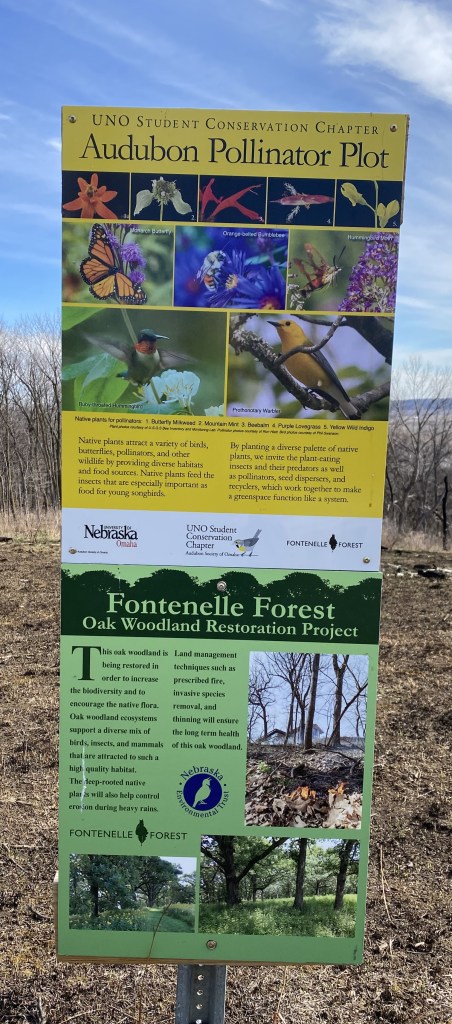
As mentioned in the previous post, I was in Omaha a week ago.  After conducting my business, I planned to treat myself by visiting Neale Woods to see the slice of tallgrass prairie the naturalists at Fontenelle Forest were restoring.  Upon arrival, I was momentarily disappointed to discover that the grassland and much of the woods had been put to the torch only a couple of weeks earlier.

I say momentarily disappointed, but I’d add a naturalist’s delight.  This was an opportunity to get a better look at the efforts to recover a corner of prairie from a century and a half of neglect.

The prairies and oak savannas of the Midwest, like the pine savannas of the Southeast, are by their nature constantly under threat from ecological succession.  Shrubs and trees push towards the interior in a never ending campaign, threatening to block the sunlight from all vegetation laying closer to the ground.  Fire – from lightning and anthropogenic sources – was always the prairie’s greatest weapon of defense and conquest in what Aldo Leopold termed the “prairie war” between grassland and forest.  When the sodbusters began plowing the dark prairie soil to grow crops, they also banished fire from the uncropped land – for fire endangered buildings and livestock, not to mention the trees that offered their wood to the settlers and later to industry.  And so it was that many oak savannas, through deliberate fire exclusion and general neglect, grew thick canopies — stealing sunlight from the grasses and forbs that needed it. 

The prairie lost all the land that could be farmed.  Without its ally, fire, it surrendered the rest to the forest.   Even the oak savannas, a neutral ground of sorts where grasses and trees coexisted, reverted to forest as less fire-tolerant tree species crowded in to create closed-canopy forests. Of the 50 million acres of oak savanna existing in the middle reaches of the United States and southern Canada prior to European settlement, only around 30,000 acres remain in scattered pockets.

However, the pendulum is shifting back a fraction. In recent decades, knowledge of the elements and interactions of this hybrid of prairie and woodland community have been joined with a will to preserve or recreate said hybrid. 

In Neale Woods, it began with the setting aside of loess hills ill-suited for farming. Then came the restocking of prairie plants in openings in the tree canopy.  Now as I looked around, I saw evidence of the continuing efforts to create an open oak savanna.  Low stumps, which would have been hidden by tall grass but were easily seen in the ash, showed the ecologist’s direct interventions against individual trees.  Larger trunks, though still standing, were neatly girdled – not indiscriminately, only individuals or small clusters, just at the margins of existing openings.  And of course, there was prescribed fire, free to do its work within the confines of subtle firebreaks.  It burned away leaf litter, scarifying forb seeds and exposing bare soil for the next generation of ground cover.  Some tree seedlings died, others were topkilled.  Fire found chinks in the bark armor of some older trees, burning deeper wounds. 

Girdled trees

Sounds catastrophic, perhaps.  But for the flora and fauna adapted to fire long before the axe or plow made their marks, fire is a part of life – a trial to be periodically overcome but which leaves the survivors in better shape.  The larger bur oaks are nearly impervious to the low-running grass fires and were scarcely troubled; they will have less competition for roots and perhaps for sky.  The mountain mint and bloodroot, the beebalm and bluestems will grow vigorously.  Wildlife, including the rabbit whose droppings I saw by the trail or the wild turkeys that I watched foraging for baked acorns and roasted insects, make use of the invigorated ground cover.  Nectar-feeders, from monarch butterflies to longhorn bees, will fill the air come summer, as will the songbirds who arrive to feed in the humming air above the prairie.  The blackened crowns of the native grasses were already sprouting green sprigs, promising a return to tall grasses waving in the summer wind.
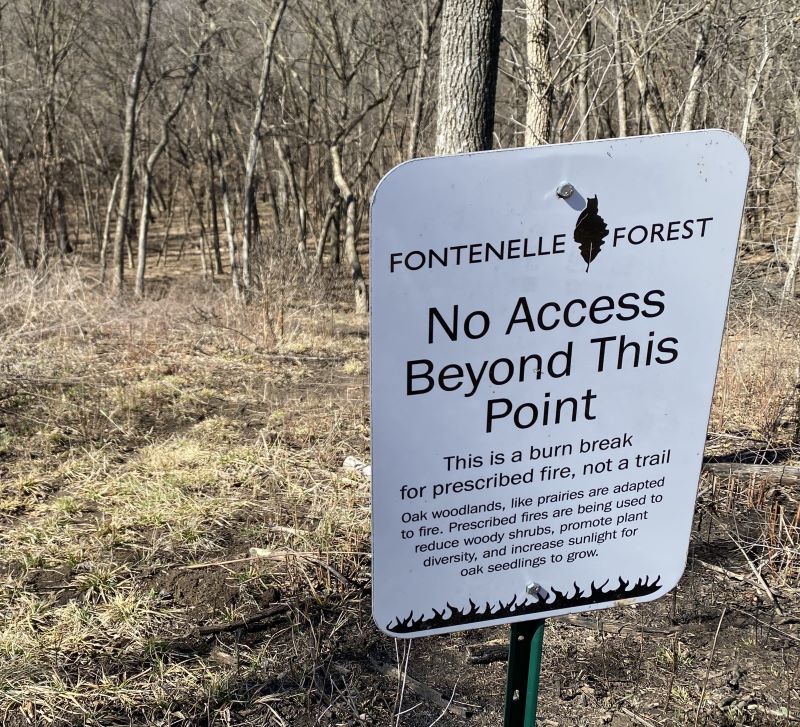
I commend the biologists and their supporters who are bringing back the oak-grassland savanna in this corner of Nebraska.  In the war between forest and prairie, these conservationists have sided with the grasses.

Additional Information:

News report on this fire

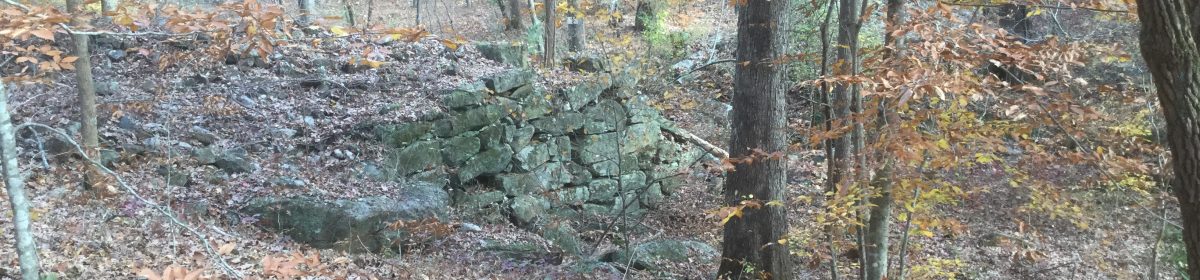
A view of Neale Woods in October

A brief view during the growing season.

Fontenelle Forest, stewards of Neale Woods.

A Tale of Tourist Attractions

What do a mound, an arch, and a bottle of catsup have in common?

When my family drove to Ohio to visit some dear old friends,  I convinced wife and son to detour through western Illinois.  You see, I had recently learned of Cahokia, and was bent on visiting.  Cahokia is the site of the largest known urban settlement of the Mississippian culture.  The population exploded in the mid-11th century; between its ritual center and outlying settlements, estimates put the local populace at nearly 40,000 during the 13th century.  If accurate, that would make the greater Cahokia landscape the largest urban population in North America until the late 18th century!  At its center was a platform mound rising 100 feet and covering 14 acres, formed by earth and sod carried one basket at a time.  Over a hundred smaller mounds rose across the local area.  Archeological finds point to Cahokia as a major center of trade, and likely a social and religious center as well, with complex social structures.

Given the dense population, it is easy to assume that supplying food and firewood, and disposing of waste, would have been increasingly difficult.  It is likely that poor nutrition and polluted water lead to rampant disease and short lifespans.  This further suggests that regular immigration was necessary to maintain the population level, though such inflows couldn’t last (the city was abandoned in the 14th century).  It is not too much to assume that traders, emissaries, pilgrims and perhaps simple tourists came to witness the center of Mississippian culture.  And here I was, a tourist of echoes, visiting the ruins whose builders and rulers have long since vanished, unable to our modern homage. I wonder how they would process the fact that people in a land they couldn’t conceive of would deem the ruins of their city of worldwide cultural significance (UNESCO World Heritage Site, one of only 1,154 worldwide).

The visit was all that we had expected. The interpretive displays in the museum were excellent, and my boy was at the point where he would actually read and appreciate the panels of text accompanying the artifacts and reconstructions.  We climbed the great mound and explored the nearby reconstructed timber circle (“Cahokia Woodhenge”) in the warm sunshine. I could have spent a leisurely day there.  Instead, we hopped in the car before noon and headed west across the Mississippi River and a more modern place of tourist pilgrimage.

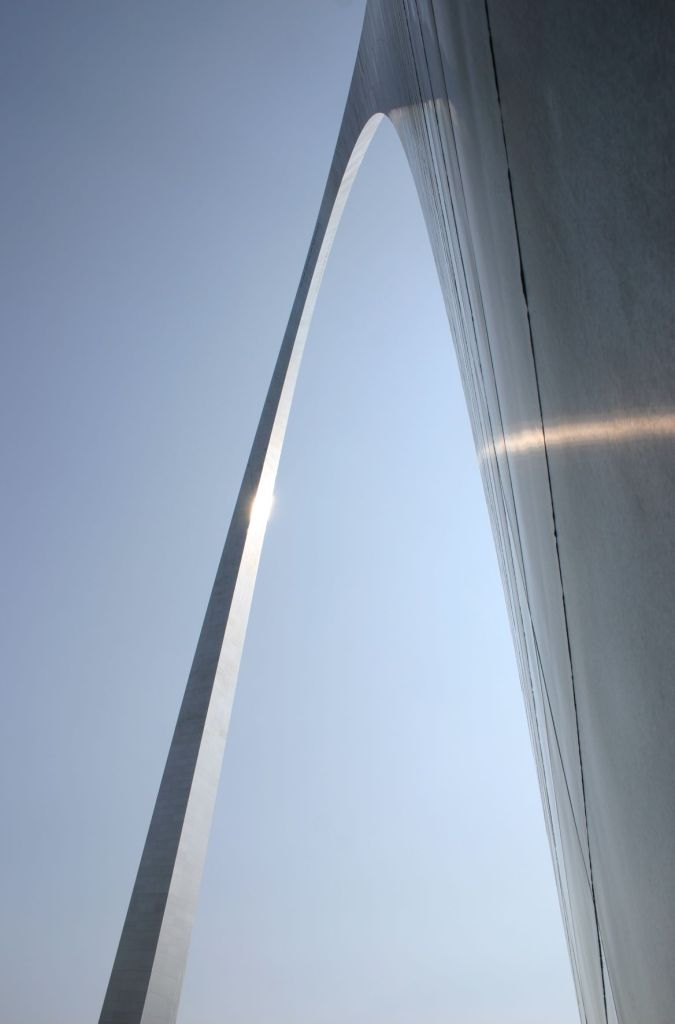
St. Louis’ Gateway Arch is considerably younger than the mounds we recently quitted, being built in the 1960s. It is also far taller (over 600 feet).  The arch segments are triangular in cross section, constructed of carbon steel covered by stainless steel.  It is an engineering marvel.

It was also expensive and crowded.  We stood in a long line in the warming late-May sunshine, before descending into the cool darkness of the visitor center.  This was followed by a two hour wait for our turn to actually enter the arch, during which we ate overpriced snacks, wandered through the museum, and sat listlessly against a wall.  I imagine boredom and expensive rations were experiences we shared in common with ancient Mississippian tourists.  But we thought, if nothing else, the boy could say he’d been to the top of the world’s tallest arch.

A little more walking, another 15-minute stand-around, and then we crammed into small tram capsules that slowly raised us several hundred feet in the arch.  Then we walked the last bit to the apex, where we vied with the crowd to look through the windows.  Thankfully, the wind wasn’t rocking the top!  It was certainly a view, with the city laid out on one side and the river and ancient floodplains stretched out on the other. After a couple of minutes, the height-shy young’un was ready to vacate.  And so this family of introverts headed groundward within ten minutes of our arrival, and left the crowd behind with all speed.

We were tired, but there was one stop to go.  It was admittedly the silliest coup to count, but we were a little punchy by this point. 

You see, when we checked in at our motel in Collinsville, the desk clerk asked what our plans were.  When we spoke of the UNESCO World Heritage Site four miles down the road, she confessed she wasn’t familiar with Cahokia Mounds.  However, she said we “absolutely have to see the Giant Catsup Bottle!” and gave explicit directions to said marvel.

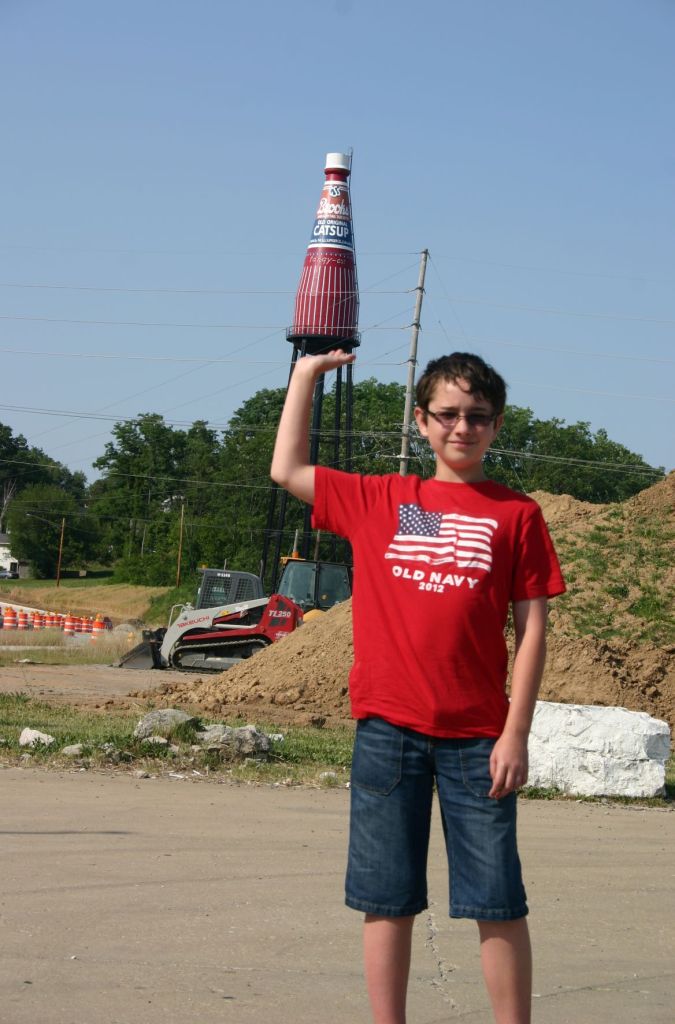
Yes, friends, she was referring to the Brooks Catsup Bottle water tower, a bit of novelty architecture from 1949 that is, indeed, shaped like a bottle of catsup.  The faux condiment container supplied water to the Brooks catsup plant. The tower needed significant restoration by the 1990s, and those needs were met by volunteer fundraising, to the tune of $80,000.  It isn’t on UNESCO’s radar, but it does hold a coveted slot on the National Register of Historic Places.

So, as no doubt many pilgrims of roadside attractions have before us, Mom and Dad took Junior to gaze upon a slice of novel Americana.   I remarked that I was now ready to go see the world’s largest ball of twine and maybe get our dinner from a hotdog-shaped restaurant, before turning in at a motor lodge shaped like a tipi.  Or, to make a Lord of the Rings reference, “I just came back from the ruins of Amon Sul, but please, I’d love to go see the largest pumpkin in the Shire.”

To summarize: Spent the morning in a world-famous archeological site that even locals haven’t heard of. Spent the afternoon standing in lines with crowds to do “the done thing” and count coup.  Finished up with roadside kitsch. Clearly, the mounds ruled the day.

Yet, they were all tourist attractions.  The city of St. Louis is proud of the stainless steel arch.  The town of Collinsville is proud of their water tower.  And the enigmatic people of 900 years ago were likely quite proud of the great ritual mound at the center of their own metropolis.