Oak Savannas: Rediscovering an Old Idea

As stated in the past, fire is a key element in shaping a forest or grassland.  Prairies in the west and south and longleaf savannas have been discussed previously.

Thinning and burning are well-known and critical practices for anyone wanting to manage pinelands for wildlife in general and deer and bobwhite quail in particular.  But you may be surprised to learn that thinning and burning can be just as important in upland oak stands.

The idea of burning hardwoods — on purpose! — was unheard of in my college days.  Oak savanna management seems to get more discussion among conservation communities in the Midwest, which Aldo Leopold poetically described as the battleground of a 20,000-year war between prairie and forest.  But there is archeological and botanical evidence of open woodlands throughout the South before farming and development changed the landscape.  We have seventeenth century accounts of savannas and open plains in the upland Carolinas, eighteenth century records of bison in Piedmont Georgia, and reports of hilly grasslands with scattered pines and oaks; naturalist William Bartram often alluded to natural strawberry fields that dyed the legs and feet of his horses in his botanical journeys through the southeast in 1776. 

It is clear that fire, whether lightning-caused or set by the native population, maintained open woodlands across Georgia.  Conversion of land to agriculture or other development altered the landscape before there was any opportunity for photographic evidence of its open character; subsequent abandonment of farmland and fire suppression in the 20th century resulted in the dense forests that many mistake for our land’s “natural,” precolonial state.

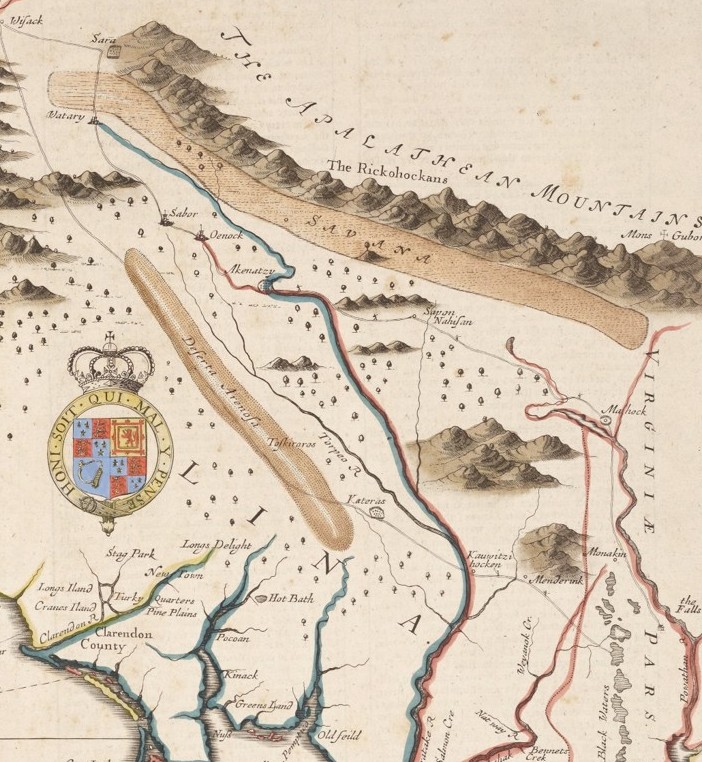
Map of Lederer’s travels, c.1670
Savanna marked in the Carolina Piedmont
What is a Savanna?  What is a Woodland? We define whether an area is a savanna, woodland, or forest based on a measurement of the canopy closure – that is, how much of the sky is obscured by vegetation in the tree canopy when viewed from a single spot.  A forest has 80% or more canopy closure, while a woodland has 30-79% canopy closure.  A savanna has 10-29% canopy closure; less than 10% canopy is considered a prairie.
Hornaday’s map showing the retreat of bison from the southeast.

How is this relevant to land managers today?  Although the landscape has changed considerably in the intervening time, the habitat requirements of deer, turkey, quail, and other species haven’t.

Lake Russell Wildlife Management Area, Georgia

Just like closed-canopy pine stands, mature hardwood forests lack diverse groundcover. Quail need that mix of native grasses and broadleaved forbs, but so do deer and turkeys – more so than many hunters realize.  Managing part of a property as an open woodland or oak savanna will provide valuable cover and forage for deer – not to mention food for pollinators, and insects for poults and chicks.  In the Piedmont, where most open lands are either cropfields or hayfields, there just isn’t much year-round native forage. 

When creating an oak savanna as with creating a pine savanna, the first step involves cutting unwanted trees.  Hilltops and slopes with southern and western exposures are warmer and drier than northern slopes and valleys, making them good candidates for a fire-managed woodland.  If the trees are merchantable, you will have to make sure the contractor is aware that you want to leave some of the most valuable trees – oaks, and particularly white oaks.  If your tract is too small or the trees are not mature enough to interest timber buyers, you can cut down or girdle unwanted stems yourself until you reach the desired density.  An immediate follow-up with the appropriate herbicide will usually be necessary to control stump sprouting and seedling release. 

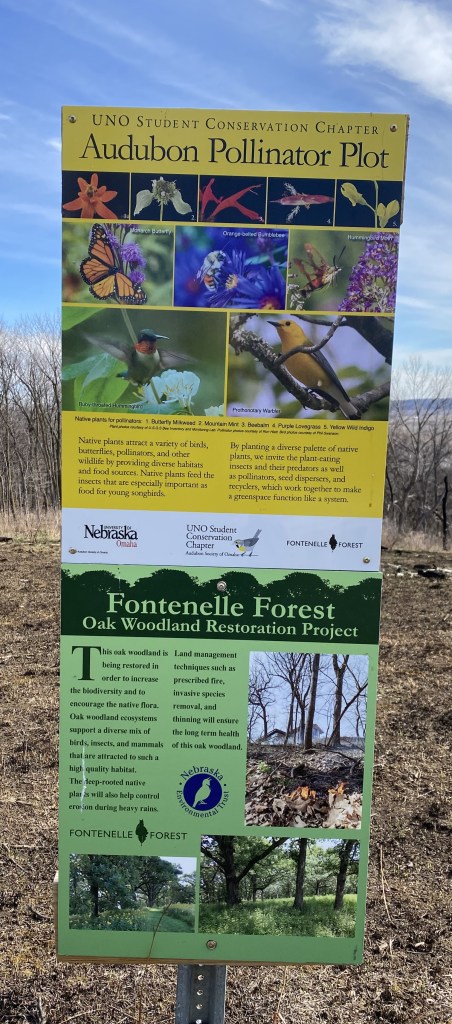
Birdwatcher in an oak woodland, Fontenelle Forest, Nebraska

The land is always growing towards a climax forest, so frequent disturbance on the ground is key to renewing new ground cover and keeping tree saplings from filling in the open spaces.   As you know, fire is one of a wildlife manager’s most important tools.

“But won’t I burn up my hardwoods?” I hear you say.  It is true that some hardwoods – beeches and maples, for example – are not fire-tolerant.  Others, such as most oaks and particularly post oak and blackjack oak, have thicker bark and heal quickly from injuries.  The shortleaf pine, an upland native, is more fire-resistant than loblolly pine and fits in well with this savanna scenario.   

Like any tool, it can produce different results depending on how it is used. Work with a forester to put together a burn plan that will help you achieve your wildlife habitat goals safely.

Additional Resources

Ecology and Management of Oak Woodlands and Savannahs (a pdf)

Fire in Eastern Oak Forests — a Primer (pdf)

Georgia Department of Natural Resources’ page on fire in the many ecoregions of the state.

The Piedmont’s Lost Prairie

Southeastern Grassland Institute

Siding With The Grasses

As mentioned in the previous post, I was in Omaha a week ago.  After conducting my business, I planned to treat myself by visiting Neale Woods to see the slice of tallgrass prairie the naturalists at Fontenelle Forest were restoring.  Upon arrival, I was momentarily disappointed to discover that the grassland and much of the woods had been put to the torch only a couple of weeks earlier.

I say momentarily disappointed, but I’d add a naturalist’s delight.  This was an opportunity to get a better look at the efforts to recover a corner of prairie from a century and a half of neglect.

The prairies and oak savannas of the Midwest, like the pine savannas of the Southeast, are by their nature constantly under threat from ecological succession.  Shrubs and trees push towards the interior in a never ending campaign, threatening to block the sunlight from all vegetation laying closer to the ground.  Fire – from lightning and anthropogenic sources – was always the prairie’s greatest weapon of defense and conquest in what Aldo Leopold termed the “prairie war” between grassland and forest.  When the sodbusters began plowing the dark prairie soil to grow crops, they also banished fire from the uncropped land – for fire endangered buildings and livestock, not to mention the trees that offered their wood to the settlers and later to industry.  And so it was that many oak savannas, through deliberate fire exclusion and general neglect, grew thick canopies — stealing sunlight from the grasses and forbs that needed it. 

The prairie lost all the land that could be farmed.  Without its ally, fire, it surrendered the rest to the forest.   Even the oak savannas, a neutral ground of sorts where grasses and trees coexisted, reverted to forest as less fire-tolerant tree species crowded in to create closed-canopy forests. Of the 50 million acres of oak savanna existing in the middle reaches of the United States and southern Canada prior to European settlement, only around 30,000 acres remain in scattered pockets.

However, the pendulum is shifting back a fraction. In recent decades, knowledge of the elements and interactions of this hybrid of prairie and woodland community have been joined with a will to preserve or recreate said hybrid. 

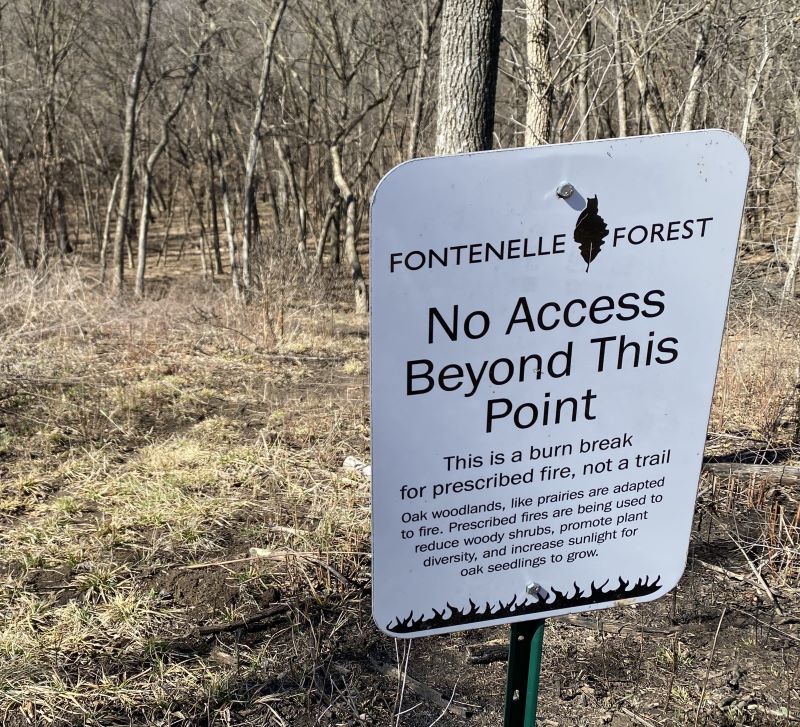
In Neale Woods, it began with the setting aside of loess hills ill-suited for farming. Then came the restocking of prairie plants in openings in the tree canopy.  Now as I looked around, I saw evidence of the continuing efforts to create an open oak savanna.  Low stumps, which would have been hidden by tall grass but were easily seen in the ash, showed the ecologist’s direct interventions against individual trees.  Larger trunks, though still standing, were neatly girdled – not indiscriminately, only individuals or small clusters, just at the margins of existing openings.  And of course, there was prescribed fire, free to do its work within the confines of subtle firebreaks.  It burned away leaf litter, scarifying forb seeds and exposing bare soil for the next generation of ground cover.  Some tree seedlings died, others were topkilled.  Fire found chinks in the bark armor of some older trees, burning deeper wounds. 

Girdled trees

Sounds catastrophic, perhaps.  But for the flora and fauna adapted to fire long before the axe or plow made their marks, fire is a part of life – a trial to be periodically overcome but which leaves the survivors in better shape.  The larger bur oaks are nearly impervious to the low-running grass fires and were scarcely troubled; they will have less competition for roots and perhaps for sky.  The mountain mint and bloodroot, the beebalm and bluestems will grow vigorously.  Wildlife, including the rabbit whose droppings I saw by the trail or the wild turkeys that I watched foraging for baked acorns and roasted insects, make use of the invigorated ground cover.  Nectar-feeders, from monarch butterflies to longhorn bees, will fill the air come summer, as will the songbirds who arrive to feed in the humming air above the prairie.  The blackened crowns of the native grasses were already sprouting green sprigs, promising a return to tall grasses waving in the summer wind.

I commend the biologists and their supporters who are bringing back the oak-grassland savanna in this corner of Nebraska.  In the war between forest and prairie, these conservationists have sided with the grasses.

Additional Information:

News report on this fire

A view of Neale Woods in October

A brief view during the growing season.

Fontenelle Forest, stewards of Neale Woods.

Falling Acorns

Although summer has continued its fierce rearguard action well past a reasonable concession date, autumn is here.  True to the colloquial name, “fall”, the trees are divesting themselves. But I’m not talking about leaves; there is still a lot of green in the trees at the moment.  I’m looking at acorns, specifically white oak acorns.

The white oak (Quercus alba) is an all-around excellent tree.  Large, long-lived, and handsome, much can be said about this species and its lumber (including being crucial for bourbon barrels and earning USS Constitution its “Old Ironsides” nickname).  But on this October day I want to talk about the nut of the oak. 

White oaks are the flagship of a cluster of species known as the white oak group (which include English oak, burr oak, post oak, overcup oak, and scores of others), as opposed to the red oak group (locally represented by the southern red oak, northern red oak, water oak, pin oak, and others). White oaks produce acorns on a one-year cycle – that is, spring blooms will develop into acorns in the early autumn, while red oaks take two years to produce.  Red oak acorns tend to drop later in the season, and are much more bitter due to the higher tannin content.  On the plus side, red oak acorns will be available to deer during the hungry months before green-up, while white oak acorns germinate soon after hitting the forest floor.

White oak acorns have been falling in prodigious quantities for a couple of weeks now.  The tree which stands closer to the house than the deer like to venture has carpeted the ground with the leathery brown nuts. This is definitely a good mast year (“mast” is the collective term for nuts, berries and seeds from trees that are eaten by wildlife) for white oaks.  You see, oak mast production is hit-and-miss; several years may go by before there is a bumper acorn crop for a given locale and species.  Acorns are sought after by a great many birds and mammals, so on an average year few if any acorns will actually make it to germination.  Periodically, a super-abundant crop of acorns will flood the market as it were, providing more nuts than wildlife can consume or stockpile, and increasing the chance that a tree’s attempt at reproducing will be successful.  Naturally, the extra food is welcomed by turkeys, deer, squirrels, jays, and other hungry critters.  It’s good for wildlife when there are several oak species in the local forest – if the northern red oak is a bust this fall, perhaps the scarlet oak will be a boom. 

This is a good year for the critters to fatten up on white oak acorns.  We’ll soon see if the red oaks will call, raise, or fold.

Windthrown

How is a climax forest renewed?  How does it go from dense overstory canopy to grasses, forbs, and tree seedlings?  Nowadays, the chainsaw is the chief instrument of change.  Beyond human actions, the likely sources for canopy-opening are fire (from lightning) and wind.  My corner of the Piedmont met the latter last week.

It was likely a straight-line wind barreling ahead of a thunderstorm, although a small tornado was possible. It came with freight train roar and the snap and crash of century-old trees. A morning’s survey of the damage revealed windthrows and snapped tops, in singles and groups.  A few widowmakers will merit wary observation in the weeks to come. 

Here, the red oaks were more likely to be thrown, while white oaks usually snapped.  I suspect this is in part due to the root systems – while all oaks spread lateral roots beyond their canopy driplines, white oaks delve deeper into the soil, chasing water and anchoring themselves more firmly that their red kin.

Below is the most impressive root ball I found today.  Look closely on the right side.  That two-tone walking stick with the black cap on top is five feet tall.  Using that for scale, the web of roots hold a block of soil over 20 feet wide!  It’s clear that the roots extended 10 or 15 feet beyond that.

The windthrows give us an opportunity to look at the soil profile.  The leaf litter and decayed organic material mixes with mineral soil to create a rather thin topsoil layer; here, litter and topsoil measure around four inches. Below that is the clay-rich loam common to this area – stripped of rich topsoil by a century or two of poor land management.  After decades of rest, this spot has recovered a scant few inches of organic soil.

The logs will do their part, as insects and fungi convert wood to soil.  However, the falling giants create a more immediate change.  The new gaps in the canopy break the sunlight blockade which the dominant trees impose upon everything below them.  Unbroken canopy is not a hospitable place for shade-intolerant plants; apart from the hardy muscadines, there is little green to be found on our forest floor. Yearly, pine seedlings rise and die in short order, starved of the sun’s energy.  Even oak, hickory, and beech seedlings struggle to subsist on whatever only dappled or filtered light reaches them.  These hardwoods may spend many years in a shrubby state, if they don’t succumb to solar neglect.  But things change when a gap opens in the canopy.  Sun-fed trees get a sudden boost of energy and growth, reaching towards the sky. 

Where there is a gap vacated by two or three trees,  and a dozen or more seedlings pushing through the leaf litter, there will eventually be competition for that space.  Assuming no more disturbances, a decade or so will find the trees trying to outgrow each other – overtopping their neighbors and claiming the underground real estate until the victorious few take their place in the canopy.

I won’t be here to see the outcome, but I’m betting on the oak. Regardless, so long as people leave this forest alone, the gradual renewal of the climax forest will continue on every acre.

Greensted Church (or, Walls Can Talk)

In a land of grand cathedrals, the Church of St Andrew, in the village of Greensted-juxta-Ongar in Essex, UK, is a modest church – smaller than some country chapels I’ve seen in back country Georgia.  Greensted Church has that eclectic mix of architectural styles common to buildings that have seen centuries of fashions come and go.  Some of the brickwork is Victorian, while the clapboard tower rose in the early 1600s. Bricklayers constructed the chancel in the 16th century.

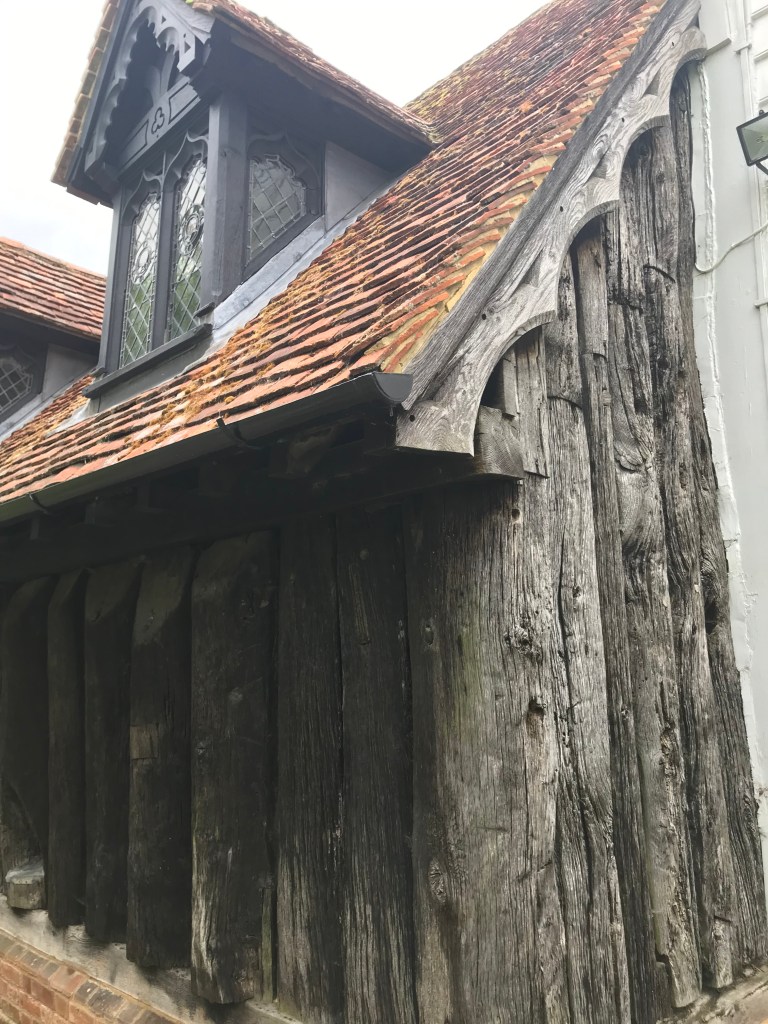
But none of those antiquarian details drew me down narrow country lanes in the remnants of Epping Forest; it was the nave that brought me here. Originally constructed of split tree trunks, each standing on end, Greensted Church is classified as a palisade church — an early version of a construction technique which evolved into the stave churches still found in Scandinavia.  Sections of these ancient walls remain in Greensted. These logs can be aged based on dendrochronology. 

Old oak log

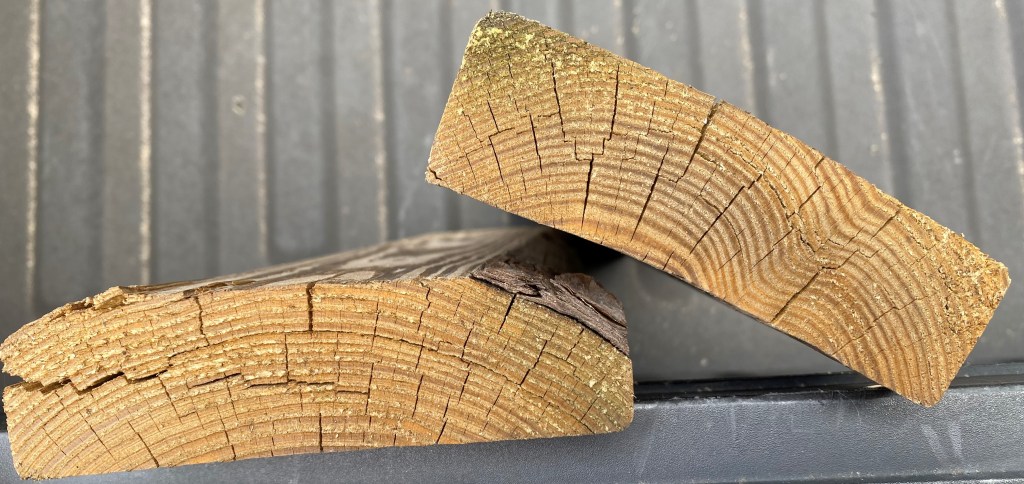
Dendrochronology? Yes, scientists love their Greek and Latin, and in Greek this technical term means “Study of Tree-Time”.  Dendrochronology is a way to determine when a log was a living tree, and this works pretty well in temperate zones with distinct growing seasons.  Trees grow new wood just beneath the bark, so the trunk gradually expands in diameter.  This growth is more rapid early in the growing season, resulting in larger cells. Later in the summer, growth slows and the new wood is denser.  Thus, each year’s growth consists of two rings – one pale, one darker.  You can count the years of a tree by ticking off the number of dark rings counted on a tree stump. Oak is especially consistent in laying on rings, but other species can be used for dating.

In years where there is favorable moisture and temperatures, trees will put on more wood and the rings will be wider.  In dry or cold years, the rings will be narrower.  And these climatic variations affect all the trees in a region.  Did a given county have a wet year in 1523, followed by several drought years?  The wood will show a wide ring, followed by several narrow ones.  In some cases, such as when a volcanic event causes planet-wide cooling, forests on several continents mark the event. 

How can this be used to determine dates?  Humans have built things out of wood for millennia.  When you have enough samples, you begin to see overlapping patterns.  Imagine a wood panel from a manor house.  It was harvested from a 180-year-old oak that was twenty years old when, say, a decade of good weather allowed it to put on wide rings.  Elsewhere in the county is a bridge plank that came from a tree already growing for a hundred years when that same weather phenomenon occurred, and then was cut almost immediately.  Noting where those ten unusually-wide rings occur on the boards will give you a good idea of when the trees were growing, and when they were cut.  In this example, if you have records showing the mansion’s paneling was installed in 1750, you can use that information to estimate when the bridge plank was cut a little after 1590. 

This is a simplified example and leaves out some of the obstacles to precise dating. You only know for certain how old the tree was when cut by looking at a complete section of heartwood and sapwood from near the base of the tree (which includes the very oldest wood).  Most sawn boards do not include the whole radius of the log, so you don’t know that the last ring you see is the last one the tree put on. Further, one can’t always be sure the wood hasn’t been reused from some other structure – the mantlepiece in my new house was originally part of a barn built in the 1850s. Still, having some of the wood is useful, and by overlapping the recognizable patterns on existing wood samples, scientists can date structures going back hundreds or thousands of years.

Rings in old pine boards. The final tree ring is beneath bark on the lower board

 Dendrochronological analysis of the old wood on the Greensted Church suggests a minimum date of 1053, with an allowance of 10-to-55 years added for sapwood that has worn away in the intervening centuries.  It may well be that the nave stood before the Norman Conquest; at any rate, the church is a contender for the title of oldest wooden church in the world, and the oldest wooden building in Europe.

Evidence points to a much older building, as is often the case on holy sites; excavations in the 1960s revealed timber structures dating to the 6th and 7th centuries — in the years when the East Saxons were newly-converted.

In a trip that saw structures both grander and far older, why spend time in an out-of-the-way little church? Because I have a historical interest in the Anglo Saxon period of Britain; I wanted to rest my hands on this timber that was likely felled and worked by Saxon craftsmen.  It was coup-counting, pure and simple.  But what historical enthusiast would not do the same, given the chance?

Additional Resources:

Dendrochronology from Historic Britain (a pdf)

Bog Oak

I’m contemplating doing some carving on bog oak.  Have you heard of it?  “Bog Oak” is a bit of a misnomer; it is likely to be oak, but could be another species such as pine or yew.  What is for sure is that it’s old, as in hundreds to several thousands of years old.

How can wood be that old?  Whether it’s a punky log in the woods or a plank that can no longer bear your weight, wood rots.  Fungi break down the structure of the wood cells to utilize the stored nutrients within.  Insects speed the process by boring through dead wood on a macro scale.  But these processes require two things: moisture and oxygen.  Take away one of these and the wood resists decay.  Wooden structures in arid or semi-arid locations can remain for hundreds of years, while those in temperate conditions collapse and crumble in a generation or so.

How can wood survive in very wet conditions?  Through a combination of factors.  The tannins in oak inhibit decay to begin with; the waterlogged wood, covered over time with earth, receives very little exposure to oxygen.  The boggy soil is generally acidic as well.  These factors all work together to inhibit fungal action (Incidentally, these same conditions are responsible for the preservation of “bog bodies”).

With time, the tannins in the wood react with iron salts and other minerals dissolved in the acidic soil and water, darkening and hardening the wood. The high mineral content makes bog oak difficult to carve; it dulls tools like no other wood I’ve worked.  The mineralization also makes the wood more resistant to burning, making bog oak an attractive material for tobacco pipes.  Bog oak is known as morta in the pipe industry.

Excavating the wood is a tricky process; most times, the wood already began to decay before being submerged or buried.  The salvageable bog wood must be stabilized and dried carefully before being milled.  As a result, bog oak is a very expensive lumber, and is most often used for small decorative objects such as pens, knife handles, or pendants (it was in demand during Victorian times for black mourning jewelry). 

Bog oak is most commonly found in Great Britain, Northern and Eastern Europe, and Russia. My source for bog oak is in Ukraine.  I won’t be ordering more wood from them for a while, because I expect they have other things to occupy them at the moment.

The Seven Sisters Oak

The southern live oak (Quercus virginiana) is a stately icon of the coastal South.  Exceptionally hard, heavy,  and difficult to work, the live oak was much used for ship in the days of tall ships;  Georgia oaks were used in the construction of the U.S.S Constitution, famously nicknamed “Old Ironsides.”  The live oak is so called because it retains its oval leaves throughout the winter.

Mighty tree

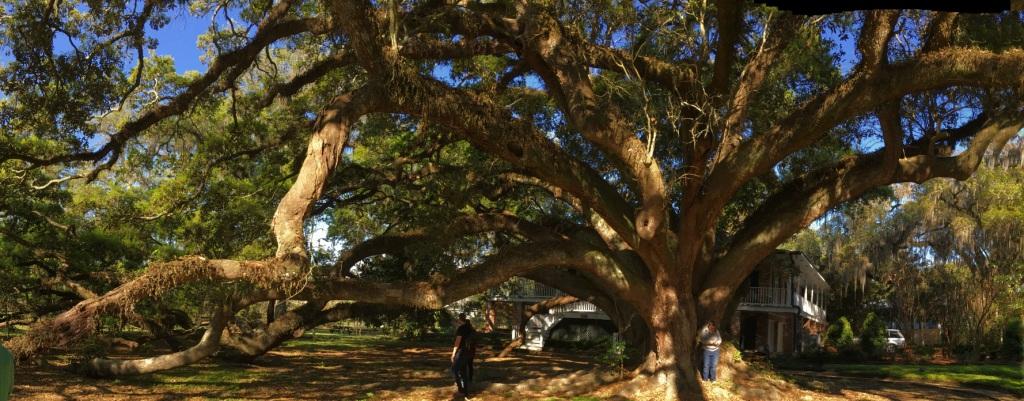
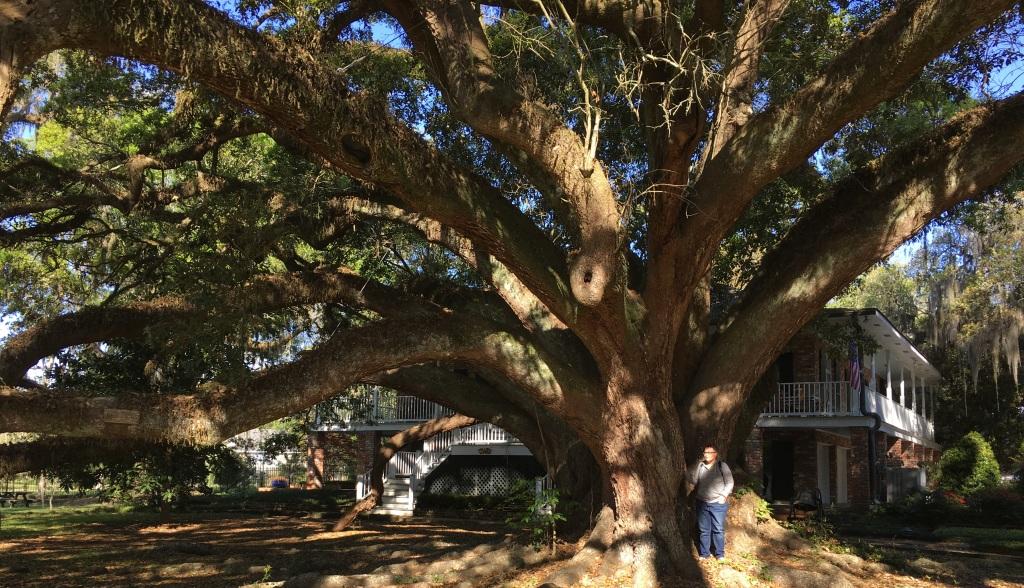
This spring I was fortunate enough to visit what is considered the largest southern live oak, named the Seven Sisters Oak.  This magnificent Louisiana tree bears seven sets of branches leading away from the center trunk and spreading to a mighty crown of 139 feet.  The limbs, each massive as the trunk a lesser oak, are decorated with Virginia creeper and resurrection ferns, and many bow gracefully to rest on the ground before rising skyward again.  The ancient trunk is just shy of 39 feet in circumference, and I expect the multiple trunks and the convoluted growth is part of the reason for the wide range in age estimates (from 300 to over 1,200 years).   I took a few photos, but the scale of such a tree really cannot be adequately captured except by standing under its canopy.

mighty tree 2The National Champion tree stands on private property near the shore of Lake Pontchartrain; the owners maintain and care for the majestic oak. I am grateful to them for their care and for allowing the public access to the tree.  I am also grateful to the generations who recognized the value of this legacy over the value of the timber or  cleared yard space.