Persistence of the Predator

If you are creeped out by snakes, you’d best move along now.

I was in the Dungeon (my basement office) when I got a text from my wife to come upstairs.  She had spied a black rat snake on the porch, eyeing the bird nest above the front door.  Rat snakes, which feed on eggs, birds, and small mammals, are common in Georgia. Now, I have nothing against these critters, since I don’t currently have chickens.  But the nest in question, owned by a pair of eastern phoebes, has occupied the transom window all season.  The nest’s proximity made me feel somewhat proprietary towards it, so I decided to intervene. Rat snakes are fairly docile, so it was easy to gather it up and deposit it in a fallowed field some 50 yards away.  The snake quickly slithered away from me towards some thickets. 

Less than half an hour later, I got another text.  A rat snake, half again as long as the first one, was climbing the handle of a post-holer and aiming to get a meal.  This one also went to the field, but immediately pointed its nose towards the house.  I halted its determined progress after 20 yards and carried  it 130 yards down the driveway and across the road. 
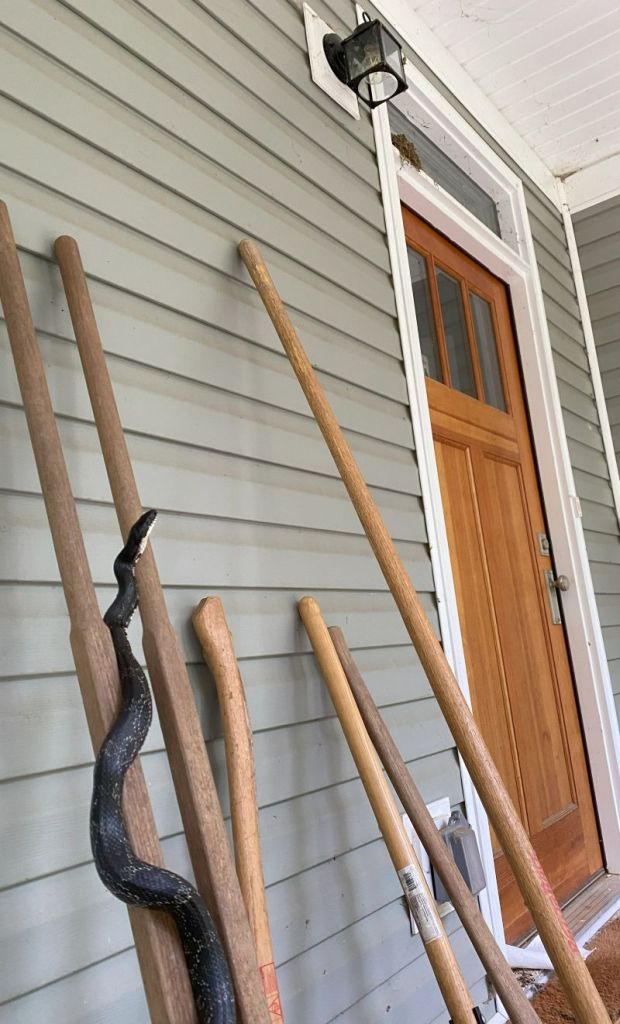
How do rat snakes find their prey?  They have a good sense of smell, although they use their tongues and an organ on the roof of their mouths (the Jacobson’s organ) rather than their nostrils. Perhaps more relevant in this case is their visual acuity and pattern recognition abilities.  Rat snakes watch the songbird activity, and home in on the hub of the birds’ flights.

An hour after exiling the snake, I got ready to head to the store.  On a hunch, I checked the front porch before leaving.  The longer snake had returned, and was just beginning her ascent on the edge of the porch.  A few minutes later, I was driving down the road, my arm out the window with a snake wrapped around it.  I let it loose 500 yards away, and hoped it would be disoriented enough that the chicks would fledge before it found its way back.

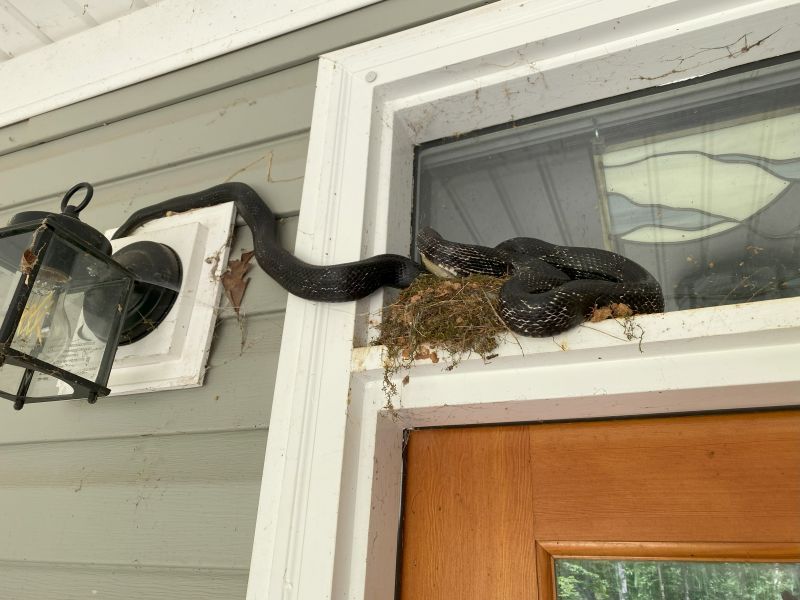
That was yesterday evening.  This morning, as I sipped coffee in the library, I eventually noticed the phoebes hopping back and forth anxiously, chipping and chirping. I was too late; one of the rat snakes was on the transom, head in the nest.  With skill and persistence, the serpent had won, and I let it have the spoils.  It fed and then slithered away.  The birds raised a clutch earlier this year, and may have time for another nesting; otherwise, they can try again next spring. 
You may be appalled at the fate of vulnerable young animals. Whether it be chicks being eaten by snakes, coyotes carrying off fawns, or bobcats snatching young rabbits, most juvenile critters live short lives.  Animals produce more young than they need to replace themselves; most die before maturity, victims of predation, disease, or misadventure. We concern ourselves with individual critters, but in the natural world, individuals don’t matter in the scheme of things – only populations.

Spider-Snake, Spider-Snake…

Can you climb a tree? 

Can you climb a tree without branches to grasp? 

Now imagine climbing a tree without the benefit of hands or feet!

I found this 5-ish foot rat snake easing up a white oak.  Notice how it bends to find any slight protrusion in the rough bark.  By pressing against many points of contact, it distributes its weight and supports itself as it inches up the trunk.  It isn’t a fast process, but snakes are patient.  Besides bark, I’ve seen snakes on brick walls as well.    

That explains the how, but what about the why?  For the same reason a snake does most things – the quest for food.  The serpent searches for nests, consuming bird eggs or young squirrels.  Snakes may also hide in trees to escape their own predators.  Wetland snakes such as cottonmouths often bask in the branches of trees, plopping back into the water when startled. 

The red-cockaded woodpecker has developed an impressive defense to deter slithery predators.  These birds make their nests in cavities they excavate in longleaf pines.  The woodpeckers smooth the rough bark on the nest trees as well as surrounding pines.  They also excavate small holes (“resin wells”) above, around, and below the nest cavity. Resin flows from these wells, forming a smooth coating on the tree truck that snakes find difficult to cross.

A Quick Visit to “The Wall”

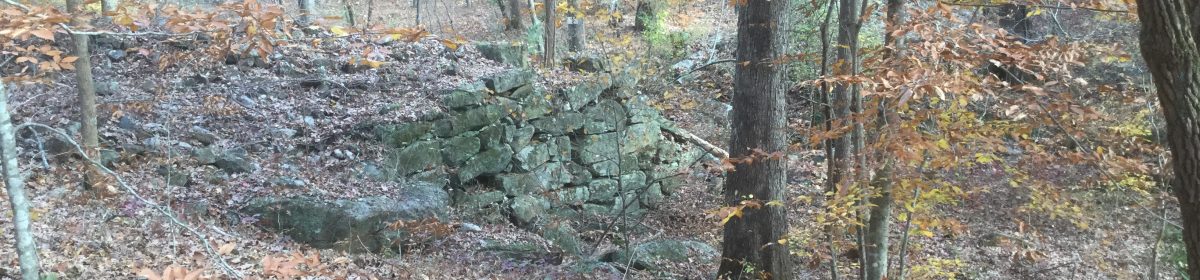
I found an excuse to make it back to my old stomping grounds for a few days last week, and carved out time for an evening walk to “The Wall”, the ruins of an old stone bridge  on which are tied many memories.   We’ve called it The Wall all my life, and for me it is the focal point of the 200-acre woodland.  It is my church, it is my touchstone, and I think of it often.

On pavement, the walk from the road to the creek would have scarcely been a 3 minute stroll, not the 15 minute creeping meander it turned out to be.  Here, enfolded by forest, I feel compelled to tread quietly, to watch my steps, to look around and listen.  So much to note:  more sourwoods here than I remembered… a neighbor’s horse left its calling card on the trail… armadillos have been rooting through the leaf litter…another old shortleaf pine has fallen victim to time… a loud snort tells me a deer has spied me before I noticed it.  As the warm May air rustles the leaves far above,  I turn off the path, stopping to brush humus and leaf litter off a small fire ring laid down 30 year ago by a smooth-faced youth with a less seasoned view of the woods; then I continue downhill to the Wall.  Loose rubble fills  the space between two massive stone walls, each wide enough to walk on. I perch on the highest end stone and silently survey the land, from where the creek rounds the bend to where it fades away behind fans of leaves.   Birdsong pierces the chuckling of the water tumbling over rocks.  Last year’s tropical storm left several trees lying across the creek, but at the moment the woods are dry enough that the resurrection ferns are curled and brown.Wall snake

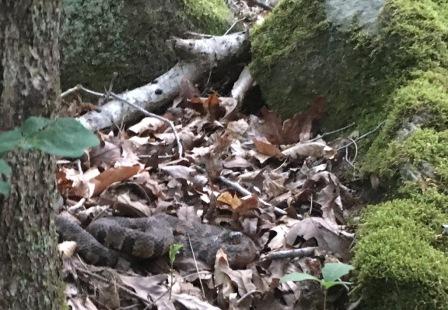
The photo of the rocks above isn’t from the normal angle I shoot the rocks because I wanted to include a bystander.  Look down near the base of the tree on the left.

nerodia 1

nerodia-2.jpg

This fellow is a northern water snake.  He stayed put from the time I saw him as I climbed down the rocks until I left the area half an hour later.  They aren’t venomous, although they’ll bite if they feel cornered and can be aggressive in defending their territory.  I’ve never seen one of these on our land before, and when I came out the next afternoon, the snake was nowhere to be found. The woods are full of life, and you will miss most of it unless you keep quiet and alert.

When you are out and about, try stopping and see what you can see, hear what you can hear.  Be still, and Nature will come to you.