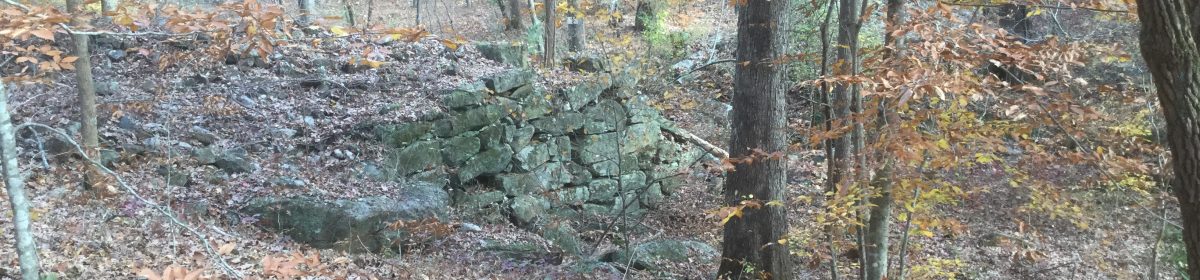
We have a tendency to take a proprietary view of things around us. “The deer down the road are a potential nuisance, but the one that feeds on the edge of my yard is okay because it’s familiar.” “That maple by the gate is familiar as an old friend.” “Stray cats are death on toast for birds, but I’ve named the one that creeps around my hedge.” “They can’t do that to our pledges, only we can do that to our pledges.” (Yes, Ma, that last one was a movie reference.)
As I mentioned a while back, the Joro spider – an Asian arachnid making itself at home in the Piedmont – fills up the woods in late summer, to the consternation of those who otherwise love the outdoors. As temperatures drop in the late autumn, the multitude of spiders drops away and their haphazard webbing disintegrates.
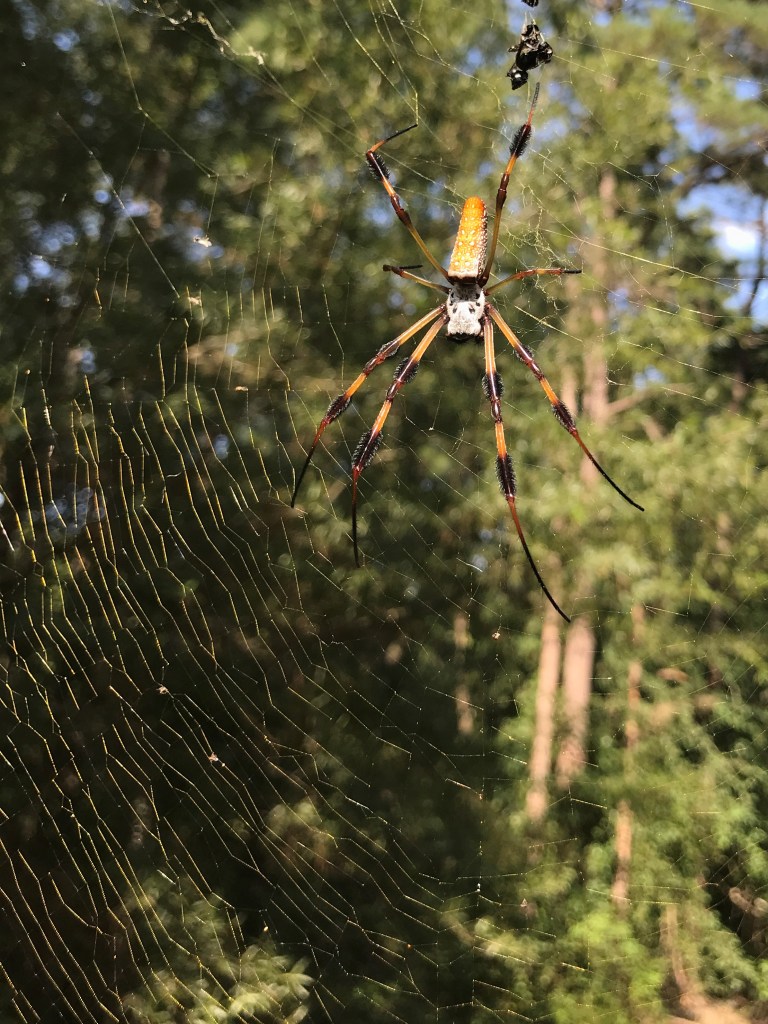
And then there was the large female residing just outside the garage. I’d see her every day, along with a few smaller Joros inhabiting that corner under the eaves. She was hanging out through the late summer and into the autumn. October…November… December… the spiders on the back porch fell away. Moths, flies, and other flying insects faded out as well. Christmas came, and the large female under the eaves remained, after cold and hunger felled all her neighbors. Was her persistence due to being the largest spider on the south-facing side of the house, protected from the worst of the winds? Regardless, at this point she’d gone from an invasive cluttering up the garage to a dogged survivor. Instead of glares, she earned appreciative glances as I walked by.
The New Year dawned with a near-freezing morning. I expected her corner to be unattended, but there she was: slowly, methodically, doggedly repairing her web with golden-tinted silk. You go, girl.
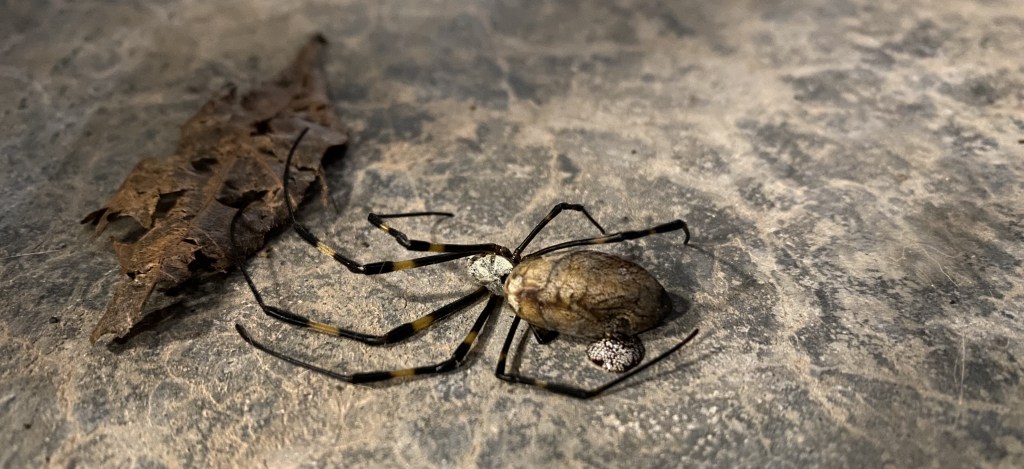
Now it’s mid-January. Atmospheric disruption at the North Pole sent a shock of subfreezing winds our way. The first morning after the hard freeze revealed a ragged, empty web. Our Joro lay on the cement floor, having finally succumbed. I wouldn’t say I had an overabundance of feeling for that critter (this was a short-lived invasive, not Charlotte), but its passing received far more attention than that of any of its brethren.
Is there a tree, a stone, an animal — any normally-anonymous thing –that you have marked with your attention? Any thing whose absence would be worthy of notice and remark? Drop a comment and let me know.

 Towards the Moon or To the Sun
You must be logged in to post a comment.