Energy Is Never Free

There was a video going around some years ago – an “exposé” on wind farms.  Besides the issue of bird kills, the video played up the relatively short lifespan of the turbines, and the fact that the blades aren’t recyclable (which isn’t entirely accurate and will be less so in the future).  It was when the program switched to touting “clean” fossil fuels that the slant became clear.  The piece must have gotten a lot of airplay on right-wing media; shortly after I had watched (and written off) the show, someone rattled off its talking points to me, finishing with “so renewable energy isn’t so renewable, is it?”

No, it isn’t.  The fact is, every source of energy has a cost.  The costs of using fossil fuels are well known.  Strip mines destroy landscapes, while underground mines destroy lungs. Burning coal leaves toxic ash and air pollution.  Oil and natural gas likewise have their problems, during extraction, processing, and burning.  But what about renewables? 

Hydroelectric?  A river valley disappears, the downstream river is diminished, fish are blockaded.

Solar?  None of my biologist colleagues have a good word for solar farms; good forest habitat or farmland becomes a giant lawn, good for nothing. I visited a landowner last week whose land is developing gullies due to runoff from the adjacent solar farm – an issue he never had when the land was a forest.  Solar panels on buildings or over parking lots are far better options, since by collecting radiant energy they keep the surfaces beneath from heating up.  Anyone living in the South can appreciate the advantages of a canopy over their car when the weather is in the sunny 90s.

Geothermal?  You have me there.  However, geothermal, solar, hydroelectric, and wind all require non-renewable resources to create the equipment necessary to harness the power, as well as the facilities and networks to transfer said power from the source to the consumer.

Biofuels?  First-generation biofuels such as ethanol need the same inputs as regular crops – fertilizers, diesel-run tractors, and such.  More advanced processes use waste materials or algae (a definite improvement) but still have environmental costs.

Does nuclear count?  The fuel is mined, the deadly waste is a pain to store, and mishaps can be catastrophic on a regional or continental scale, so I wouldn’t say so.  However, given the amount of heat generated by radioactive decay, it boils water like nobody’s business, providing cheap electricity.

And when you get down to it, most of these power sources don’t provide power in themselves.  They are simply there to move some form of wind or water to turn a contraption with magnets and wires in such a way as to create an electrical current. 

So, sure, renewable energy has downsides, just like fossil fuels.  But as mentioned in the beginning of this essay, fossil fuels poison the extractors, wildlife, land, water, and anyone who breathes.  The overwhelming body of evidence, collected and analyzed by scientists across the globe, leaves no room for doubt.  When you rationally compare the pluses and minuses to each, it becomes clear that non-renewable fossil fuels cost us much more in the long run. They are not, despite what the lobbies insist, “clean” fuels.

Everything we do has a cost.  Most of us don’t feel that cost, and therefore we are not aware of it. I’m writing this using electricity, which is how you are reading it. I am in favor of a power grid run on renewable power.  I am in favor of finding alternatives to fossil fuels.  But I believe we should understand that energy is never free, and make our choices accordingly.

The Inland Dunes on the Missouri

Last week I explored a couple of parks near Omaha, Nebraska, and thought I would take a couple of posts to talk about them.

West of the Missouri River and in the Great Plains region, you may expect unvaried topography.  Yet in Neale Woods Nature Reserve I found myself 200 feet above the nearest cornfield, on what was likely a thousand-year-old dune made of loess.

In geological terms, loess (pronounced “luss”) is material transported and deposited by aeolian (wind) action, consisting predominantly of silt-sized particles. The most familiar source of loess would be from the combination of drought and poor farming practices that became known as the Dust Bowl in the 1930s. However, the hills I stood on and the larger ridges across the river have an older and more distant origin.

The Loess Hills across the Missouri River in Iowa.

As glaciers and ice sheets expanded across the landscape during the last hundred thousand years, the accumulated weight of ice scoured earth down to bedrock, grinding away stone and carrying the powdered rock along with it.  During warmer periods, the ice retreated, with melt water transporting the “rock flour” downstream. Eventually, the silt settled into glaciofluvial mudflats. Much later, this floury dust dried, to be picked up by the wind (becoming loess) and carried aloft for hundreds or thousands of miles before coming to rest in blankets across much of the Midwest and down to the Gulf of Mexico (map).  There are other sources of loess, including dust blown in from deserts, volcanic fields, or other sites with fine particles and the wind to carry them.  The upper layers of loess in Nebraska likely come from deserts or perhaps previous loess deposits, sent windborne again as local climates fluctuated.  This deposition formed high dunes of silt and fine sand, and dates to between 1000 and 11,000 years ago.

Loess tends to have a high mineral content which, with some weathering and centuries of extraction by plant roots, creates exceptionally fertile soil.  This is one reason for the productivity of the Midwest and Great Plains. Unfortunately, loess is highly erodible by wind or water, and without a thick prairie sod to protect it, tons of fertile soil are lost on each farmed acre every year.

Notice the dark layer of organic topsoil

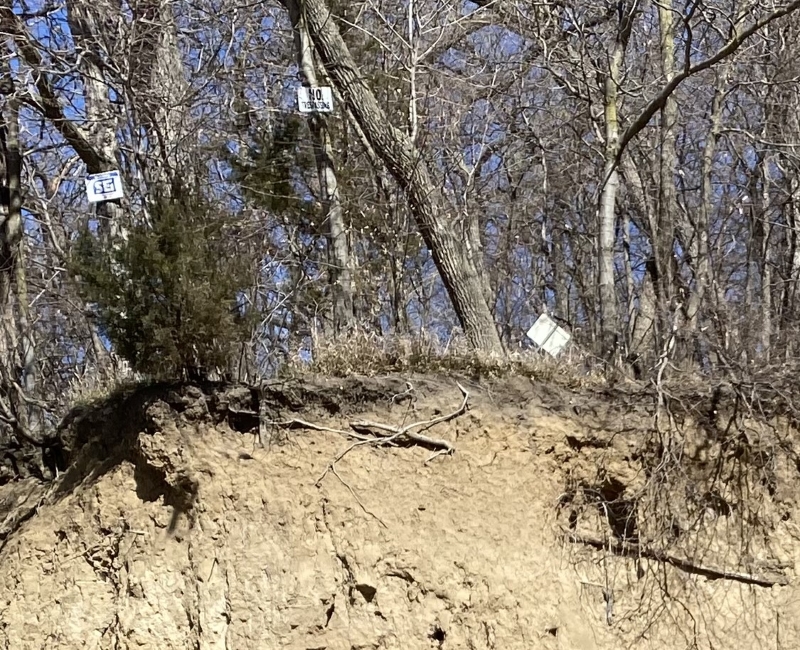
While easily eroded, loess tends to maintain vertical integrity provided there is some protection at the top.  That may explain why I came across these cliff faces.  Where Man’s desire for level roads conflicts with dune topography, the hill gets shorn.  In more sandy terrain, that 20-foot wall would have slumped all over the road in short order.

Ranging up to 200 feet, these forest-covered dunes stand long and narrow, dissected by gullies. They might have eroded down to low berms if not pinned in place by oaks and prairie grasses. Whether for the dune geology or the prairie ecology, they are worth a look if you ever get out that way.

This ridgetop is only level for about 15 yards before sloping down either side
Soil profile at Neale Woods. Note quarter for scale.

Windthrown

How is a climax forest renewed?  How does it go from dense overstory canopy to grasses, forbs, and tree seedlings?  Nowadays, the chainsaw is the chief instrument of change.  Beyond human actions, the likely sources for canopy-opening are fire (from lightning) and wind.  My corner of the Piedmont met the latter last week.

It was likely a straight-line wind barreling ahead of a thunderstorm, although a small tornado was possible. It came with freight train roar and the snap and crash of century-old trees. A morning’s survey of the damage revealed windthrows and snapped tops, in singles and groups.  A few widowmakers will merit wary observation in the weeks to come. 

Here, the red oaks were more likely to be thrown, while white oaks usually snapped.  I suspect this is in part due to the root systems – while all oaks spread lateral roots beyond their canopy driplines, white oaks delve deeper into the soil, chasing water and anchoring themselves more firmly that their red kin.

Below is the most impressive root ball I found today.  Look closely on the right side.  That two-tone walking stick with the black cap on top is five feet tall.  Using that for scale, the web of roots hold a block of soil over 20 feet wide!  It’s clear that the roots extended 10 or 15 feet beyond that.

The windthrows give us an opportunity to look at the soil profile.  The leaf litter and decayed organic material mixes with mineral soil to create a rather thin topsoil layer; here, litter and topsoil measure around four inches. Below that is the clay-rich loam common to this area – stripped of rich topsoil by a century or two of poor land management.  After decades of rest, this spot has recovered a scant few inches of organic soil.

The logs will do their part, as insects and fungi convert wood to soil.  However, the falling giants create a more immediate change.  The new gaps in the canopy break the sunlight blockade which the dominant trees impose upon everything below them.  Unbroken canopy is not a hospitable place for shade-intolerant plants; apart from the hardy muscadines, there is little green to be found on our forest floor. Yearly, pine seedlings rise and die in short order, starved of the sun’s energy.  Even oak, hickory, and beech seedlings struggle to subsist on whatever only dappled or filtered light reaches them.  These hardwoods may spend many years in a shrubby state, if they don’t succumb to solar neglect.  But things change when a gap opens in the canopy.  Sun-fed trees get a sudden boost of energy and growth, reaching towards the sky. 

Where there is a gap vacated by two or three trees,  and a dozen or more seedlings pushing through the leaf litter, there will eventually be competition for that space.  Assuming no more disturbances, a decade or so will find the trees trying to outgrow each other – overtopping their neighbors and claiming the underground real estate until the victorious few take their place in the canopy.

I won’t be here to see the outcome, but I’m betting on the oak. Regardless, so long as people leave this forest alone, the gradual renewal of the climax forest will continue on every acre.