The Richest Man in the World

I met Dr. Walter Cook over three decades ago.  In his Forest Engineering course, I learned how to (among other things) properly lay out a trail in the woods; in Forest Recreation, he taught me why these trails were important.  He was an important mentor for my Eagle project, which involved constructing a stretch of trail at Sandy Creek Park in Athens.

I reconnected with my professor at his 90th birthday celebration.  Fittingly, it was in a park pavilion.   During the gathering, nature-lovers lauded his tireless work in developing, coordinating, and building trails and paths on over 130 projects across both private and public lands.

Last week, I went to lunch with Dr. Cook to catch up.  He has read this blog, and agreed to share some of his thoughts here.  This is the first of his essays which I post with his permission.

The Richest Man in the World

By Dr. Walter Cook

Who among us has not occasionally wished to be rich?  As Tevye sang in Fiddler on the Roof, “If I were a Rich Man…” he would no longer have to work.  Some people have other reasons for wanting to be rich – to have a big car (or maybe two), to have a big house (or maybe two), to travel the world, to send their children to the best university, or merely not to worry about their monthly bills.  Many times in the literature of myth, characters who have unlimited riches are depicted as having large chests overflowing with jewels, surrounded by the utmost beauty of colorful paintings, with everything touched by gold.

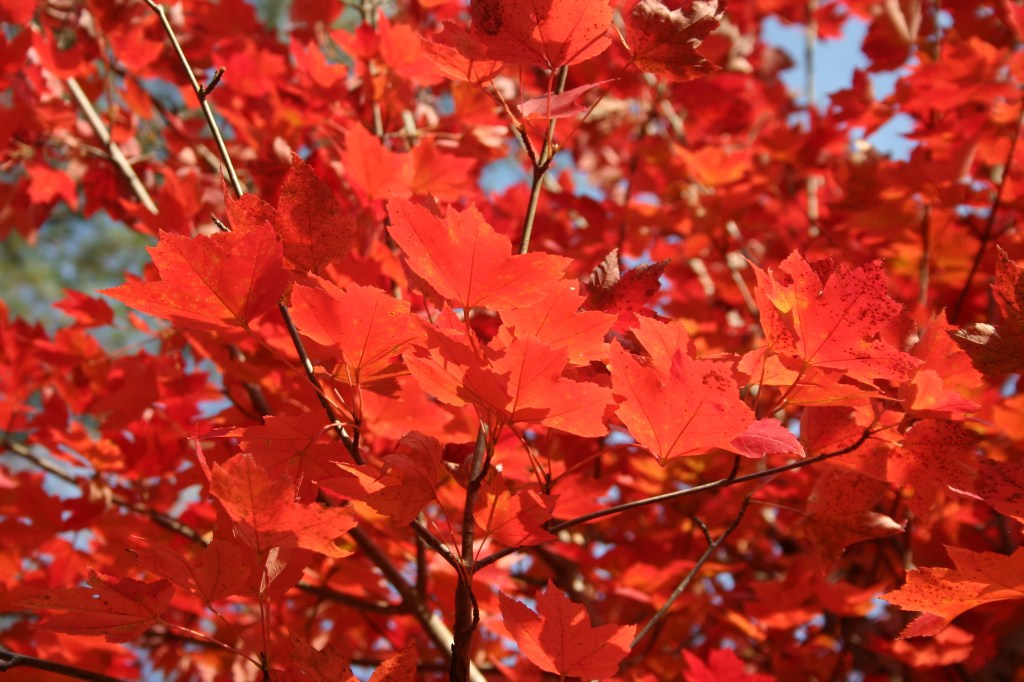
On a fall day several years ago, I discovered that I, too, was rich – not in the sense of Tevye’s longings, not in the sense of a carefree life, but rich in the sense of a mythical king.  As I was walking down the Middle Oconee River (near my hometown of Athens, Georgia) I enjoyed the many colorful red and sugar maples, dogwoods, blackgums, and poison ivy along the river’s levee.  Many leaves had fallen, and I recalled that when I was a young boy, I would gather a half dozen of the prettiest leaves as I walked home from school to bring home to share their beauty with my mother.  But as I looked at the leaves lying ankle-deep on the ground, I realized it would be impossible to choose the six best leaves – there were so many!  How could anyone make such a choice.  They were like jewels, even better than jewels, for no jewel could match the dazzling spectrum of colors in even one leaf, much less all the leaves.  And, as I looked up at the trees that had produced these super jewels, they were like paintings, only far surpassing any human-made work of art.
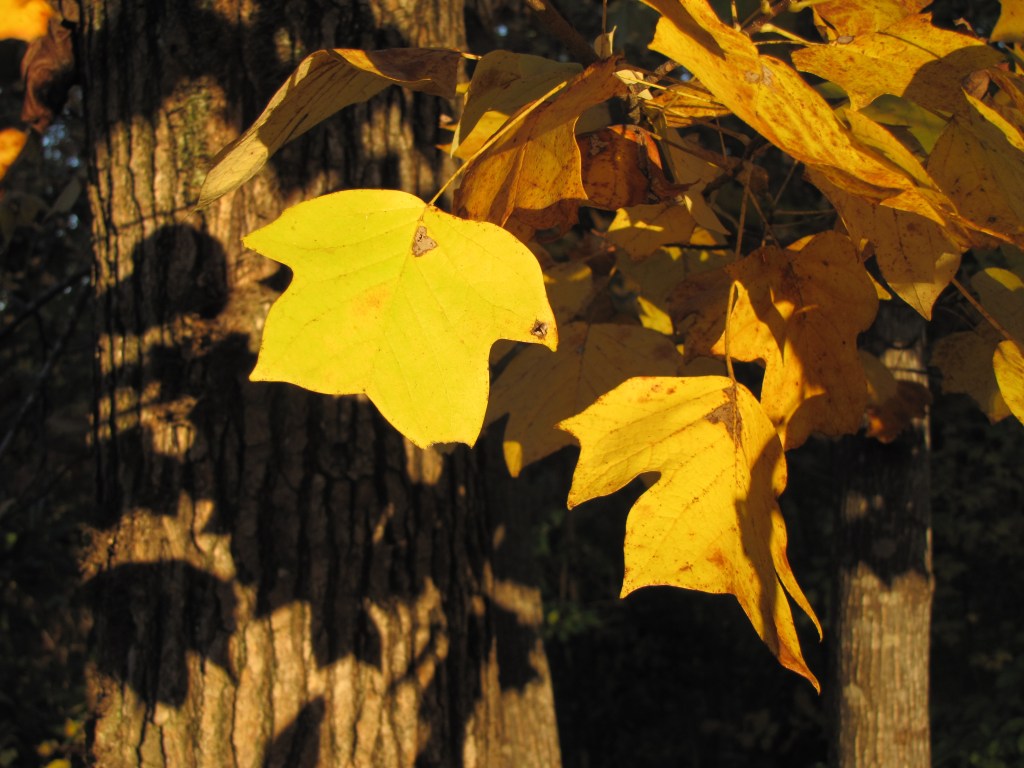
So, there I was, ankle-deep in the world’s most beautiful jewels, surrounded by superb works of art, and all the while being entertained by the music of songbirds.  What more could one possibly wish for?  I was a rich man, and I didn’t even have to work for it.  Tevye would have liked that.

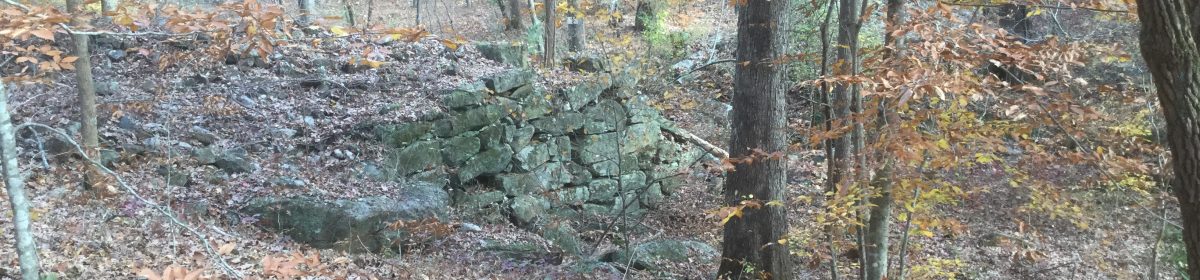
[Since that long ago day in 1993, I have walked in a lot of forests, along many riverbanks, and in other interesting environments.  In the past few years, I have enjoyed exploring the back country while flagging new trails in the Jocassee Gorges in South Carolina.  Compared with the quiet beauty of the Oconee River in Georgia, the scenery in Jocassee is simply spectacular. The tremendous cliffs (not all cliffs are in state parks!), the numerous waterfalls, the natural gardens of wildflowers, and the views of endless mountains rolling to infinity, all certainly qualify as beautiful.]

But don’t be fooled!!  The nice thing about nature is you don’t have to wait until fall or go to a special place to enjoy its beauty. Nature is, almost by definition, beautiful.  We rightly enjoy the special shows of fall colors, spring and summer flowers, winter ice and snow, and the beautiful landscape of the Southern Appalachians.  But even without these spectaculars, nature – the undisturbed environment – is beautiful.  All we need to enjoy it is to open our minds to its presence.  Then we can all be as rich as a mythical king.
Article on Cook and Trails

Falling Acorns

Although summer has continued its fierce rearguard action well past a reasonable concession date, autumn is here.  True to the colloquial name, “fall”, the trees are divesting themselves. But I’m not talking about leaves; there is still a lot of green in the trees at the moment.  I’m looking at acorns, specifically white oak acorns.

The white oak (Quercus alba) is an all-around excellent tree.  Large, long-lived, and handsome, much can be said about this species and its lumber (including being crucial for bourbon barrels and earning USS Constitution its “Old Ironsides” nickname).  But on this October day I want to talk about the nut of the oak. 

White oaks are the flagship of a cluster of species known as the white oak group (which include English oak, burr oak, post oak, overcup oak, and scores of others), as opposed to the red oak group (locally represented by the southern red oak, northern red oak, water oak, pin oak, and others). White oaks produce acorns on a one-year cycle – that is, spring blooms will develop into acorns in the early autumn, while red oaks take two years to produce.  Red oak acorns tend to drop later in the season, and are much more bitter due to the higher tannin content.  On the plus side, red oak acorns will be available to deer during the hungry months before green-up, while white oak acorns germinate soon after hitting the forest floor.

White oak acorns have been falling in prodigious quantities for a couple of weeks now.  The tree which stands closer to the house than the deer like to venture has carpeted the ground with the leathery brown nuts. This is definitely a good mast year (“mast” is the collective term for nuts, berries and seeds from trees that are eaten by wildlife) for white oaks.  You see, oak mast production is hit-and-miss; several years may go by before there is a bumper acorn crop for a given locale and species.  Acorns are sought after by a great many birds and mammals, so on an average year few if any acorns will actually make it to germination.  Periodically, a super-abundant crop of acorns will flood the market as it were, providing more nuts than wildlife can consume or stockpile, and increasing the chance that a tree’s attempt at reproducing will be successful.  Naturally, the extra food is welcomed by turkeys, deer, squirrels, jays, and other hungry critters.  It’s good for wildlife when there are several oak species in the local forest – if the northern red oak is a bust this fall, perhaps the scarlet oak will be a boom. 

This is a good year for the critters to fatten up on white oak acorns.  We’ll soon see if the red oaks will call, raise, or fold.

The Cusp of Fall

Though I work in the outdoors at all times of the year, autumn is my favorite season; summer is my least.  After a week of mornings with doors open and air conditioning off, I believe we are at the turning of the temperature tide. Although the heat index briefly rallied a final time, the sun is in full retreat southward.

That’s not to say that summer is altogether evil!  As a season, it has much to offer.  But, having lived most of my adult life in the outdoor sauna that is southern Georgia, northern Florida, and Louisiana, I can be forgiven for thinking that one of autumn’s virtues is in succeeding summer, just as spring’s chief fault is in giving way to it.

I post this on the Autumnal Equinox, the official start of fall.  Having now gained elevation and latitude since the last time I discussed this date, I am pleased to be in a place where “First Day of Autumn” may mean something more than just a promise on a calendar.

In a week or two, leaves will begin to turn.  The air will grow crisp.  Old bucks will overindulge on hormones, losing their wits and their guile.  Some creatures will go to earth, others will take to the sky.  And I will quietly immerse myself in the season, and hope to use well the restless energy that always rises as the leaves fall.

When autumn came, he knew that part at least of his heart would think more kindly of journeying, as it always did at that season. – J.R.R. Tolkien, The Fellowship of the Ring