The Fall and Rise of the Whitetail

A couple of months ago, I attended a prescribed fire conference at the National Infantry Museum in Fort Moore, just outside of Columbus, Georgia.  After finishing the official part of the meeting, we were allowed to wander through some of the exhibits.  Among the relics was a recruiting poster from the 1920s – back when the post was known as Camp Benning.  The spiel suggests an easy life, good weather, new barracks (“nearly completed”) and “Great fishing and hunting”.  But what caught my eye was the list of game species: raccoon, opossum, fox, rabbit, and squirrel.  One conspicuous omission: white-tailed deer.  Why wouldn’t they advertise a game animal that is so plentiful today?

Deer were plentiful all across the Southeast when the first Europeans arrived.  As the colonies established and spread, hunting for food and for trade items (deerskin was a premium leather for exportation to Europe) decimated the population.  In the 19th century, the growing cities demanded meat of all kinds, and market hunters were happy to add venison to the menu. The loss of forests to logging and agricultural expansion made the problem that much worse. Laws to protect deer, such as a hunting season enacted in 1840, were largely ineffectual.   By the first decade of the 20th century, fewer than a third of the counties in Georgia claimed to have any deer left.  I presume Muscogee and Chattahoochee counties, where Camp Benning stood, were not among the fortunate third. 

The return of whitetails to Georgia comes down to three things.  First, the reforesting of Georgia: in many places, old fields were abandoned, and old cutovers regrew. Governments acquired land for wildlife protection, especially after the Pittman-Robertson Act in 1937. 

The second factor was the restocking effort.  A U.S. Forest Service ranger named Arthur Woody began the process by himself with half a dozen deer released in the mountains in the late 1920s. Federal funds in the ‘30s allowed for a more systematic approach. For some six decades, deer were brought in from a number of other states (including Texas, Wisconsin, Kentucky, and Maryland), and coastal islands of Georgia to be released around the state.     

The third factor in the recovery was protection.  More regulation, coupled with more rigorous enforcement and public education, allowed the deer herd to expand.  Once the state reopened a hunting season, scientific monitoring allowed biologists to assess and adjust management of the deer population.

When I was a child in the early 1970s, seeing a deer was a pretty big deal.  Coming home this evening, I saw half a dozen does feeding on the shoulder of the road. This season I’ve put four deer in the freezer.  We now have a million, give or take, white-tailed deer in Georgia, and the most liberal harvest opportunities of my life.

I heard tell they can even hunt deer on Fort Moore.

Additional Resources:

Deer Restocking Program in Georgia: 1928-1974

Deer’s Spring Break

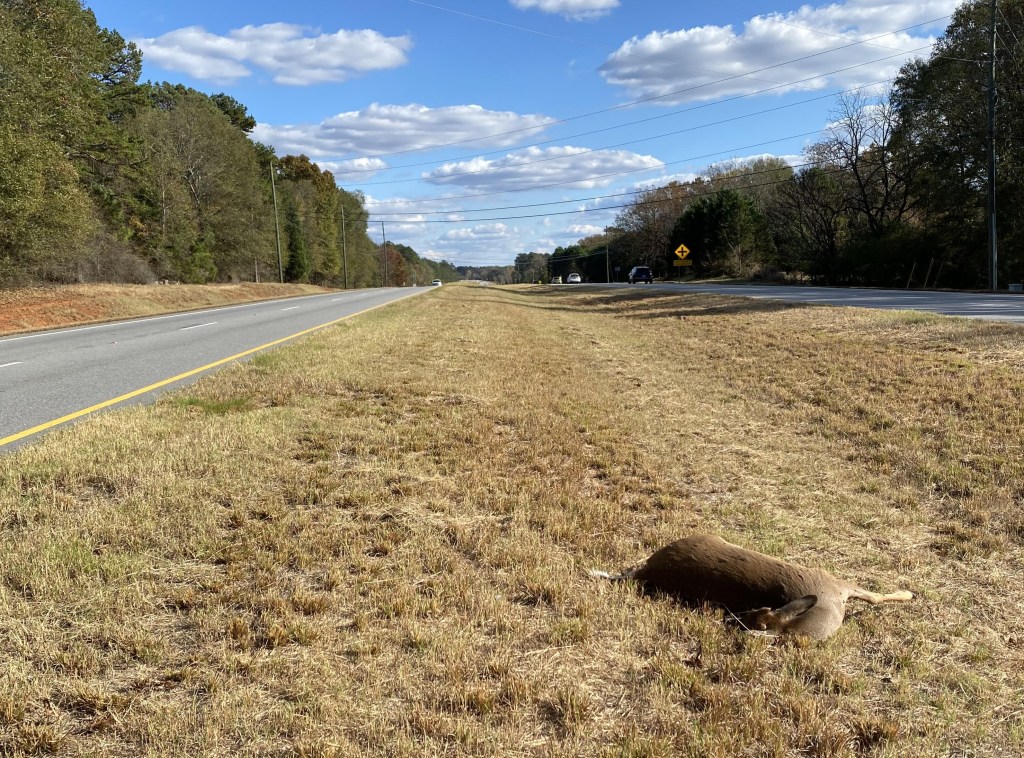
Have you ever hit a deer?  Depending on the circumstances, the results can range from inconvenient to catastrophic for the driver — and usually worse for the animal. 

For most of the summer, I’ve seen does and fawns serenely nibbling greenery on the wide road shoulders and ignoring passing vehicles.  These aren’t the critters to worry about; rather, it is the travelers – those deer with somewhere to be, that aren’t paying attention to where they’re going, that are panicked by the searing bright headlights and the roar of engines – that are imperiled when crossing the asphalt.  And while victims of these vehicle-animal intersections are common enough on the sides of highways and back roads, the frequency peaks in the autumn. Why is that?  More reckless driving?  The time change?  Young deer club initiation ritual?  Actually, the reason is most likely hormonal.

I’m near a university town, so let’s look at a familiar example. Take some individually-(reasonably)-responsible college kids and put them together in the noisy, alcohol-soaked hormonal haze that is beachfront Florida during spring break. Imagine all the delights the still-developing frontal lobes are tempted with, unchecked by wiser authority figures. Imagine the skyrocketing level of YOLO stupidity that propagates like a runaway nuclear reaction. Now imagine you are a 200-pound male deer whose entire decision-making process has been reduced to the choices of “chase the girls” and “fight the boys.”

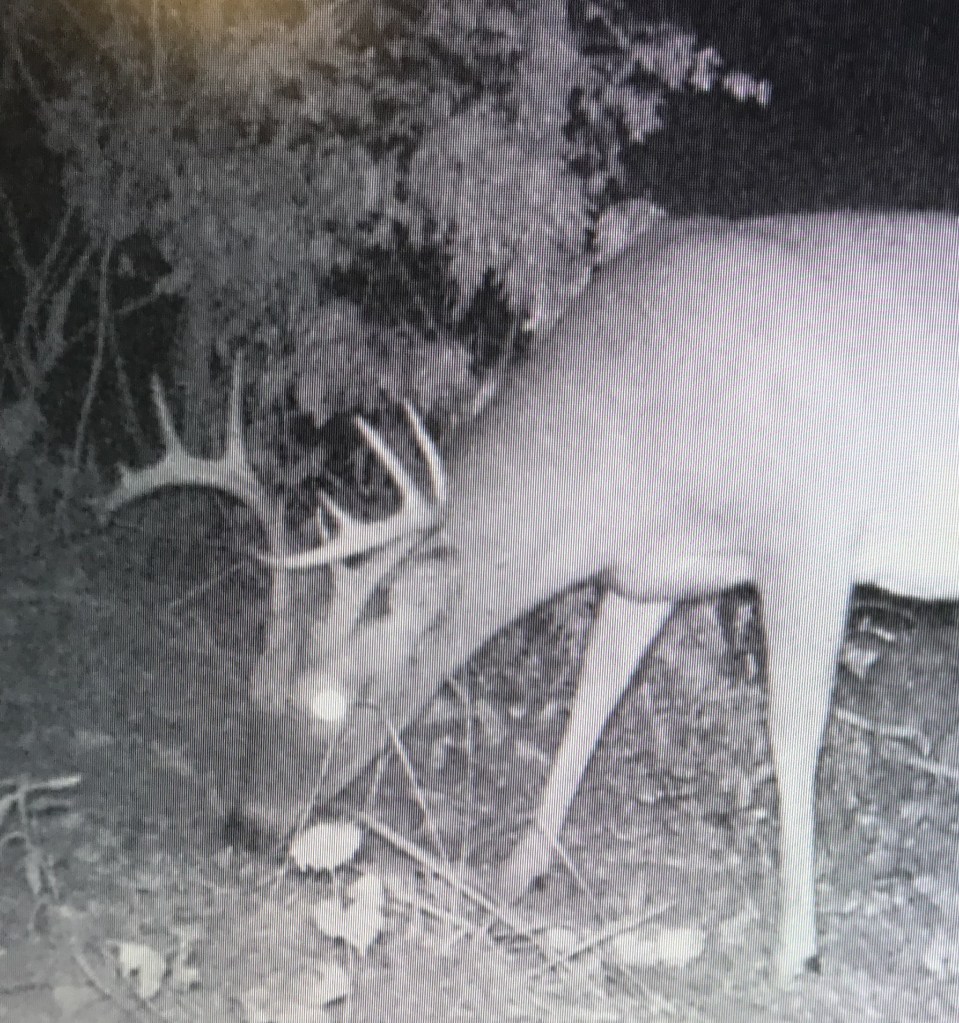
Yes, Fall is the white-tailed deer’s spring break, and normal impulses (like looking for food and watching for danger) are offline. Canny bucks that normally sneak like ghosts through dense underbrush are now barreling across roads. The does you normally see serenely nibbling on the roadsides are likewise dashing over pavement. As a result, unfortunate deer-car interactions spike at this time of year.

The peak of the breeding season coincides with the peak of collisions. If you live in Georgia, you can look to the rut map, based on a UGA study of deer/car collisions, to see when the danger is highest in your county.  As the rut fades away, bucks will return to their gray-ghost sneakiness, and does will have fewer reasons to run headlong into roadways.

Always be mindful of deer, but extra vigilance is required during the deer’s spring break.

Falling Acorns

Although summer has continued its fierce rearguard action well past a reasonable concession date, autumn is here.  True to the colloquial name, “fall”, the trees are divesting themselves. But I’m not talking about leaves; there is still a lot of green in the trees at the moment.  I’m looking at acorns, specifically white oak acorns.

The white oak (Quercus alba) is an all-around excellent tree.  Large, long-lived, and handsome, much can be said about this species and its lumber (including being crucial for bourbon barrels and earning USS Constitution its “Old Ironsides” nickname).  But on this October day I want to talk about the nut of the oak. 

White oaks are the flagship of a cluster of species known as the white oak group (which include English oak, burr oak, post oak, overcup oak, and scores of others), as opposed to the red oak group (locally represented by the southern red oak, northern red oak, water oak, pin oak, and others). White oaks produce acorns on a one-year cycle – that is, spring blooms will develop into acorns in the early autumn, while red oaks take two years to produce.  Red oak acorns tend to drop later in the season, and are much more bitter due to the higher tannin content.  On the plus side, red oak acorns will be available to deer during the hungry months before green-up, while white oak acorns germinate soon after hitting the forest floor.

White oak acorns have been falling in prodigious quantities for a couple of weeks now.  The tree which stands closer to the house than the deer like to venture has carpeted the ground with the leathery brown nuts. This is definitely a good mast year (“mast” is the collective term for nuts, berries and seeds from trees that are eaten by wildlife) for white oaks.  You see, oak mast production is hit-and-miss; several years may go by before there is a bumper acorn crop for a given locale and species.  Acorns are sought after by a great many birds and mammals, so on an average year few if any acorns will actually make it to germination.  Periodically, a super-abundant crop of acorns will flood the market as it were, providing more nuts than wildlife can consume or stockpile, and increasing the chance that a tree’s attempt at reproducing will be successful.  Naturally, the extra food is welcomed by turkeys, deer, squirrels, jays, and other hungry critters.  It’s good for wildlife when there are several oak species in the local forest – if the northern red oak is a bust this fall, perhaps the scarlet oak will be a boom. 

This is a good year for the critters to fatten up on white oak acorns.  We’ll soon see if the red oaks will call, raise, or fold.

The Bone Eaters

“You can’t eat the antlers.” It’s a way of saying to hunters that obsess over taking the buck with the largest rack that a doe will probably be tastier, and certainly more worthwhile to the meat hunter.  But while the phrase is true for you and me, there are exceptions.

Bucks shed their antlers every winter and start growing a new set the following spring.  With well over half a million male white-tailed deer in Georgia, there are bound to be considerable numbers of shed antlers on the ground by spring green-up. Those that escape shed hunters threaten to pop the tires of tractors and ATVs.  Year after year, more pairs of antlers hit the ground.  So why aren’t fields and forests carpeted by pointy bone caltrops? Critters, that’s why. 

Like all bones, antlers contain a lot of calcium, phosphorus, and other minerals – which are scarce or lacking in the local vegetation.  Ingested bits of bone are like mineral supplements, providing raw materials to build bone and muscle.

Squirrels, mice, and other rodents are some of the big culprits at bone eating.  This makes sense when you consider that the teeth of rodents and lagomorphs (rabbits and hares) never stop growing.  Gnawing hard bone wears down teeth, which if left to grow too long cause serious health issues.  At the same time, ingesting the powdered antler provides the rodents with the minerals for rebuilding the teeth!

Grooves from rodent incisors

Non-rodents can join in; coyotes, raccoons, and even deer have been seen chewing on antlers and other bones.  As most adult mammals don’t have regenerating teeth, this practice is not as beneficial for the fox as for the squirrel.

Bone-gnawing is not reserved for antlers.  Each animal that dies above ground leaves bones that will likely be chewed on before the remains weather away.

Nibbled-on raccoon skull

The next time you find a bone in the woods, take a moment; look to see if some forest creature has snacked on them. You’re looking at natural recycling made manifest.

Weathered antler, missed by osteophages

Madstones

Have you ever heard of a Madstone? It’s a bit of old deer lore I was reminded of recently. 

Madstones, also called bezoars, beazlestones, or enteroliths, form in much the same way as pearls in shellfish (due to their rarity, some deer experts consider them even more valuable).  A foreign body, such as a coin, hairball, or even a clump of dirt, remains in the stomach rather than passing through the intestines.  Over time, mineral salts (particularly phosphates) and food particles coat the object.

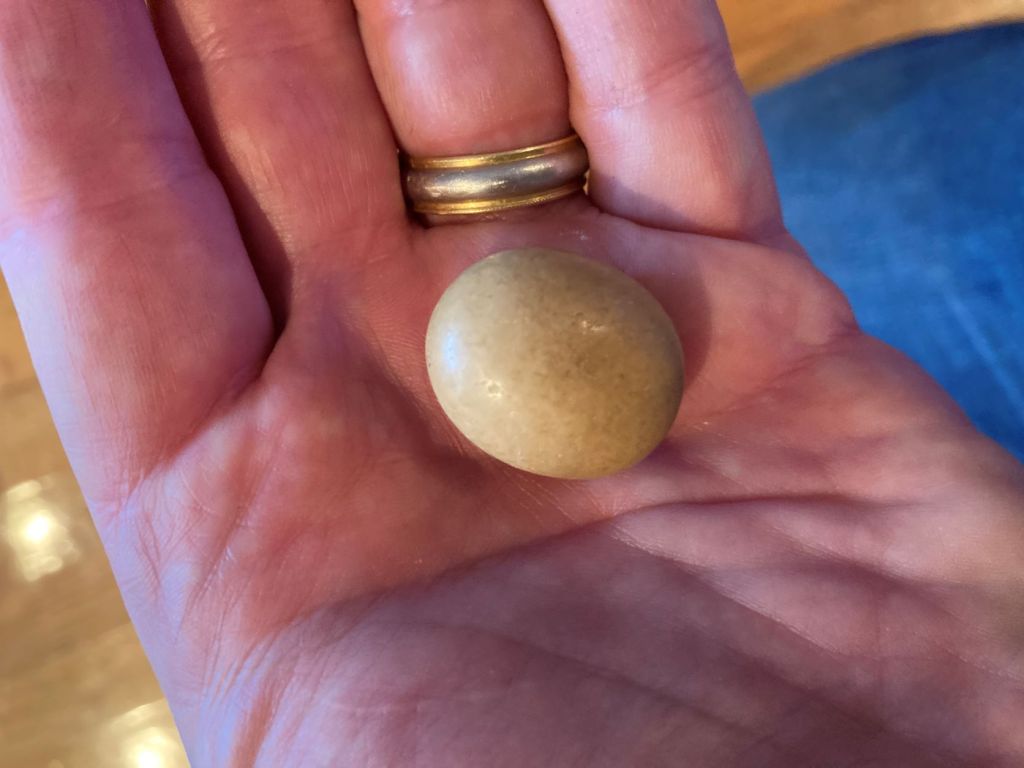
Madstone from my Dad’s collection

Bezoars come in several different types.  The madstone-type is usually smooth and rounded like a river pebble.  Hairballs coated with minerals are called trichobezoars, and may be either soft and stringy or hard and urchin-like.  Balls of plant fibers form phytobezoars, and may be either smooth or knotty and rough.  A combination of hair and plant fiber may form phytotrichobezoars, which are often soft and velvety.  Size-wise, bezoars can run from smaller than a pea to nearly twenty pounds.  Bezoars are often found in the stomachs or throats of horses, occasionally found in ruminants such as deer, cattle, or goats, and rarely seen in cats, dogs, and even humans.  They don’t present a danger to the animals unless the bezoar blocks the intestine.

Magical power has long been ascribed to these stones.  During the Middle Ages, for example, bezoars were thought to cure epilepsy in children, break fevers, prevent plague, cure rabies, and neutralize any poison from snakebite to arsenic (the word bezoar is derived from the Persian word padzahr, which means “expelling poison”).  Even in modern times, some people collect the stones for their reputed curative powers or for just plain good luck.

Beazlestones are also found in deerhunter’s lore.  Some local traditions say that white or piebald deer carry the stones in their throats, others say that any deer can have them.  According to the folktales, a wounded deer coughs up its madstone, bringing good fortune to the hunter that finds the pebble.  More likely, the stone is found in the rumen when the deer being dressed. In these times when most deer go through a commercial processor, I expect many madstones are never recovered. 

Finding a madstone is a bit of luck in itself. Whether or not they bring good luck is a question I leave to you.