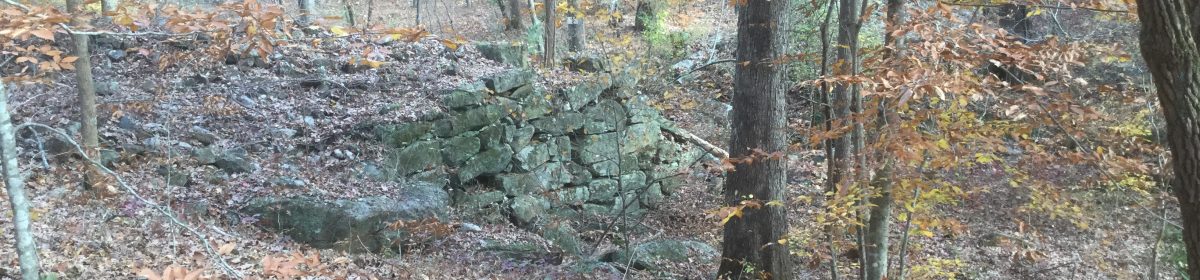
Another year has cycled through, and the canopy of colorful leaves around my house is now a carpet in different shades of brown. From the mighty white oaks to the humble dogwoods, all sport naked limbs, awaiting the return of spring to unfurl new green leaves.

But one tree stands out in the forest. The American Beech (Fagus grandifolia) holds on to its withered tan leaves throughout the dormant season. This quality of holding on to dead leaves after other plants have shed them is called “marcescence”. Studies suggest marcescence is a strategy for deterring deer and other herbivores from browsing on the more nutritious twigs and buds, or perhaps for improving the tree’s nutrient uptake by delaying leaf decomposition until spring.
The beech is one of the most shade tolerant of trees, allowing it to spend decades holding its own beneath the forest canopy until a fallen tree gives it an opening to grow into the light. The beech prefers moderately moist conditions, and its thin bark provides scant protection against fire. In open woodlands of the precolonial Piedmont, oaks dominated, while beeches withdrew to the more sheltered bottomlands. With fire removed from hardwood forests, beeches, maples, and other thin-barked trees advanced into the uplands as forest canopies closed. They are firmly part of the climax forest community.
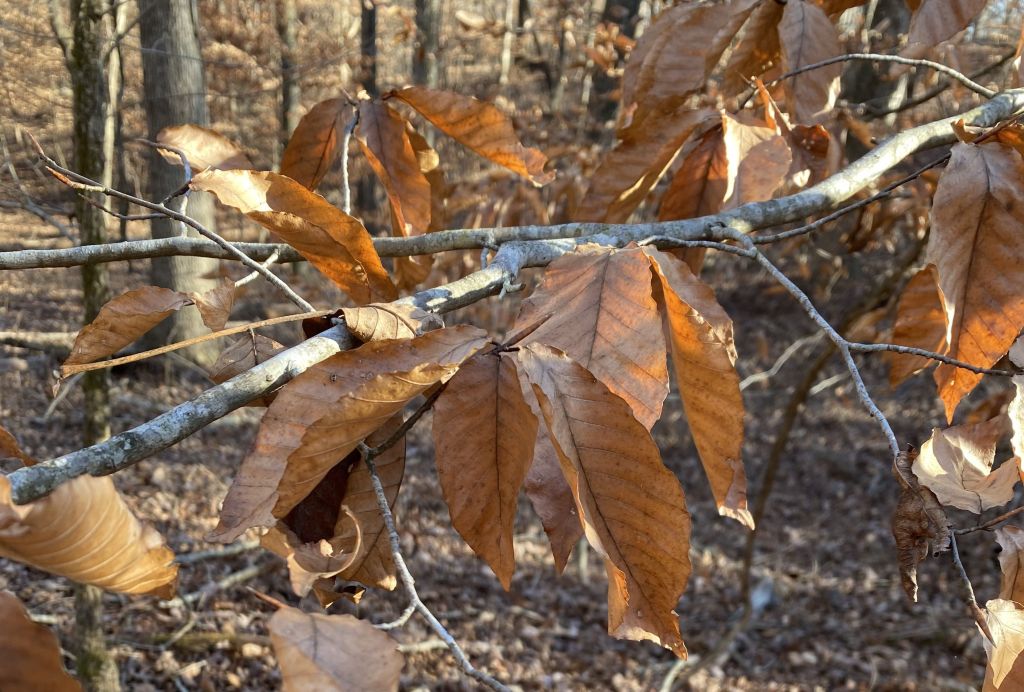
Beechnuts are a much-sought-after food for birds and mammals, from blue jays to black bears. It was a primary fall food source for the long-vanished passenger pigeon. Humans make vegetable oil from beechnuts, or roast them to eat or to make a caffeine-free coffee substitute. Unfortunately, a seedling will grow for several decades before putting on the first beechnuts, and thereafter produce at intervals ranging from two to eight years. Beeches can live for 400 years, assuming they aren’t cut for lumber or high-quality firewood, or succumb to one of several introduced disease-causing pests.
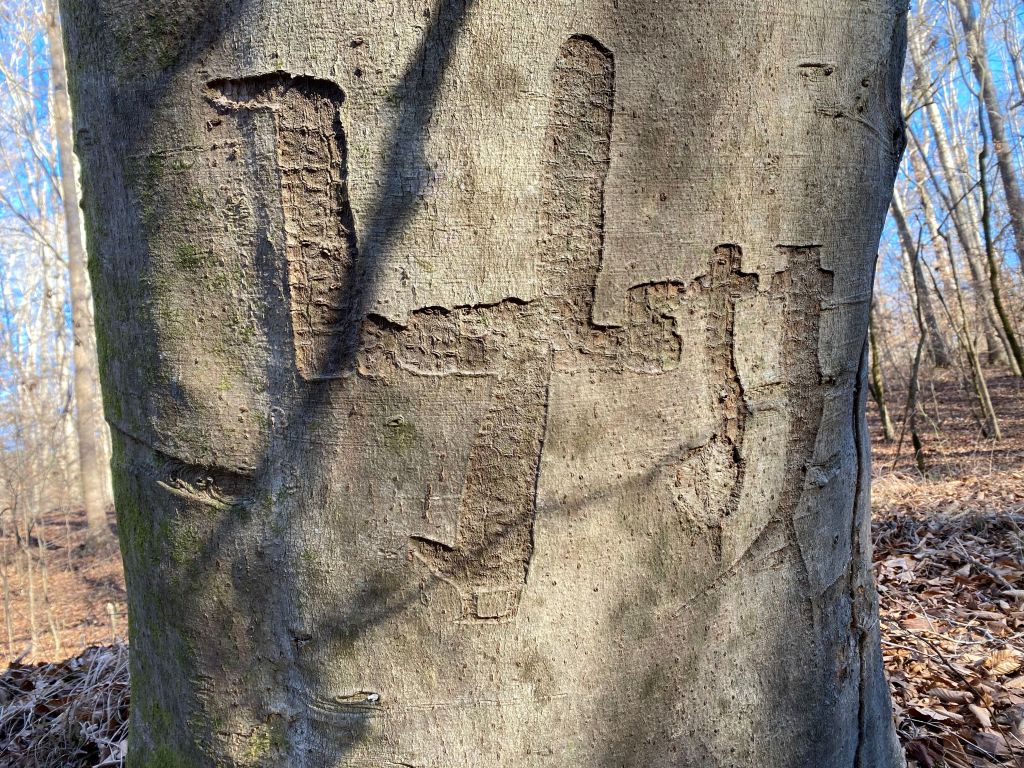
The bark of the beech is relatively smooth and pale gray, making it a tempting canvas on which folks may carve their initials, dates, or other sentiments. I don’t recommend the practice — cutting the bark allows pathogens to attack the tree, and it’s rude to future visitors — but don’t be surprised to see the declarations of love, territory or simple presence written across a trunk. Yesterday, I walked downstream a short way to a beech tree I remember from my youth; decades ago, a local with the surname Inglett took knife to bark, staking his claim on that patch of woods. I don’t know how long ago this bit of vandalism occurred, but the scars were old when I was a kid, and they have stretched to near illegibility since then.
When you pass through the woods this winter, Keep an eye out for marcescent leaves of beeches.


 Towards the Moon or To the Sun
You must be logged in to post a comment.