
If you are creeped out by snakes, you’d best move along now.
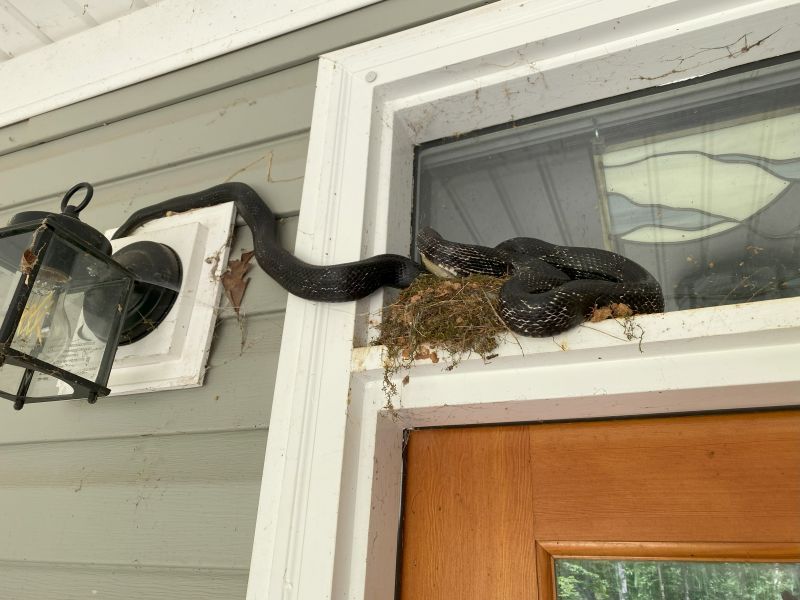
I was in the Dungeon (my basement office) when I got a text from my wife to come upstairs. She had spied a black rat snake on the porch, eyeing the bird nest above the front door. Rat snakes, which feed on eggs, birds, and small mammals, are common in Georgia. Now, I have nothing against these critters, since I don’t currently have chickens. But the nest in question, owned by a pair of eastern phoebes, has occupied the transom window all season. The nest’s proximity made me feel somewhat proprietary towards it, so I decided to intervene. Rat snakes are fairly docile, so it was easy to gather it up and deposit it in a fallowed field some 50 yards away. The snake quickly slithered away from me towards some thickets.

Less than half an hour later, I got another text. A rat snake, half again as long as the first one, was climbing the handle of a post-holer and aiming to get a meal. This one also went to the field, but immediately pointed its nose towards the house. I halted its determined progress after 20 yards and carried it 130 yards down the driveway and across the road.
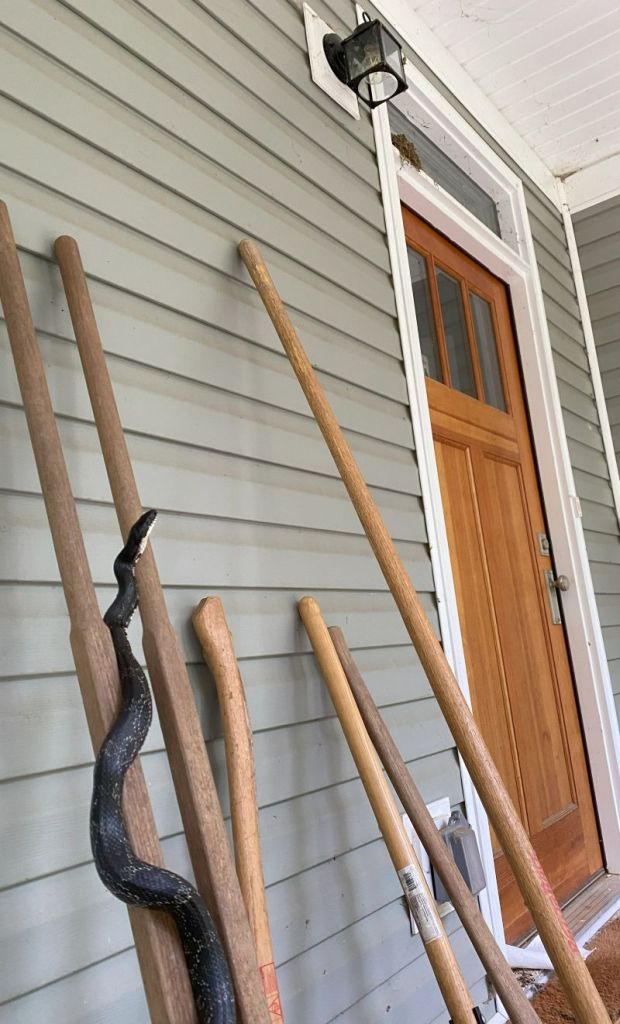
How do rat snakes find their prey? They have a good sense of smell, although they use their tongues and an organ on the roof of their mouths (the Jacobson’s organ) rather than their nostrils. Perhaps more relevant in this case is their visual acuity and pattern recognition abilities. Rat snakes watch the songbird activity, and home in on the hub of the birds’ flights.
An hour after exiling the snake, I got ready to head to the store. On a hunch, I checked the front porch before leaving. The longer snake had returned, and was just beginning her ascent on the edge of the porch. A few minutes later, I was driving down the road, my arm out the window with a snake wrapped around it. I let it loose 500 yards away, and hoped it would be disoriented enough that the chicks would fledge before it found its way back.
That was yesterday evening. This morning, as I sipped coffee in the library, I eventually noticed the phoebes hopping back and forth anxiously, chipping and chirping. I was too late; one of the rat snakes was on the transom, head in the nest. With skill and persistence, the serpent had won, and I let it have the spoils. It fed and then slithered away. The birds raised a clutch earlier this year, and may have time for another nesting; otherwise, they can try again next spring.
You may be appalled at the fate of vulnerable young animals. Whether it be chicks being eaten by snakes, coyotes carrying off fawns, or bobcats snatching young rabbits, most juvenile critters live short lives. Animals produce more young than they need to replace themselves; most die before maturity, victims of predation, disease, or misadventure. We concern ourselves with individual critters, but in the natural world, individuals don’t matter in the scheme of things – only populations.

 Towards the Moon or To the Sun
You must be logged in to post a comment.