Devils Tower

In one corner of the sparsely-peopled state of Wyoming, a long road leads you through the Black Hills to a singularly impressive sight.  Blue with distance, a dark stone column stands stark against the sky, towering over its surroundings.  It has as many names as there were cultures to encounter it, based on its appearance (“Tree Rock”) or the legends associated with its creation (“Bear’s Lodge”); the current stewards of the place, the National Park Service (NPS), use the name Devils Tower.  

As a child, my first awareness of this magnificent butte came in 1977 with the release of Close Encounters of the Third Kind. My appreciation for the site grew in later years as I learned more about the geology of the place.  Tens of millions of years ago, magma intruded through sedimentary formations; cooling, the igneous rock fractured into geometric columns.  In the intervening epochs, erosion bared and shaped the structure to what it is today.   There are several similar structures — the Missouri Buttes — a few miles away, but none are as striking as this lone pillar.

When my family journeyed  westward this spring, I put it on the list of “Things I’d Like to See.”  Even by western travel standards (where the goal of a day’s drive was a motel rather than a point of interest), it was out of the way, but there was enough interest among the fam that it made it on the itinerary: a five hour drive north, followed by an hour-long backtrack to Gillette for the night.
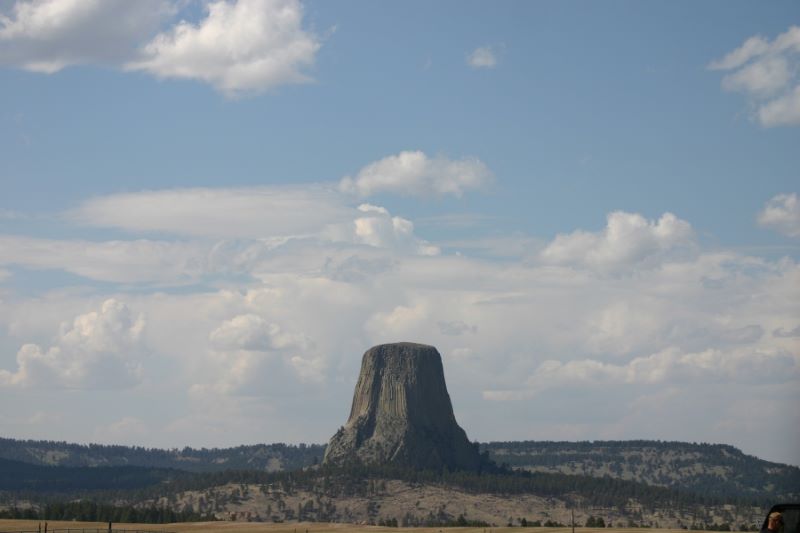
By mid-afternoon on the appointed day, we caught a first a brief glimpse of the pillar of Devils Tower, many miles away. Over the next half hour, it graced us with a few more teasing views, gradually growing in size with each glimpse.  Then we entered the valley of the Belle Fourche River, where the butte loomed far above us from our spot in the line at the park entrance. I waited with growing impatience as we followed the park road around and up – and had to wait until someone freed up a parking space so we could continue to the visitors center.  Finally parked, we were ready to follow the 1.3 mile trail around the base of the 860 ft butte.

One could accuse me of coup-counting — laying eyes on a celebrated place or view merely for bragging rights.  I hope that was not the case, but I can say that, from the very first moment I beheld the tower, I felt a sense of awe.  To provide contrast: some years ago when I visited Stonehenge, I was impressed on an intellectual level – the effort to conceive of and then build this enigmatic stone structure certainly fires the imagination.  But Devils Tower is on a different scale entirely.  Sixty million years of erosion unearthed the tower, which is a sacred site for over two dozen tribes.  It is just…massive.  Sheer.  Over a tenth of a mile in the air. Composed of fused columns that gave rise to the stories of giant bears clawing at the stone.

So many details, so much to hear and see. I took over a hundred photos of the butte, from all angles, including a climber in a painstaking descent, vultures wheeling around the summit, and the remains of a ladder put in place over a century ago.

The ponderosa pines clustering around the base showed signs of fire.  I read the interpretive sign talking about the NPS using periodic prescribed burning to simulate lightning fires.  Good on them!   Another sign said the top of the tower is about the size of a football field, and includes sagebrush, grass, and cactus, as well as, somehow, rodents and snakes.  The signage was excellent, explaining (for those who would stop to read) the natural and cultural history, and the Park Service’s role in maintaining the U.S’s first national monument.

Of course, many breezed by the signs. not everyone felt reverence for the site.  There were some stereotypical loud Americans, prattlers and coup-counters.  Halfway through the circuit, some middle-aged women passed by, complaining about the rigors of walking the uneven, unpaved trail.   On the other end of the spectrum, a native man and woman passed by us silently, solemnly, purposefully.  Although attempts to change the name of the monument to something closer to a Native moniker have failed, the NPS doesn’t provide climbing permits for the butte during June, out of respect for ceremonies held during that month.

A few hours was not enough time to fully experience a place, but in this case it was enough to awe.

Additional Information:

National Park Service’s page for Devils Tower

On the Open Road

There’s an old joke about the difference between Americans and the British: “Americans think 100 years is a long time, and Britons think 100 miles is a long way.” 

Early on during our recent vacation, my wife asked where we would recommend a traveler from the United Kingdom (where we’ve traveled several times) go to get a true taste of America.  She thought a list of 10 cities – including Boston, Washington, and New Orleans – would be ideal. I countered that if a “true” taste was the goal, small towns – including the moribund ones with more churches than active businesses – should be included.  By the end of the trip, we both agreed that, wherever the journey led, it should be conducted by road.  

The country of England could fit inside the state of Georgia — the 24th largest state out of 50 United States. The lower 48 states stretch across four of the regular 24 time zones.  The distance from “sea to shining sea” measures some 2800 miles (4500 km). In 2019 we traveled in a meandering path from Woodbridge (near Ipswitch) to Boscastle in Cornwall — a trip of some 400 miles; the outward leg of this month’s trip — to Gillette, Wyoming — sent us at least 1700 miles down the road from our front porch near Athens.  The United States is so large and diverse it has been suggested that it is culturally nine or even 11 cultural and economic nations in one.  This doesn’t count the actual sovereign nations scattered across the land.  Common customs, foods, and laws vary considerably as one travels from region to region, often within a single state.

I don’t think one can conceive of the scale of the continent by hopping from airport to airport.  Our dependence on the automobile and the subsequent restructuring of cities for car travel, the sprawling nature of municipalities, the colloquial use of hours rather than miles as the measure of distance…and the only way to understand the American obsession with the Freedom of the Open Road is to experience it.  The rush of miles passing underneath your wheels. The vistas.  The loneliness.  The boredom. Praying that the first gas station in 100 miles is still open. Standing on top of your car with your arm raised in hopes of getting a signal. Crawling along in bumper-to-bumper traffic, or to drive all night with no headlights but your own. These must be experienced to get a feel for the country, because the scope of the land shaped, and continues to influence, the history, economics, culture, and politics of the nation.

Screaming Trees

I was early for a meeting in Wilkes County. With some time to kill, I followed the distant but pervasive sound of (pardon the geek reference) a phaser pistol overloading.  I parked where a neighborhood met a wooded drain, and from a roadside swamped by wisteria, I heard the steady, whining drone of untold numbers of cicadas, all looking for love.

Like many insects, cicada adulthood is merely a fraction of the insects’ total lifespan.  After hatching from eggs drilled into tree twigs, the nymphs fall to the ground. They burrow in and live in the earth for from as little as one to as many as 17 years, surviving by drinking sap from tree roots.  When the time comes, the nymphs climb up trees, poles, grass, or whatever they find to get a little elevation.  They split the back of their exoskeletal skin and molt.  Once the new exoskeleton hardens and the wings straighten and dry, they fly off to find a mate.  The males do all the calling; I can’t fathom how a female chooses one among the cacophony.  Cicadas do take time to feed, drinking plant juices, but don’t do much damage considering their numbers. They don’t bite or sting, although the deep buzz of a low-flying cicada can be startling.

Georgia is home to 20 or so “annual” species of cicada, so called because adults appear every year. After spending less than half a dozen years in the darkness, these large insects appear in the heat of the summer, buzz around in their millions for a few weeks, and then die.  They are often dull-colored or camouflaged, and more likely to be heard than seen until we find them dead on the ground at the end of their final sprint. 

There are also six species known as “periodic” cicadas.  These black and orange insects spend 13 to 17 years as nymphs before rising to deafen the neighbors.  While some annual cicadas appear every year, the periodic cicadas all rise together in tremendous broods.  This year, the trillions of members of 13-year Brood XIX are keeping folks awake from Virginia to Louisiana and up into the Midwest (Broods are multi-state masses of periodic cicadas that all rise in the same summer. A 17-year group known as Brood XIII has also risen this year in the upper Midwest).

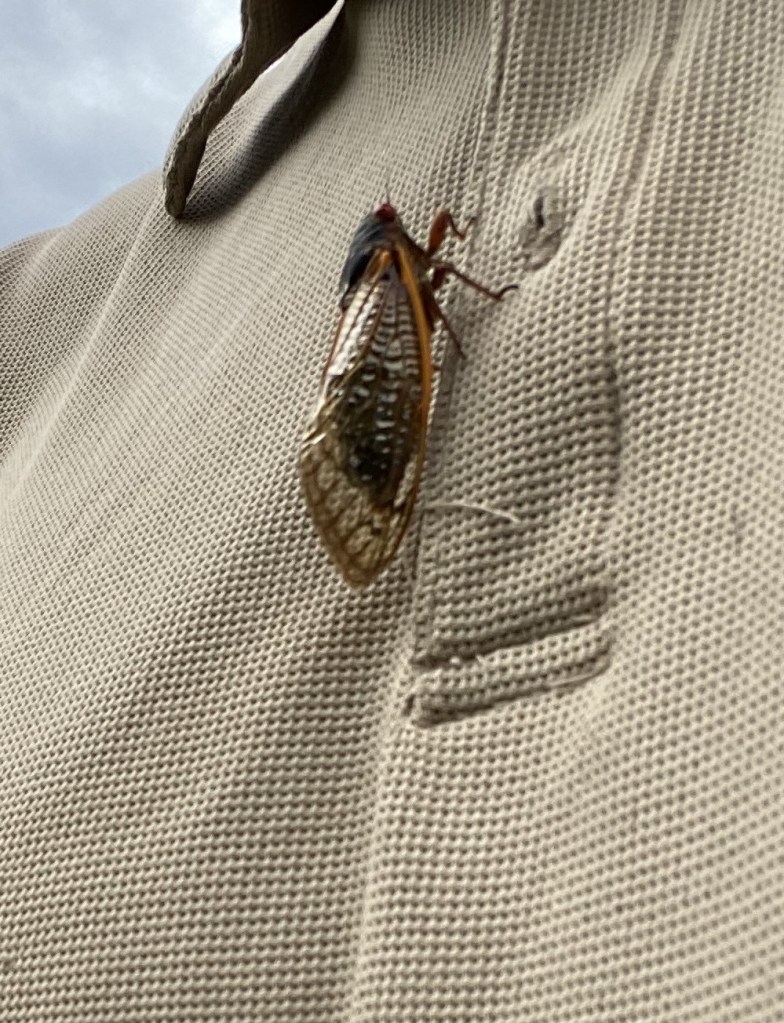
My first close contact took place just as I stepped from the truck; an orange-eyed critter landed on my shirt and stayed put for a couple of minutes before getting spooked and flying off.  Once I started looking, I saw the empty husks everywhere – dozens on a branch, sometimes one on each side of a leaf!  And while the trees ahead of me housed the vast majority of cicadas, there were several specimens amongst the shells at my feet, mostly unbothered by me even at close range. 

How many husks can you see here?

And the air was full of the wailing siren of cicada courtship. Did they reach the estimated one million per acre in these woods? All that noise suggested it was a possibility. At close range, cicada calls can reach 90-100 decibels, or as loud as a power drill! I was as close as I needed to be to the unearthly courting cries.

After a while, I set about collecting some of the exoskeletons (because that’s the sort of thing I do). A 15-foot strip of roadside netted me several dozen husks, and there were others in view that I didn’t harvest.

I took my collection back to the truck; it was time for my meeting, and the cicadas had their own business to attend.

4H student shows off her collection of exoskeletons

Further Information

Cicadas recorded at this roadside

Common Cicadas in Georgia

Siding With The Grasses

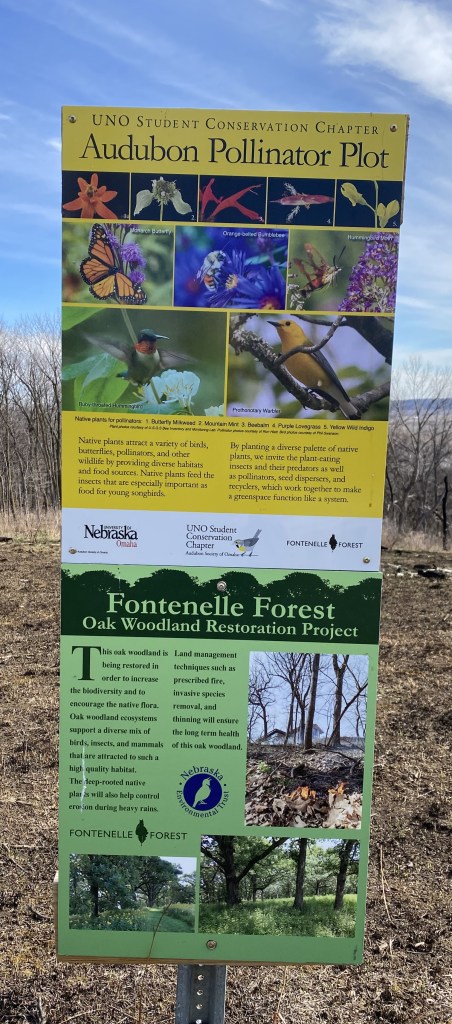
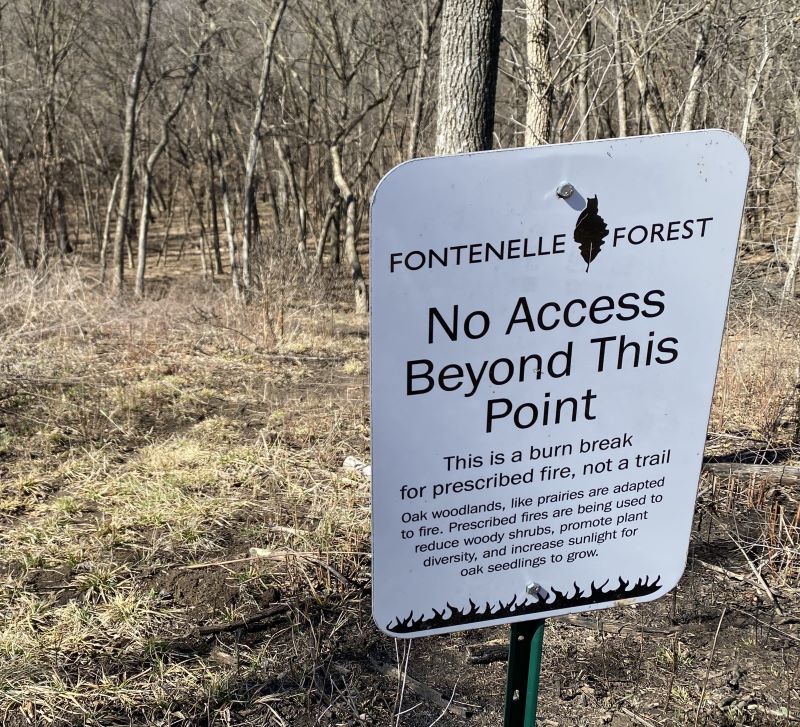
As mentioned in the previous post, I was in Omaha a week ago.  After conducting my business, I planned to treat myself by visiting Neale Woods to see the slice of tallgrass prairie the naturalists at Fontenelle Forest were restoring.  Upon arrival, I was momentarily disappointed to discover that the grassland and much of the woods had been put to the torch only a couple of weeks earlier.

I say momentarily disappointed, but I’d add a naturalist’s delight.  This was an opportunity to get a better look at the efforts to recover a corner of prairie from a century and a half of neglect.

The prairies and oak savannas of the Midwest, like the pine savannas of the Southeast, are by their nature constantly under threat from ecological succession.  Shrubs and trees push towards the interior in a never ending campaign, threatening to block the sunlight from all vegetation laying closer to the ground.  Fire – from lightning and anthropogenic sources – was always the prairie’s greatest weapon of defense and conquest in what Aldo Leopold termed the “prairie war” between grassland and forest.  When the sodbusters began plowing the dark prairie soil to grow crops, they also banished fire from the uncropped land – for fire endangered buildings and livestock, not to mention the trees that offered their wood to the settlers and later to industry.  And so it was that many oak savannas, through deliberate fire exclusion and general neglect, grew thick canopies — stealing sunlight from the grasses and forbs that needed it. 

The prairie lost all the land that could be farmed.  Without its ally, fire, it surrendered the rest to the forest.   Even the oak savannas, a neutral ground of sorts where grasses and trees coexisted, reverted to forest as less fire-tolerant tree species crowded in to create closed-canopy forests. Of the 50 million acres of oak savanna existing in the middle reaches of the United States and southern Canada prior to European settlement, only around 30,000 acres remain in scattered pockets.

However, the pendulum is shifting back a fraction. In recent decades, knowledge of the elements and interactions of this hybrid of prairie and woodland community have been joined with a will to preserve or recreate said hybrid. 

In Neale Woods, it began with the setting aside of loess hills ill-suited for farming. Then came the restocking of prairie plants in openings in the tree canopy.  Now as I looked around, I saw evidence of the continuing efforts to create an open oak savanna.  Low stumps, which would have been hidden by tall grass but were easily seen in the ash, showed the ecologist’s direct interventions against individual trees.  Larger trunks, though still standing, were neatly girdled – not indiscriminately, only individuals or small clusters, just at the margins of existing openings.  And of course, there was prescribed fire, free to do its work within the confines of subtle firebreaks.  It burned away leaf litter, scarifying forb seeds and exposing bare soil for the next generation of ground cover.  Some tree seedlings died, others were topkilled.  Fire found chinks in the bark armor of some older trees, burning deeper wounds. 

Girdled trees

Sounds catastrophic, perhaps.  But for the flora and fauna adapted to fire long before the axe or plow made their marks, fire is a part of life – a trial to be periodically overcome but which leaves the survivors in better shape.  The larger bur oaks are nearly impervious to the low-running grass fires and were scarcely troubled; they will have less competition for roots and perhaps for sky.  The mountain mint and bloodroot, the beebalm and bluestems will grow vigorously.  Wildlife, including the rabbit whose droppings I saw by the trail or the wild turkeys that I watched foraging for baked acorns and roasted insects, make use of the invigorated ground cover.  Nectar-feeders, from monarch butterflies to longhorn bees, will fill the air come summer, as will the songbirds who arrive to feed in the humming air above the prairie.  The blackened crowns of the native grasses were already sprouting green sprigs, promising a return to tall grasses waving in the summer wind.

I commend the biologists and their supporters who are bringing back the oak-grassland savanna in this corner of Nebraska.  In the war between forest and prairie, these conservationists have sided with the grasses.

Additional Information:

News report on this fire

A view of Neale Woods in October

A brief view during the growing season.

Fontenelle Forest, stewards of Neale Woods.

The Inland Dunes on the Missouri

Last week I explored a couple of parks near Omaha, Nebraska, and thought I would take a couple of posts to talk about them.

West of the Missouri River and in the Great Plains region, you may expect unvaried topography.  Yet in Neale Woods Nature Reserve I found myself 200 feet above the nearest cornfield, on what was likely a thousand-year-old dune made of loess.

In geological terms, loess (pronounced “luss”) is material transported and deposited by aeolian (wind) action, consisting predominantly of silt-sized particles. The most familiar source of loess would be from the combination of drought and poor farming practices that became known as the Dust Bowl in the 1930s. However, the hills I stood on and the larger ridges across the river have an older and more distant origin.

The Loess Hills across the Missouri River in Iowa.

As glaciers and ice sheets expanded across the landscape during the last hundred thousand years, the accumulated weight of ice scoured earth down to bedrock, grinding away stone and carrying the powdered rock along with it.  During warmer periods, the ice retreated, with melt water transporting the “rock flour” downstream. Eventually, the silt settled into glaciofluvial mudflats. Much later, this floury dust dried, to be picked up by the wind (becoming loess) and carried aloft for hundreds or thousands of miles before coming to rest in blankets across much of the Midwest and down to the Gulf of Mexico (map).  There are other sources of loess, including dust blown in from deserts, volcanic fields, or other sites with fine particles and the wind to carry them.  The upper layers of loess in Nebraska likely come from deserts or perhaps previous loess deposits, sent windborne again as local climates fluctuated.  This deposition formed high dunes of silt and fine sand, and dates to between 1000 and 11,000 years ago.

Loess tends to have a high mineral content which, with some weathering and centuries of extraction by plant roots, creates exceptionally fertile soil.  This is one reason for the productivity of the Midwest and Great Plains. Unfortunately, loess is highly erodible by wind or water, and without a thick prairie sod to protect it, tons of fertile soil are lost on each farmed acre every year.

Notice the dark layer of organic topsoil

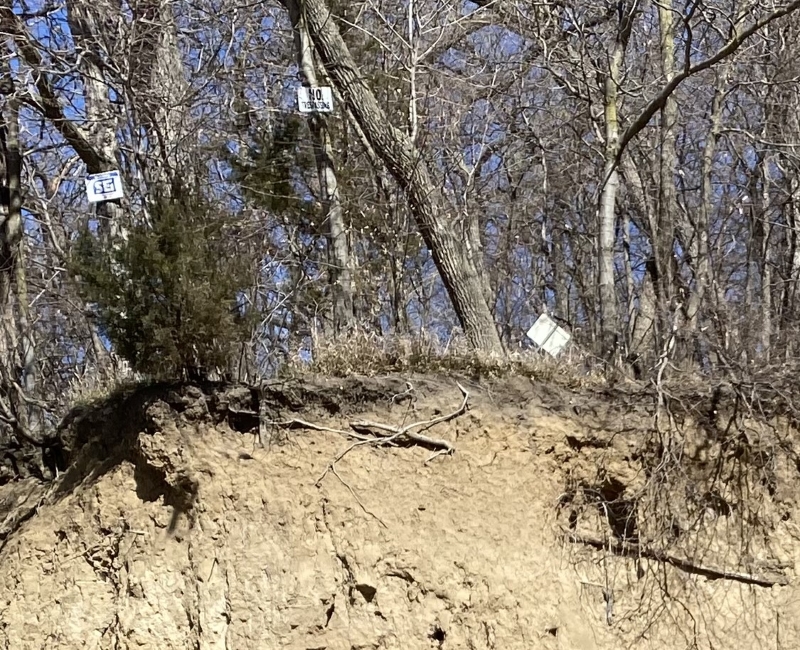
While easily eroded, loess tends to maintain vertical integrity provided there is some protection at the top.  That may explain why I came across these cliff faces.  Where Man’s desire for level roads conflicts with dune topography, the hill gets shorn.  In more sandy terrain, that 20-foot wall would have slumped all over the road in short order.

Ranging up to 200 feet, these forest-covered dunes stand long and narrow, dissected by gullies. They might have eroded down to low berms if not pinned in place by oaks and prairie grasses. Whether for the dune geology or the prairie ecology, they are worth a look if you ever get out that way.

This ridgetop is only level for about 15 yards before sloping down either side
Soil profile at Neale Woods. Note quarter for scale.

Last Joro

We have a tendency to take a proprietary view of things around us.  “The deer down the road are a potential nuisance, but the one that feeds on the edge of my yard is okay because it’s familiar.” “That maple by the gate is familiar as an old friend.” “Stray cats are death on toast for birds, but I’ve named the one that creeps around my hedge.”  “They can’t do that to our pledges, only we can do that to our pledges.” (Yes, Ma, that last one was a movie reference.)

As I mentioned a while back, the Joro spider – an Asian arachnid making itself at home in the Piedmont – fills up the woods in late summer, to the consternation of those who otherwise love the outdoors.  As temperatures drop in the late autumn, the multitude of spiders drops away and their haphazard webbing disintegrates.

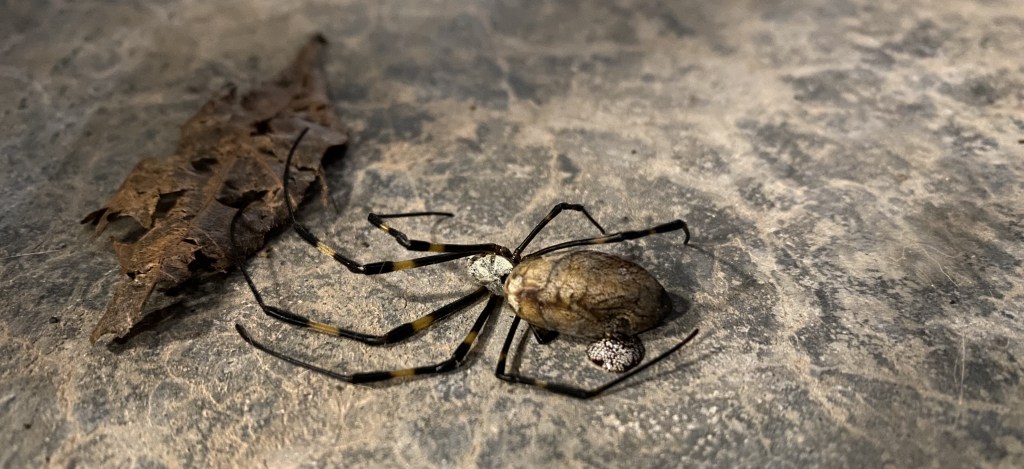
And then there was the large female residing just outside the garage.  I’d see her every day, along with a few smaller Joros inhabiting that corner under the eaves. She was hanging out through the late summer and into the autumn.  October…November… December… the spiders on the back porch fell away.  Moths, flies, and other flying insects faded out as well.  Christmas came, and the large female under the eaves remained, after cold and hunger felled all her neighbors. Was her persistence due to being the largest spider on the south-facing side of the house, protected from the worst of the winds? Regardless, at this point she’d gone from an invasive cluttering up the garage to a dogged survivor.  Instead of glares, she earned appreciative glances as I walked by. 

The New Year dawned with a near-freezing morning.  I expected her corner to be unattended, but there she was: slowly, methodically, doggedly repairing her web with golden-tinted silk.  You go, girl.

Now it’s mid-January. Atmospheric disruption at the North Pole sent a shock of subfreezing winds our way.  The first morning after the hard freeze revealed a ragged, empty web.  Our Joro lay on the cement floor, having finally succumbed. I wouldn’t say I had an overabundance of feeling for that critter (this was a short-lived invasive, not Charlotte), but its passing received far more attention than that of any of its brethren.   

Is there a tree, a stone, an animal — any normally-anonymous thing –that you have marked with your attention? Any thing whose absence would be worthy of notice and remark? Drop a comment and let me know.

Mylar Balloon Pollution

Here is a guest piece from Dr. Larry Marchinton, professor emeritus from UGA. I picked up balloon fragments on a landowner property this week, so this topic is top of mind for me.

Mylar Balloon Pollution

By Dr. Larry Marchinton

Since the 1970’s, we have been plagued by Mylar balloons. Mylar is made from nylon with a metallic coating.  These balloons may look shiny or colorful with designs on them.  They are not porous and the helium gas in them does not leak out easily, so they can fly very long distances before coming down.  As a result, the balloons end up littering the countryside in forests and pristine places far from where they are released.  These kinds of balloons are ugly and permanent trash and do not disappear because they are not biodegradable.

In other words, they are released as celebratory symbols in densely populated areas but become a permanent blight on places far from the cities and towns where released.  Mylar balloons are terrible trash pollution in otherwise pristine forests, farmland and even wilderness areas.  Unless picked up, they never disappear.

We have 200 acres in Jackson County, Georgia that is maintained for nature and wild things.  It is over 10 miles from any city or town but is littered with deflated balloons–an incredible blight that we cannot prevent.  Huge numbers are falling every year.

 I found on Google that at least 5 states have already made it illegal to release Mylar balloons, although mostly for other reasons such as shorting out power lines and causing fires, chemical pollution and waste of helium (which is a finite resource).

 Georgia should ban them, too!

The Last Leaves of the Season

Another year has cycled through, and the canopy of colorful leaves around my house is now a carpet in different shades of brown.  From the mighty white oaks to the humble dogwoods, all sport naked limbs, awaiting the return of spring to unfurl new green leaves.  

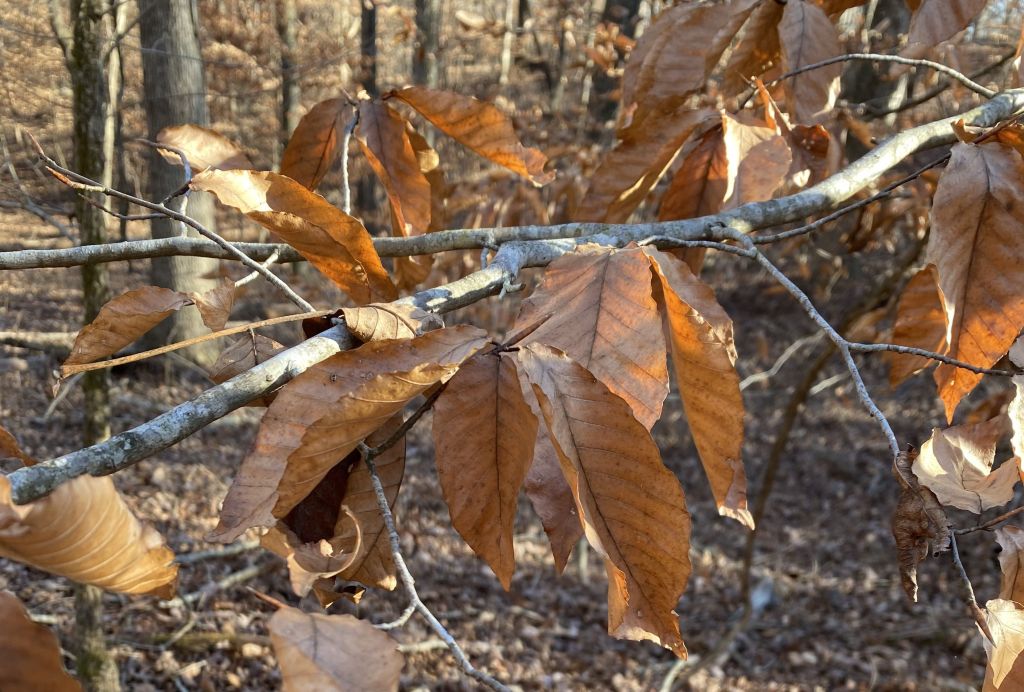
But one tree stands out in the forest.  The American Beech (Fagus grandifolia) holds on to its withered tan leaves throughout the dormant season.  This quality of holding on to dead leaves after other plants have shed them is called “marcescence”.  Studies suggest marcescence is a strategy for deterring deer and other herbivores from browsing on the more nutritious twigs and buds, or perhaps for improving the tree’s nutrient uptake by delaying leaf decomposition until spring. 

The beech is one of the most shade tolerant of trees, allowing it to spend decades holding its own beneath the forest canopy until a fallen tree gives it an opening to grow into the light.  The beech prefers moderately moist conditions, and its thin bark provides scant protection against fire.  In open woodlands of the precolonial Piedmont, oaks dominated, while beeches withdrew to the more sheltered bottomlands.  With fire removed from hardwood forests, beeches, maples, and other thin-barked trees advanced into the uplands as forest canopies closed.  They are firmly part of the climax forest community.   

Beechnuts are a much-sought-after food for birds and mammals, from blue jays to black bears.  It was a primary fall food source for the long-vanished passenger pigeon. Humans make vegetable oil from beechnuts, or roast them to eat or to make a caffeine-free coffee substitute.  Unfortunately, a seedling will grow for several decades before putting on the first beechnuts, and thereafter produce at intervals ranging from two to eight years. Beeches can live for 400 years, assuming they aren’t cut for lumber or high-quality firewood, or succumb to one of several introduced disease-causing pests.

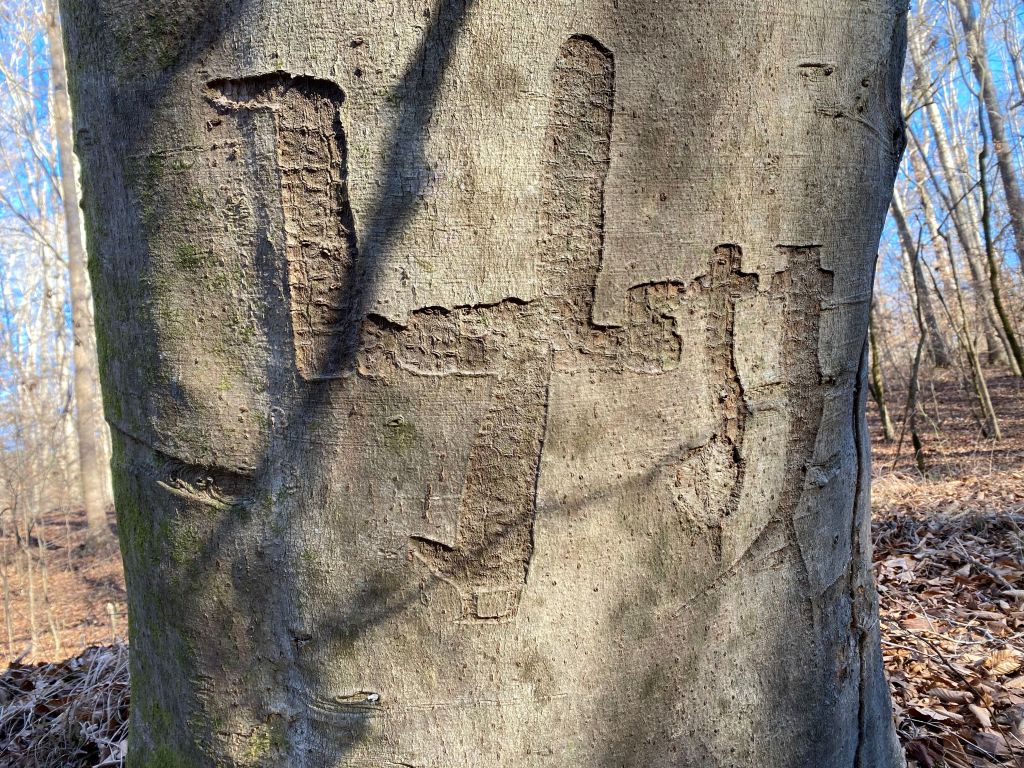
The bark of the beech is relatively smooth and pale gray, making it a tempting canvas on which folks may carve their initials, dates, or other sentiments.  I don’t recommend the practice — cutting the bark allows pathogens to attack the tree, and it’s rude to future visitors — but don’t be surprised to see the declarations of love, territory or simple presence written across a trunk. Yesterday, I walked downstream a short way to a beech tree I remember from my youth; decades ago, a local with the surname Inglett took knife to bark, staking his claim on that patch of woods.  I don’t know how long ago this bit of vandalism occurred, but the scars were old when I was a kid, and they have stretched to near illegibility since then.

When you pass through the woods this winter, Keep an eye out for marcescent leaves of beeches.

Trails: What Good Are They, Anyway?

Here is the second essay from Dr. Walter Cook, reprinted with permission of the author.

Trails – What Good Are They, Anyway?

By Dr. Walter Cook

This is the title of an hour-long slide show I have given many times at the Len Foote Hike Inn.  Mostly, the slides show unusual things, beautiful flowers, and other curiosities one will find along trails.  My purpose is to encourage people to walk, stroll, or hike on a foot path.  Of course, the audience at Hike Inn didn’t need any encouragement, since they walked five miles to get there, but like many hikers, they may be busy talking and not notice the interesting things they pass along the trail.

My purpose in designing, maintaining, and sometimes building trails is also to encourage others, especially those who have never walked on a woodland trail. I like to open their minds to the natural world they are in.  To me, a trail is more than an exercise facility – it is an educational facility. It “educates” a first-time visitor so they can discover that the outdoors – forest, meadow, stream – is not a threatening environment. By staying on the trail, they can see nature but they don’t have to touch it, nor let nature touch them. And after that first time, when they have safely survived the new experience, they will be less reluctant to try it again – and again and again. And on each successive experience, they will discover new things, besides the fact that the natural environment is not a dangerous place. They will begin to be curious about things they see or hear.  Soon, they will enjoy the experience. They will gradually become familiar with the natural environment, and eventually, they will want to ensure the environment remains protected.

Trails also have much to offer the experienced naturalist.  I am not a birder, but I’m sure it must be easier to enjoy birds from a trail, where there is no noisy crunch of dry leaves.  I am a wildflower enthusiast, and trails do help me to enjoy them. I hope to walk each of the trails described by Hugh and Carol Nourse in their book, Favorite Wildflower Walks in Georgia.

As a trail designer, I spend a lot of time walking “off trail.” Wandering through the forest with clinometer and plastic colored flagging is my favorite recreational activity. Although I get paid for some “jobs,” it is always enjoyable to get away from where others have been (at least recently) and discover new things.

But all the while I am tying flags, I imagine people walking on the trail after it is built.  As they see things along the trail, what will be their response? Will they like what they see?  Will they be curious about things they see?  Will they notice that some trees look alike, but unlike others? Will they wonder what kind of bird is singing so conspicuously? Will they remember to tell their friends that they had a positive experience, and encourage the friends to go with them next time?

So, if you have a friend or relative, especially a young person who isn’t familiar with the natural world, encourage him or her – no, insist they go with you on a walk. Make it an easy, short walk – don’t make it strenuous, just enjoyable.  When my granddaughter was about four, we walked a mile in my woods, and at the end, she said, “That was a gooood hike.”  I was pleased.

Additional Resources:

American Trails.org: connecting people to nature

Alltrails: Find trails by location, length, and difficulty

Webinar: Building Trails On Your Property. The page leading to the webinar has links to some great resources at the bottom.

The Richest Man in the World

I met Dr. Walter Cook over three decades ago.  In his Forest Engineering course, I learned how to (among other things) properly lay out a trail in the woods; in Forest Recreation, he taught me why these trails were important.  He was an important mentor for my Eagle project, which involved constructing a stretch of trail at Sandy Creek Park in Athens.

I reconnected with my professor at his 90th birthday celebration.  Fittingly, it was in a park pavilion.   During the gathering, nature-lovers lauded his tireless work in developing, coordinating, and building trails and paths on over 130 projects across both private and public lands.

Last week, I went to lunch with Dr. Cook to catch up.  He has read this blog, and agreed to share some of his thoughts here.  This is the first of his essays which I post with his permission.

The Richest Man in the World

By Dr. Walter Cook

Who among us has not occasionally wished to be rich?  As Tevye sang in Fiddler on the Roof, “If I were a Rich Man…” he would no longer have to work.  Some people have other reasons for wanting to be rich – to have a big car (or maybe two), to have a big house (or maybe two), to travel the world, to send their children to the best university, or merely not to worry about their monthly bills.  Many times in the literature of myth, characters who have unlimited riches are depicted as having large chests overflowing with jewels, surrounded by the utmost beauty of colorful paintings, with everything touched by gold.

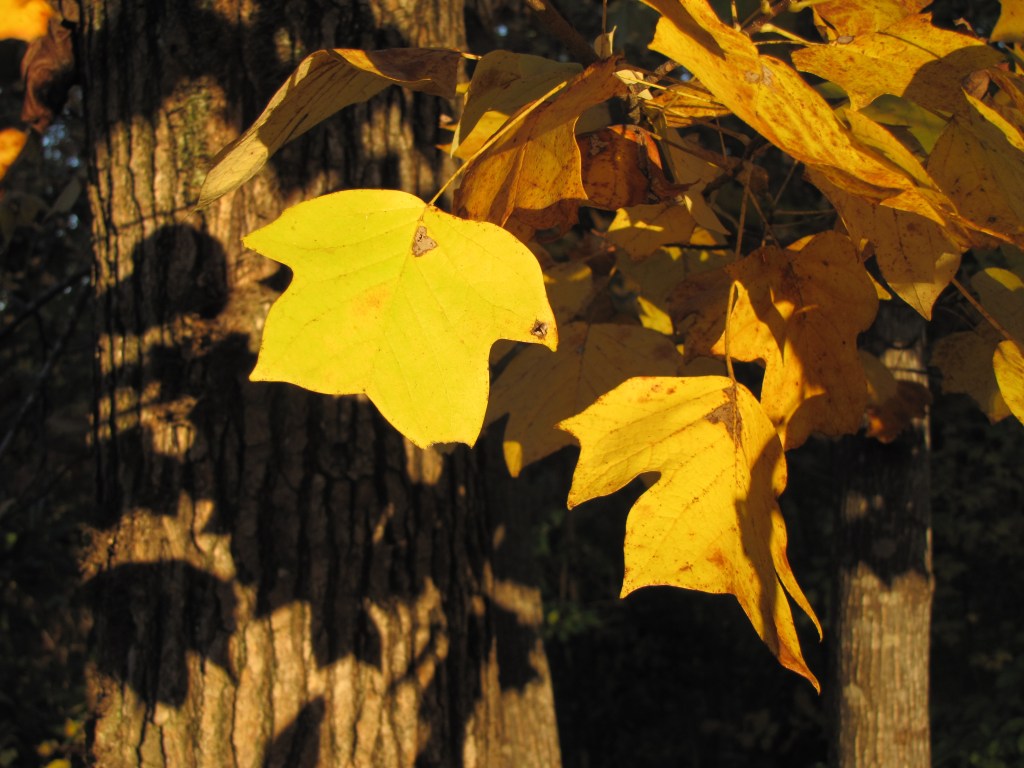
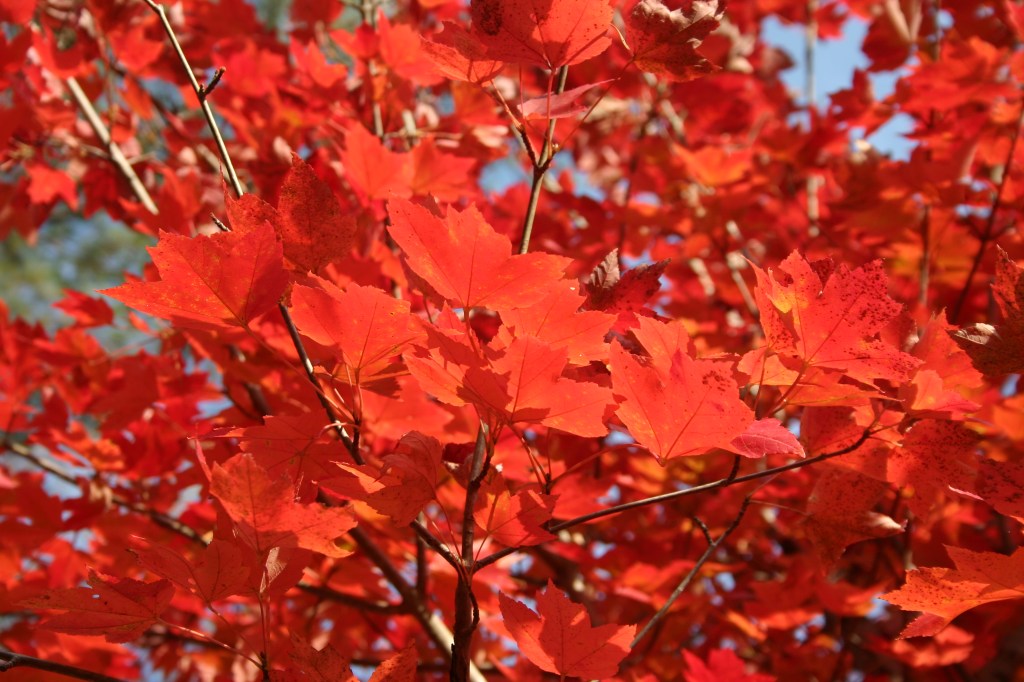
On a fall day several years ago, I discovered that I, too, was rich – not in the sense of Tevye’s longings, not in the sense of a carefree life, but rich in the sense of a mythical king.  As I was walking down the Middle Oconee River (near my hometown of Athens, Georgia) I enjoyed the many colorful red and sugar maples, dogwoods, blackgums, and poison ivy along the river’s levee.  Many leaves had fallen, and I recalled that when I was a young boy, I would gather a half dozen of the prettiest leaves as I walked home from school to bring home to share their beauty with my mother.  But as I looked at the leaves lying ankle-deep on the ground, I realized it would be impossible to choose the six best leaves – there were so many!  How could anyone make such a choice.  They were like jewels, even better than jewels, for no jewel could match the dazzling spectrum of colors in even one leaf, much less all the leaves.  And, as I looked up at the trees that had produced these super jewels, they were like paintings, only far surpassing any human-made work of art.

So, there I was, ankle-deep in the world’s most beautiful jewels, surrounded by superb works of art, and all the while being entertained by the music of songbirds.  What more could one possibly wish for?  I was a rich man, and I didn’t even have to work for it.  Tevye would have liked that.

[Since that long ago day in 1993, I have walked in a lot of forests, along many riverbanks, and in other interesting environments.  In the past few years, I have enjoyed exploring the back country while flagging new trails in the Jocassee Gorges in South Carolina.  Compared with the quiet beauty of the Oconee River in Georgia, the scenery in Jocassee is simply spectacular. The tremendous cliffs (not all cliffs are in state parks!), the numerous waterfalls, the natural gardens of wildflowers, and the views of endless mountains rolling to infinity, all certainly qualify as beautiful.]

But don’t be fooled!!  The nice thing about nature is you don’t have to wait until fall or go to a special place to enjoy its beauty. Nature is, almost by definition, beautiful.  We rightly enjoy the special shows of fall colors, spring and summer flowers, winter ice and snow, and the beautiful landscape of the Southern Appalachians.  But even without these spectaculars, nature – the undisturbed environment – is beautiful.  All we need to enjoy it is to open our minds to its presence.  Then we can all be as rich as a mythical king.

Article on Cook and Trails