The Skinny on Suckers

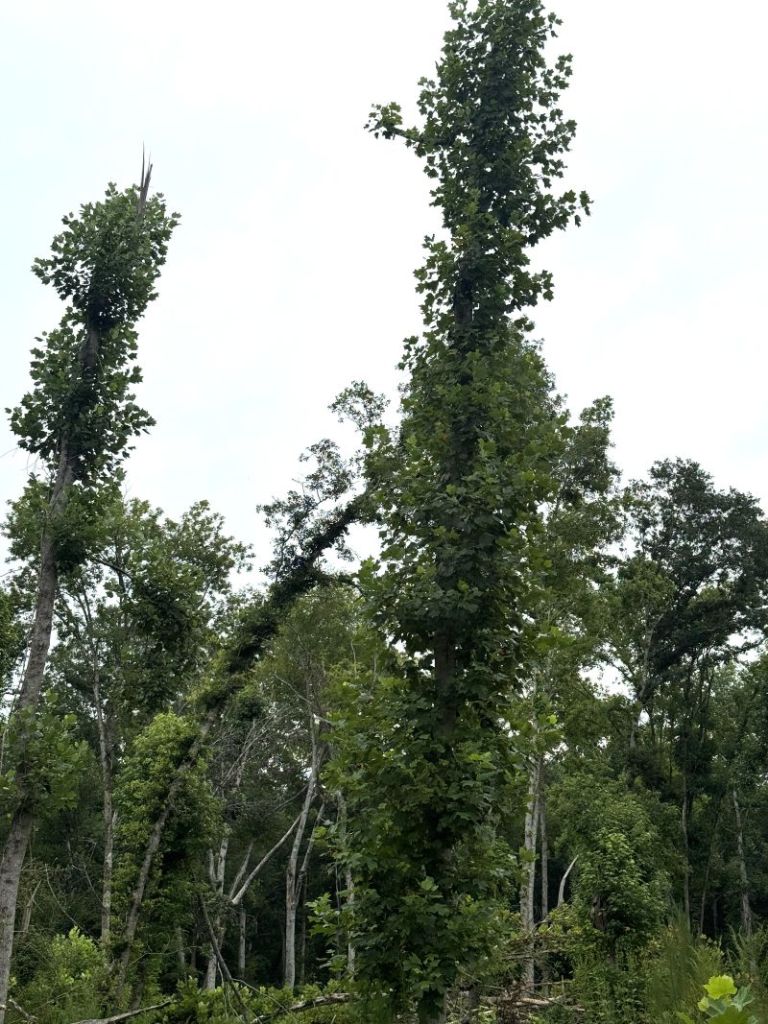
You know what an oak tree should look like, right? Trunk rising straight and limbless to the forest canopy, when it spreads its limbs to claim its share of the sunlight.  Or maybe you’re thinking of a mighty monarch in Grandpa’s yard, massive limbs starting halfway up the trunk and bifurcating endlessly to form a thick, tangled crown that dominates the sky.  But though you may not have noticed, you’ve probably seen tall oak trunks clothed in a close-fitting cloak of leaves.  I see them on the edges of clearcuts and in subdivisions where house lots have intruded on forest spaces. Twigs bearing leaves have spontaneously appeared all up and down the tree. And this effect can be seen on many hardwoods, not just oaks, and as well as some conifers.  What causes this?

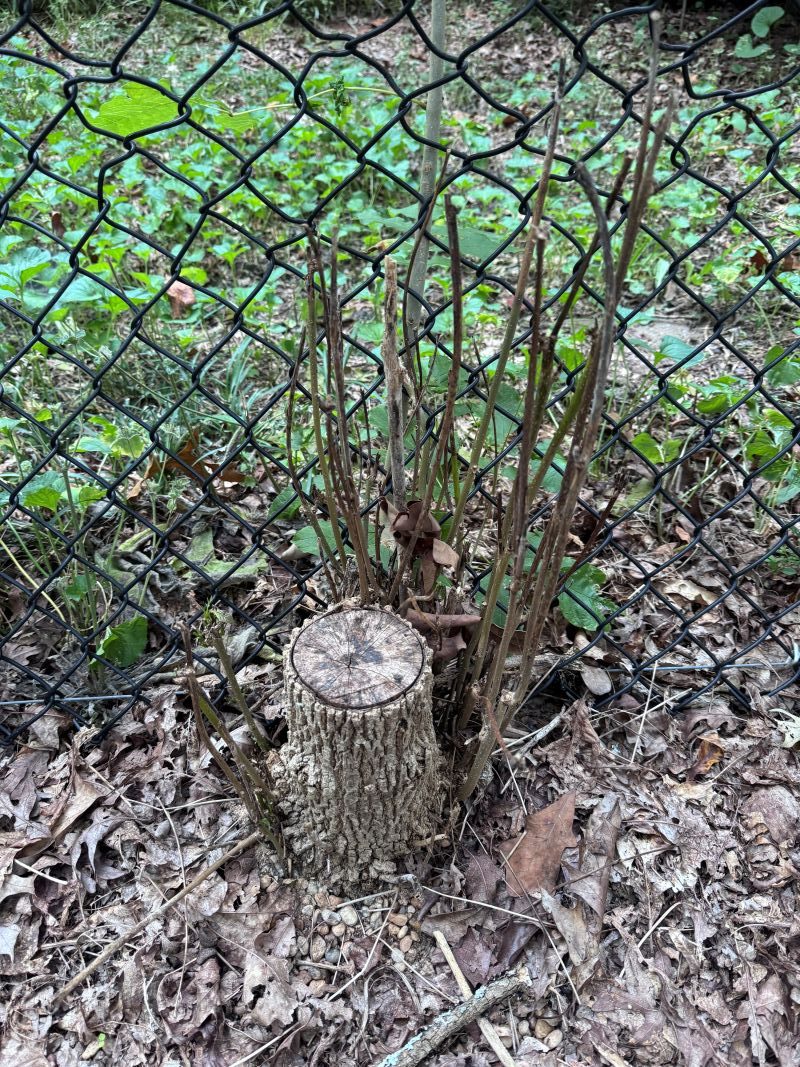
Most leaf buds lie at the end of young twigs, which themselves are found along older limbs branching from the tree’s trunk.  However, there are also buds hidden under the bark, kept dormant by hormones.  These are known as epicormic buds (epi=upon, kormos=log or trunk).

When a tree is under severe stress – through disease, insect infestations, or physical damage – the hormones are disrupted, letting the buds develop and grow shoots through the bark.   This can also occur when direct sunlight suddenly hits the tree trunk during the growing season – such as when all the neighboring trees have been removed.
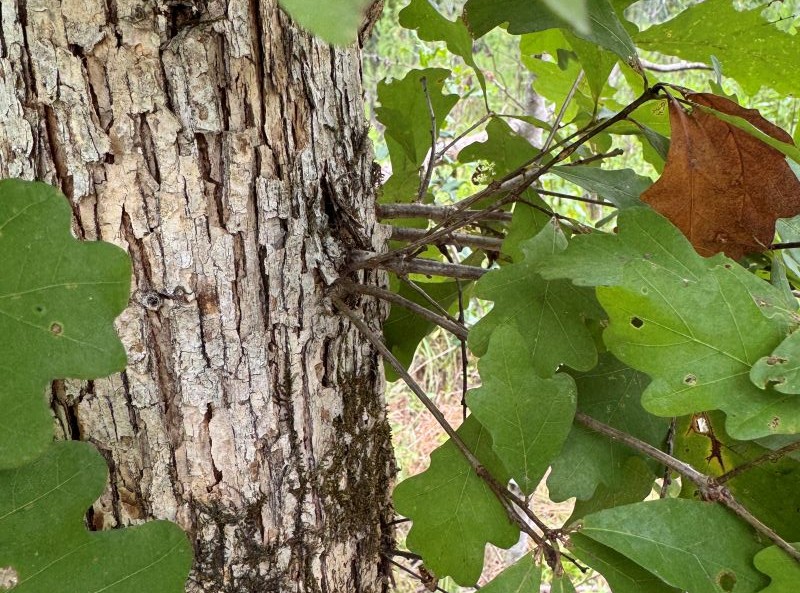
These shoots don’t just appear on the trunk.  When cut down, some trees will sprout from epicormic buds around stumps; sweetgums will go farther, sending sprouts (aka “suckers”) popping up all along the roots. In landscapes where fire is common, the intense heat will kill the trunks of young trees; epicormic sprouts send stems up all around the root collar.  Root suckering is the reason we still have American chestnuts in the Piedmont and mountains.
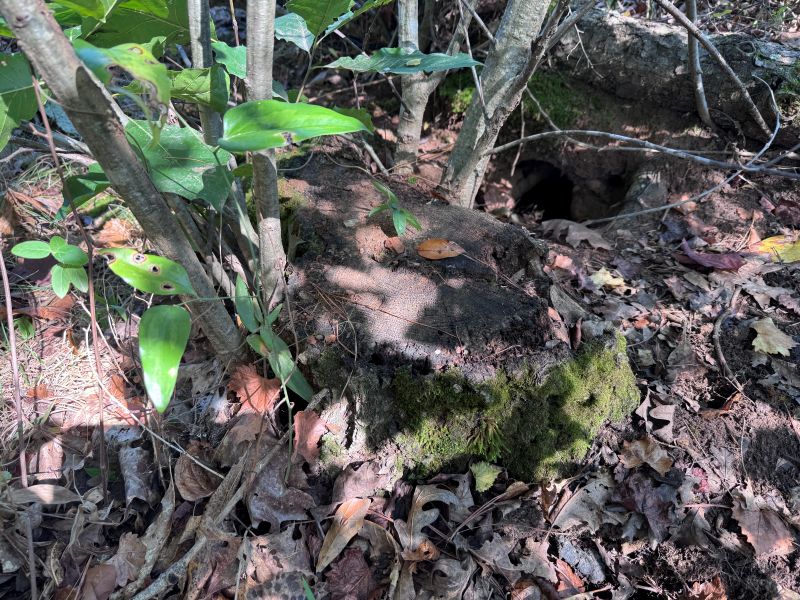
Epicormic branching can cause problems with fruit trees.  The scions are grafted onto hardier but less-palatable root stocks, and if the fruit tree dies, the root stock may re-sprout without the desirable qualities of the graft (this is one reason why Bradford pears turn into Callery pears).

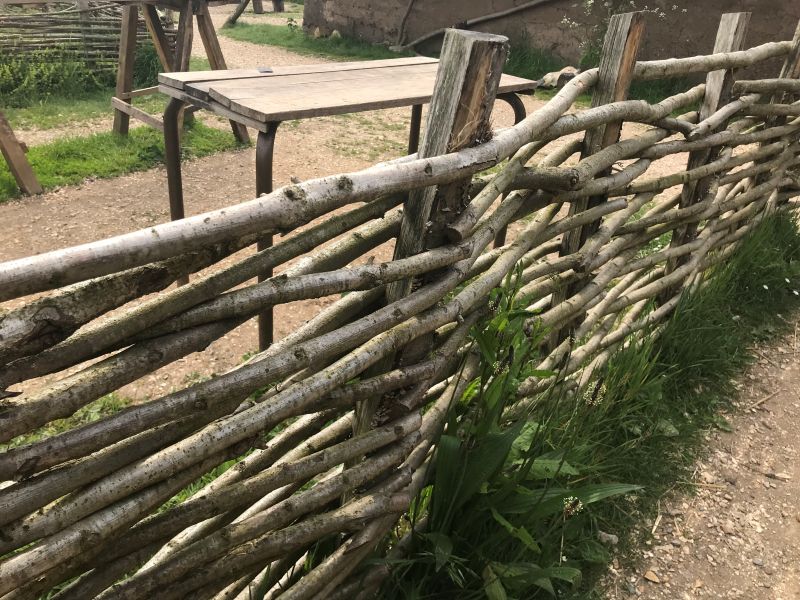
It’s not all bad, though.  Humans have learned how to use these sprouts for their own benefit.  Cutting a tree to deliberately create new sprouts is called coppicing. Limber young shoots can be used for waddle fences or walls, while older shoots can be used for poles for carpentry or firewood.  Coppicing is even used to increase cinnamon harvest.
It’s worth noting that many animals are attracted to the tender shoots growing from stumps.  Some trees are pruned above the reach of livestock to protect the harvest from browsers.  This variation is called pollarding.

So, what if you don’t want your hardwoods to get shaggy?  If you are in the process of clearing a lot, I’d recommend you clear it in stages over a few years; without that sudden shock of sunlight on the bark, the dormant buds are less likely to awaken.  However, chances are you either don’t have that much time or have already done your clearing and are unhappy with the new aesthetic. In that case, you can prune the new branches.  Again, don’t do it all at once, but cut them over several years.  Also, prune only during the winter to minimize stress to the tree.  Stressing the tree is what started this!
The Unkempt Lawn

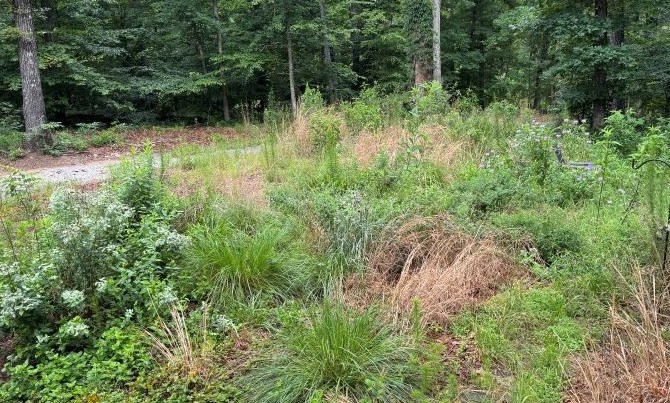
“Lawns can’t look untidy.”  “Grass kept at 2 ½-3 inches.”  “No weeds.”  “Flower beds are restricted to the approved palate of plants.” Whenever I hear about Homeowners Associations and their draconian lawn rules, I gaze upon my riotous jungle of natives with satisfaction. 

When we moved here, the plan was to plant only natives, and for the most part we’ve kept to that.  After four years, the greenery is firmly established.

Early in the wilding process, the mailman cheerfully suggested I cut down a few of my white oaks so when I sod the lawn the grass would stand a better chance.  The trees are still here and the clumps of grass are up to my belt; the fella hasn’t said anything more.

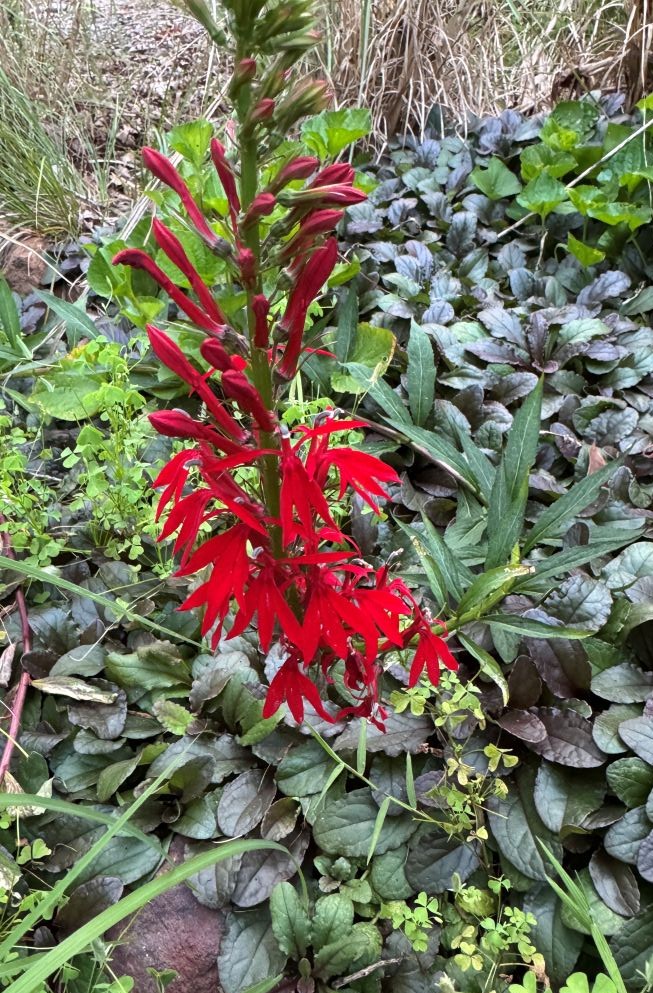
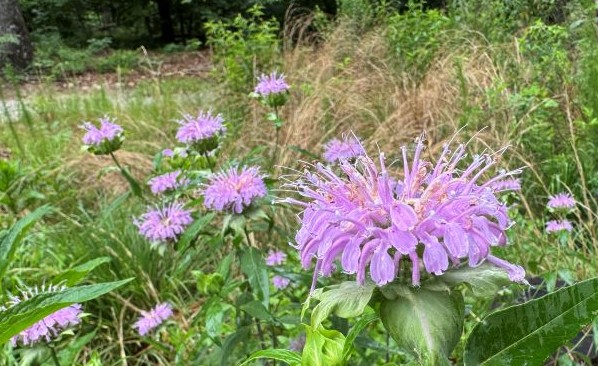
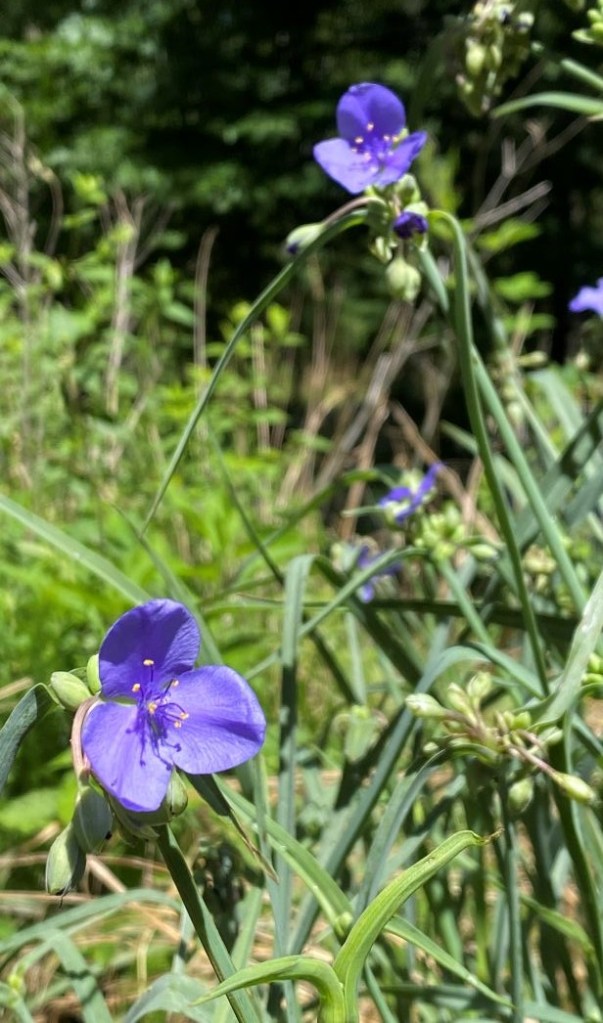
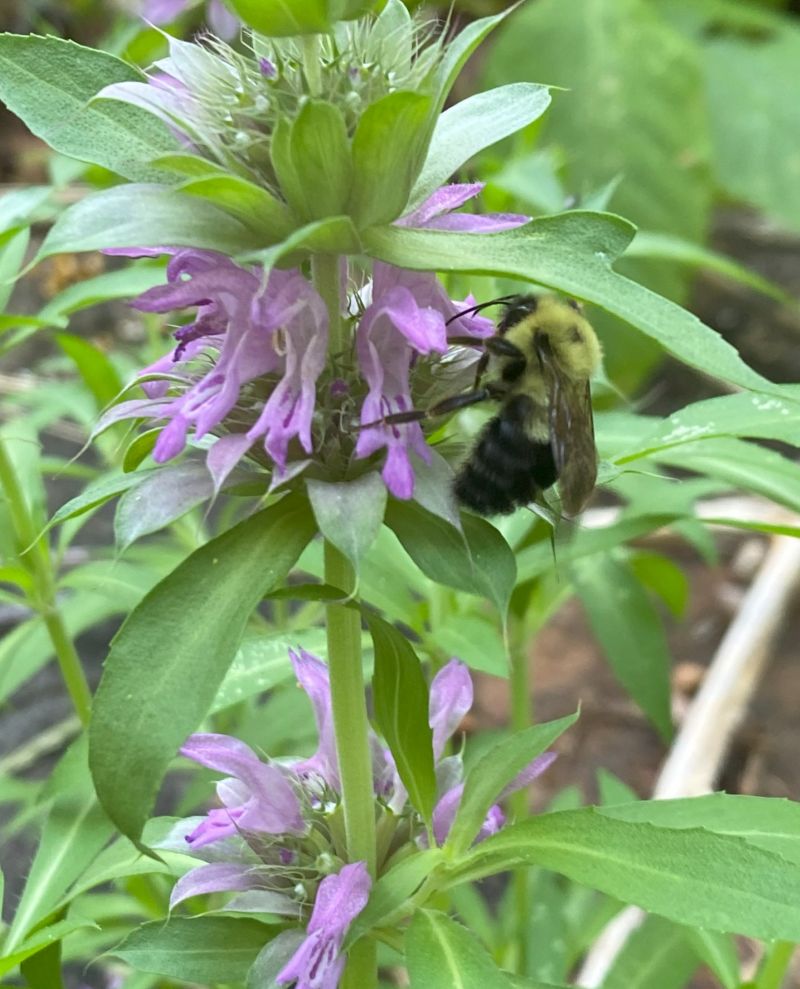
At the moment, the spiderworts are fading in and out, the bergamots and cardinal flowers are in full bloom, and the mountain mints are just starting to flower.  Blue mistflowers are shy; a couple blooms are hesitantly peeking out while their sisters watch with trepidation.  But all are appreciated by the bumblebees, butterflies, and other pollinators that are bellying up to the bar as it were. 

And the grasses – bluestems and broom sedges, Indiangrass and the others – are digging their fibrous roots into the clay subsoil, so that with luck we will start to build soil where the builders scraped all the good earth away. Rabbits and even a fawn have been using lush vegetation along the driveway as cover.

I don’t leave the yard plants completely to their own devices, though.  Blackberries, dog fennel, and the all-devouring muscadine get yanked when I find them.  The mountain mint would take over the yard if I let it, so that gets trimmed back in the autumn. For the most part, though, I let the plants do their unruly thing, and watch lizards, dragonflies, butterflies and rabbits do theirs.

Further Reading:

Why We Have Lawns

Fleeting Southern Snow

When I was a little lad (back when they included cuneiform on multi-lingual instruction sheets), I got a sled for Christmas.  Several years went by before I had actual snow to test it on, although I do remember sliding down a hill of ice.  Where I live, ice is a common hazard of winter: rain followed by a cold night, or worse – rain that freezes on contact.  Freezing rain is to be feared. Not only does it slicken stairs and pavement, but it weighs down tree limbs to the point of breaking.  A forecast of freezing rain sends us filling the bathtub and checking flashlights in preparation against downed power lines.   We seldom get winter wonderlands in our part of the Piedmont, only hazards and inconveniences.

This month, the heating of the upper atmosphere, perhaps ironically, disrupted the normal pattern of the polar vortex, sending frigid air blasting southward.  Weather prognosticators warned the nation to brace for a bitter storm.  Our run up to last weekend was a flurry of storm prep, with the expectation that power could be out for days.  Snowpocalyse, for us at least, was thankfully over-advertised. We woke to a layer of sleet and ice, but also running water and lights.  Treading carefully and driving as little as possible was the order of the week.  Life went on.

“But wait, there’s more,” cried the meteorologists, declaring another wave of cold and wet was on its way.  On Friday evening, we checked that last weekend’s preparations were still in place, and braced for ice and snow.  

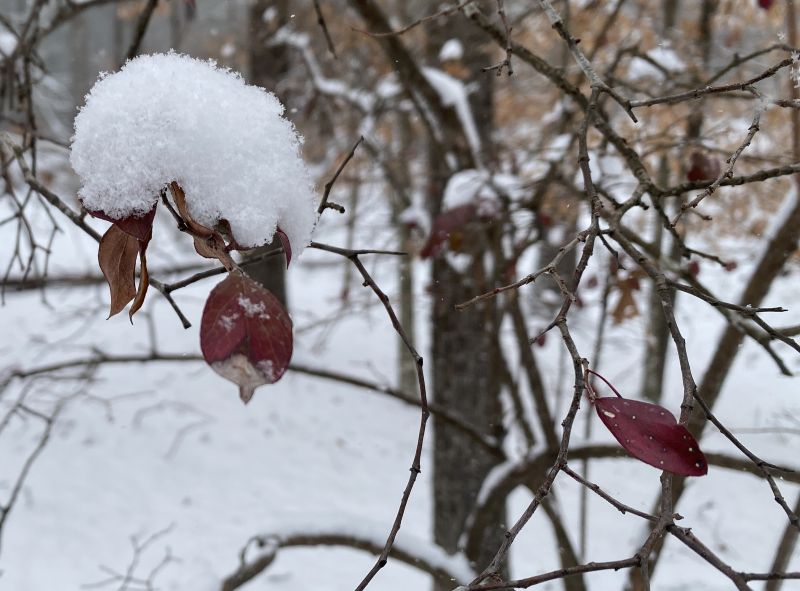
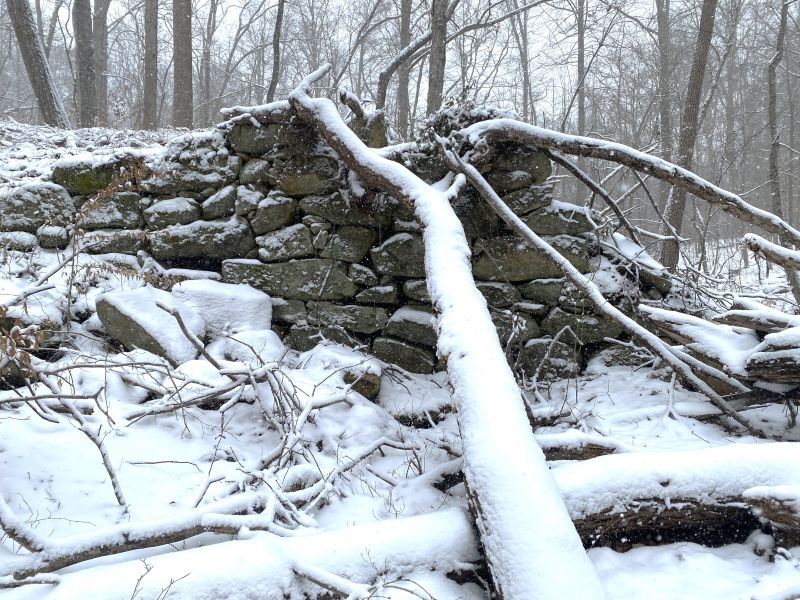
By mid-morning on Saturday, a few tiny flakes began floating down, heralding a heavier snowfall that was sticking before noon.  Snow petered out around 3:30. Depending on where you looked, it lay at 2-4” deep, and powdery with that soft crunchy-squeak sound.  I took some of our dogs out for a spin.  They stuck their muzzles in the snow like they were searching for where the smells went. 

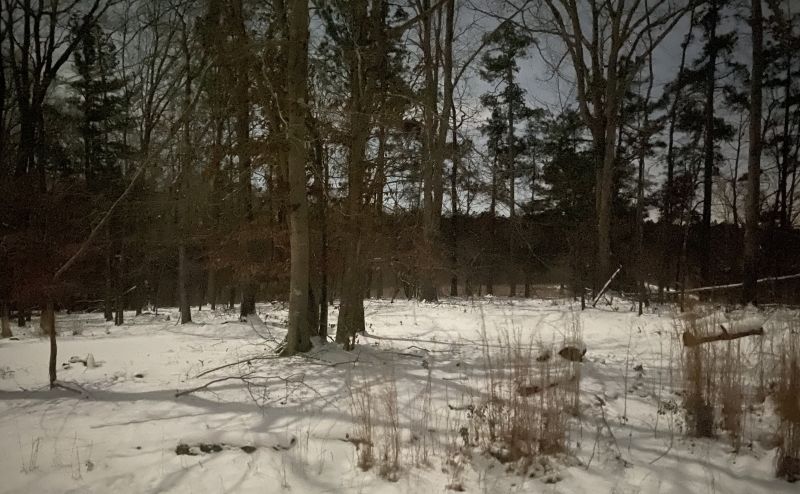
After dark, we were treated to a brilliant full moon and a cloudless sky, which made for sharp shadows on a silver-gray ground (below). Between a decline in drivers willing to brave the roads and the muffling effect of the snow, the woods were truly quiet in a way they rarely are in the crowded spaces between cities.

Sunday dawned clear and well below freezing – rising just above freezing by afternoon. Already, the roads and driveways were clearing.  The view in field and forest was still brilliant white, but patches of tan grasses and brown leaves dotted the vista.

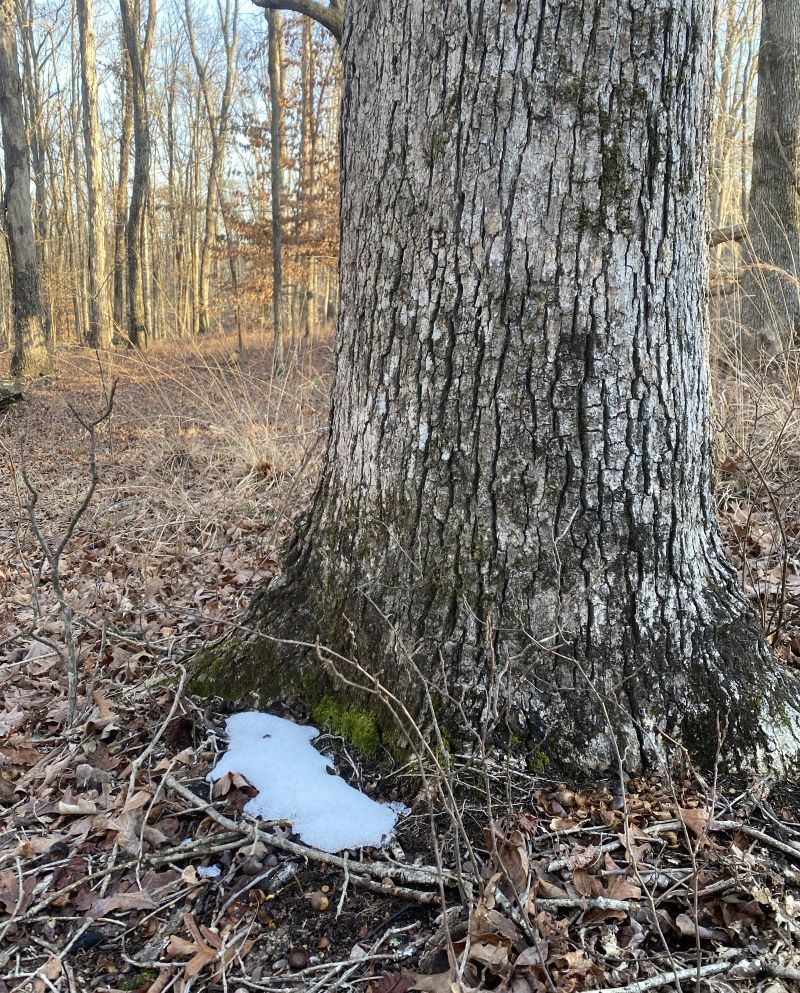
Monday’s temperature shot up to the lower 50s. The sun ate away at the snow.  By evening, the weekend’s fine powder blanket was reduced to a few coarse icy clumps huddled against the north side of trees.  By mid-week, the show was over. 

As a kid, I envied my northern counterparts their months of deep snow.  As an adult, I can enjoy the novelty of an appreciable snowfall and still be glad to return to dry ground within the week.  Probably just as well I don’t still have a sled.

Ground Cedar

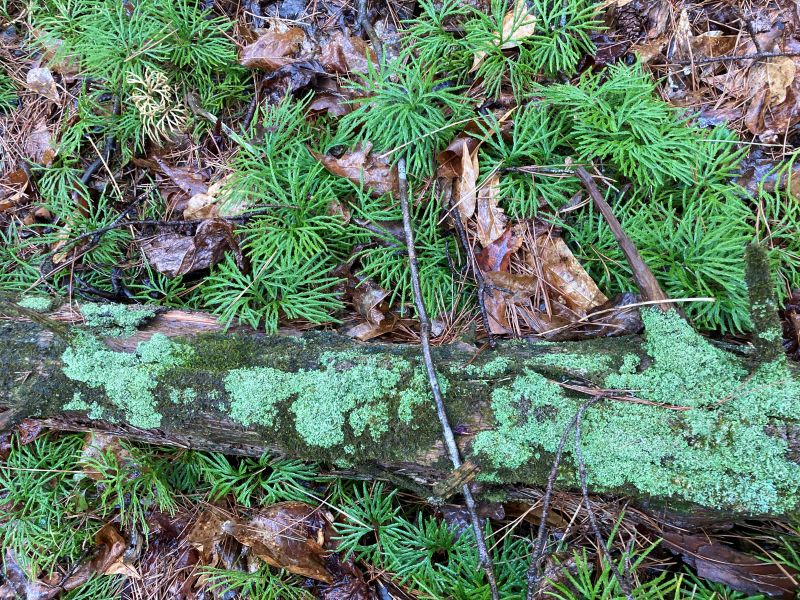
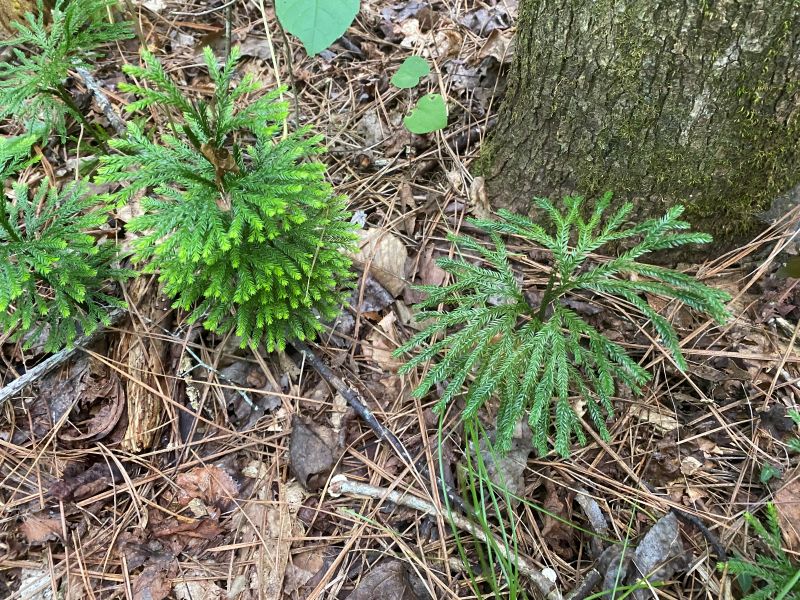
If you wander through the foothills after the leaves have fallen and the ground is dressed in shades of brown and gray, you find that a line or patch of green is liable to stand out. These tiny fan-shaped branches covered in shiny scale-like leaves stand only a few inches high, and look similar to cedar boughs; in fact, that appearance gives the plant several of its common names.

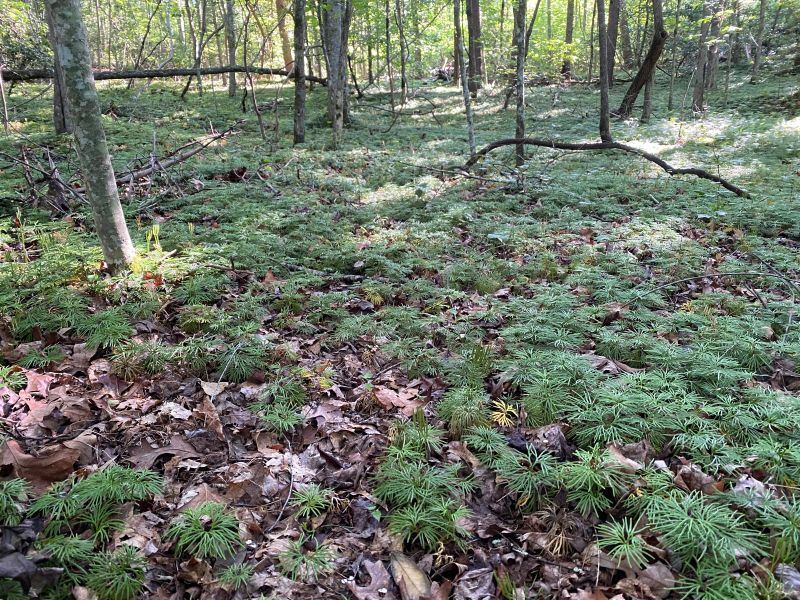
Ground cedar (Diphasiastrum digitatum), also known as running cedar, is a club moss – a type of plant more closely related to ferns than mosses.  They are diminutive relatives of the extinct tree-like Lepidodendrales that grew over a hundred feet tall in forests during the Carboniferous Period (which are interesting in themselves, for reasons I’ll relate in another post), and kin to lycophytes (also called lycopods) around the world.  Found in well-drained woodlands and pine forests, ground cedar spreads through runners along the soil’s surface or rhizomes just below the surface, with the fan-shaped leaves popping up every few inches.

The largest ground cedar stand I’ve seen was on private land in the northeastern corner of Georgia, where it covered perhaps a quarter of an acre.  Apart from that extravagant specimen, I rarely see patches more than a few feet in diameter.

Is it useful for wildlife? I haven’t seen evidence that animals consume it, and since it produces spores rather than seeds, there are no flowers to interest pollinators.  However, humans have found a number of uses for the plant.  The oily spores burn brightly but too briefly to set anything alight, making it useful for magicians’ dramatics, fireworks, and 19th century flash photography.  Spores were also used in baby powders, wound treatment, pill coatings, and as mordants for dyes.  The plant itself was used in teas and medicinal preparations. Probably its most common use in the last few generations has been as a Christmas decoration.  Being evergreen and in easy reach, it provides welcome greenery for decking the halls at a time when other foliage is brown and down.

Here’s the problem.  Ground cedar grows slowly. Spores may lie dormant for many years before germinating.  It requires the presence of certain species of fungi to thrive. A transplanted runner will almost certainly die (as I discovered some years ago).  Every runner you pull up will take a while to regrow. Decades of being harvested commercially for holiday decorations and gardens have made ground cedar scarce, and the practice continues.

Enjoy it where it lives, but leave it there, please.

Ground cedar (right), with a relative, princess pine (Dendrolycopodium obscurum)

On the Open Road

There’s an old joke about the difference between Americans and the British: “Americans think 100 years is a long time, and Britons think 100 miles is a long way.” 

Early on during our recent vacation, my wife asked where we would recommend a traveler from the United Kingdom (where we’ve traveled several times) go to get a true taste of America.  She thought a list of 10 cities – including Boston, Washington, and New Orleans – would be ideal. I countered that if a “true” taste was the goal, small towns – including the moribund ones with more churches than active businesses – should be included.  By the end of the trip, we both agreed that, wherever the journey led, it should be conducted by road.  

The country of England could fit inside the state of Georgia — the 24th largest state out of 50 United States. The lower 48 states stretch across four of the regular 24 time zones.  The distance from “sea to shining sea” measures some 2800 miles (4500 km). In 2019 we traveled in a meandering path from Woodbridge (near Ipswitch) to Boscastle in Cornwall — a trip of some 400 miles; the outward leg of this month’s trip — to Gillette, Wyoming — sent us at least 1700 miles down the road from our front porch near Athens.  The United States is so large and diverse it has been suggested that it is culturally nine or even 11 cultural and economic nations in one.  This doesn’t count the actual sovereign nations scattered across the land.  Common customs, foods, and laws vary considerably as one travels from region to region, often within a single state.

I don’t think one can conceive of the scale of the continent by hopping from airport to airport.  Our dependence on the automobile and the subsequent restructuring of cities for car travel, the sprawling nature of municipalities, the colloquial use of hours rather than miles as the measure of distance…and the only way to understand the American obsession with the Freedom of the Open Road is to experience it.  The rush of miles passing underneath your wheels. The vistas.  The loneliness.  The boredom. Praying that the first gas station in 100 miles is still open. Standing on top of your car with your arm raised in hopes of getting a signal. Crawling along in bumper-to-bumper traffic, or to drive all night with no headlights but your own. These must be experienced to get a feel for the country, because the scope of the land shaped, and continues to influence, the history, economics, culture, and politics of the nation.

Screaming Trees

I was early for a meeting in Wilkes County. With some time to kill, I followed the distant but pervasive sound of (pardon the geek reference) a phaser pistol overloading.  I parked where a neighborhood met a wooded drain, and from a roadside swamped by wisteria, I heard the steady, whining drone of untold numbers of cicadas, all looking for love.

Like many insects, cicada adulthood is merely a fraction of the insects’ total lifespan.  After hatching from eggs drilled into tree twigs, the nymphs fall to the ground. They burrow in and live in the earth for from as little as one to as many as 17 years, surviving by drinking sap from tree roots.  When the time comes, the nymphs climb up trees, poles, grass, or whatever they find to get a little elevation.  They split the back of their exoskeletal skin and molt.  Once the new exoskeleton hardens and the wings straighten and dry, they fly off to find a mate.  The males do all the calling; I can’t fathom how a female chooses one among the cacophony.  Cicadas do take time to feed, drinking plant juices, but don’t do much damage considering their numbers. They don’t bite or sting, although the deep buzz of a low-flying cicada can be startling.

Georgia is home to 20 or so “annual” species of cicada, so called because adults appear every year. After spending less than half a dozen years in the darkness, these large insects appear in the heat of the summer, buzz around in their millions for a few weeks, and then die.  They are often dull-colored or camouflaged, and more likely to be heard than seen until we find them dead on the ground at the end of their final sprint. 

There are also six species known as “periodic” cicadas.  These black and orange insects spend 13 to 17 years as nymphs before rising to deafen the neighbors.  While some annual cicadas appear every year, the periodic cicadas all rise together in tremendous broods.  This year, the trillions of members of 13-year Brood XIX are keeping folks awake from Virginia to Louisiana and up into the Midwest (Broods are multi-state masses of periodic cicadas that all rise in the same summer. A 17-year group known as Brood XIII has also risen this year in the upper Midwest).

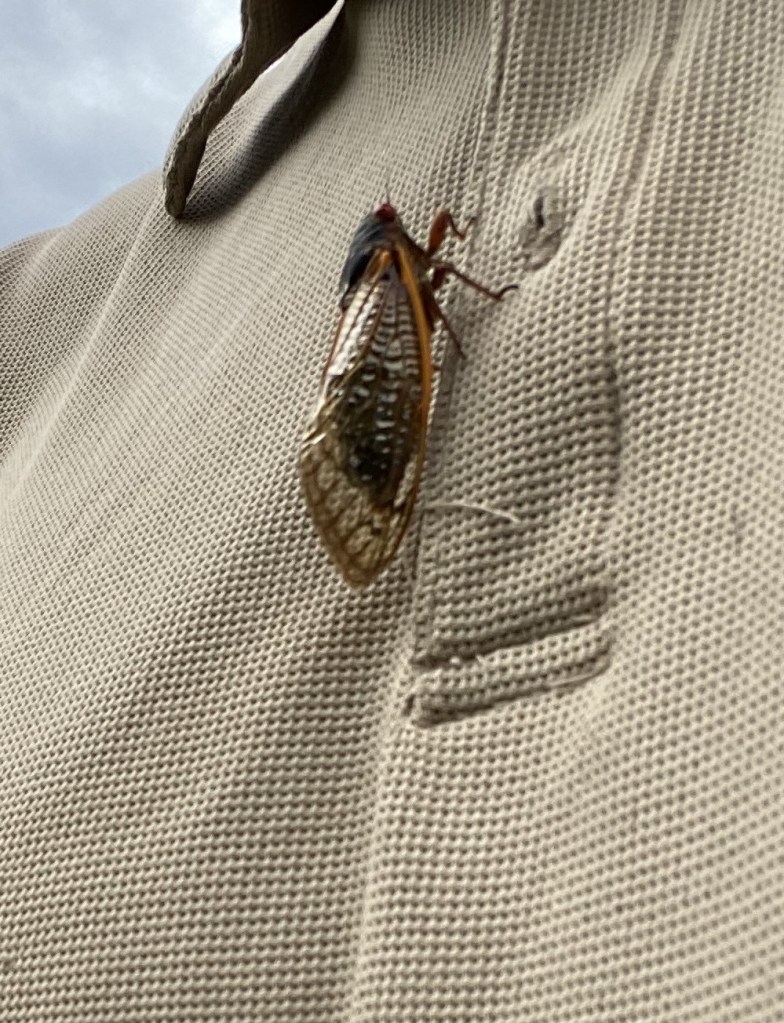
My first close contact took place just as I stepped from the truck; an orange-eyed critter landed on my shirt and stayed put for a couple of minutes before getting spooked and flying off.  Once I started looking, I saw the empty husks everywhere – dozens on a branch, sometimes one on each side of a leaf!  And while the trees ahead of me housed the vast majority of cicadas, there were several specimens amongst the shells at my feet, mostly unbothered by me even at close range. 

How many husks can you see here?

And the air was full of the wailing siren of cicada courtship. Did they reach the estimated one million per acre in these woods? All that noise suggested it was a possibility. At close range, cicada calls can reach 90-100 decibels, or as loud as a power drill! I was as close as I needed to be to the unearthly courting cries.

After a while, I set about collecting some of the exoskeletons (because that’s the sort of thing I do). A 15-foot strip of roadside netted me several dozen husks, and there were others in view that I didn’t harvest.

I took my collection back to the truck; it was time for my meeting, and the cicadas had their own business to attend.

4H student shows off her collection of exoskeletons

Further Information

Cicadas recorded at this roadside

Common Cicadas in Georgia