Trails: What Good Are They, Anyway?

Here is the second essay from Dr. Walter Cook, reprinted with permission of the author.

Trails – What Good Are They, Anyway?

By Dr. Walter Cook

This is the title of an hour-long slide show I have given many times at the Len Foote Hike Inn.  Mostly, the slides show unusual things, beautiful flowers, and other curiosities one will find along trails.  My purpose is to encourage people to walk, stroll, or hike on a foot path.  Of course, the audience at Hike Inn didn’t need any encouragement, since they walked five miles to get there, but like many hikers, they may be busy talking and not notice the interesting things they pass along the trail.

My purpose in designing, maintaining, and sometimes building trails is also to encourage others, especially those who have never walked on a woodland trail. I like to open their minds to the natural world they are in.  To me, a trail is more than an exercise facility – it is an educational facility. It “educates” a first-time visitor so they can discover that the outdoors – forest, meadow, stream – is not a threatening environment. By staying on the trail, they can see nature but they don’t have to touch it, nor let nature touch them. And after that first time, when they have safely survived the new experience, they will be less reluctant to try it again – and again and again. And on each successive experience, they will discover new things, besides the fact that the natural environment is not a dangerous place. They will begin to be curious about things they see or hear.  Soon, they will enjoy the experience. They will gradually become familiar with the natural environment, and eventually, they will want to ensure the environment remains protected.

Trails also have much to offer the experienced naturalist.  I am not a birder, but I’m sure it must be easier to enjoy birds from a trail, where there is no noisy crunch of dry leaves.  I am a wildflower enthusiast, and trails do help me to enjoy them. I hope to walk each of the trails described by Hugh and Carol Nourse in their book, Favorite Wildflower Walks in Georgia.

As a trail designer, I spend a lot of time walking “off trail.” Wandering through the forest with clinometer and plastic colored flagging is my favorite recreational activity. Although I get paid for some “jobs,” it is always enjoyable to get away from where others have been (at least recently) and discover new things.

But all the while I am tying flags, I imagine people walking on the trail after it is built.  As they see things along the trail, what will be their response? Will they like what they see?  Will they be curious about things they see?  Will they notice that some trees look alike, but unlike others? Will they wonder what kind of bird is singing so conspicuously? Will they remember to tell their friends that they had a positive experience, and encourage the friends to go with them next time?

So, if you have a friend or relative, especially a young person who isn’t familiar with the natural world, encourage him or her – no, insist they go with you on a walk. Make it an easy, short walk – don’t make it strenuous, just enjoyable.  When my granddaughter was about four, we walked a mile in my woods, and at the end, she said, “That was a gooood hike.”  I was pleased.

Additional Resources:

American Trails.org: connecting people to nature

Alltrails: Find trails by location, length, and difficulty

Webinar: Building Trails On Your Property. The page leading to the webinar has links to some great resources at the bottom.

Pitcher Plant Bog

It’s morning in late April, and spring is in full swing in the southwestern corner of Georgia. The air is warm without being oppressive, but summer is too impatient a season for that state to last long. 

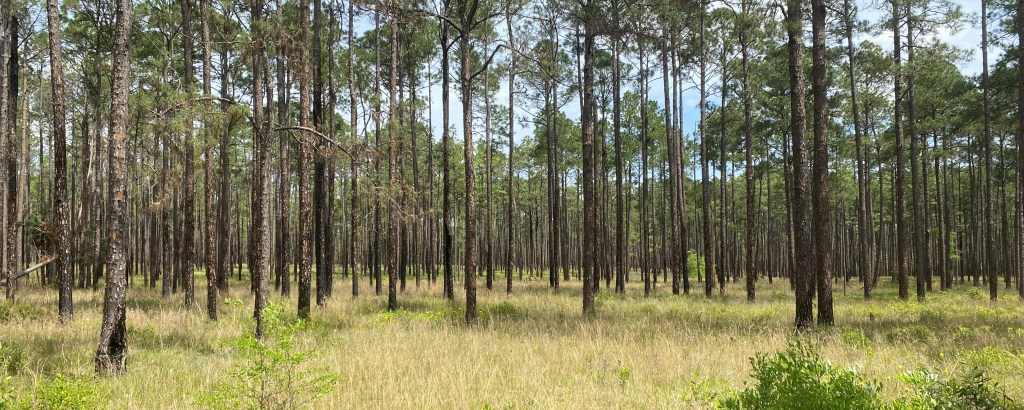
You stand in a broad, open woodland of longleaf and slash pines; a little crowded to be a proper savanna, but open enough to allow a rich mix of groundcover species. This land was clearcut in the 1940s, but unlike most of the land around it, it wasn’t converted to agriculture.  In fact, roughly a square mile (barely a postage stamp on the greater landscape) around this spot is protected as a state wildlife management area.  This is fortunate, for you get to see a remnant of this vanishing ecosystem in a more or less functional state.

When nature-watching, careful attentiveness to your surroundings is key.  A quick sweep of this woodland, and the casual observer sees a broad expanse of grasses broken here and there by clumps of shrubs.  But standing within that groundcover forces a change of perspective. One reason, of course, is that some of the more mobile denizens of the forest don’t appreciate being stepped on and will tell you so, painfully.  Others, more vulnerable, are unable to defend against a boot but still worthy of recognition and protection.  

Without close attention, you would have missed the fingernail-sized puff of pink on the ground between the deerberry and the wiregrass clump.  The sensitive brier has bipinnately compound leaves snap shut and droop suddenly when touched.  Perhaps this serves to startle herbivores or shake off leaf-munching insects, but also entertains a youth with woodwise curiosity. 

The flowers rising between grass clumps host wild bees and bright butterflies as they make the rounds; less noticeable are the beetles, flies and wasps that also sip the nectar in exchange for pollen transport.

Toothache grass

The change in elevation is too slight for a Piedmont hill-dweller to notice, but a close eye on the vegetation reveals it.  Wiregrass gives way to dropseed and toothache grass, and then to rushes.  In a matter of inches of height, the upland has become bog, and a new suite of plants surrounds you.

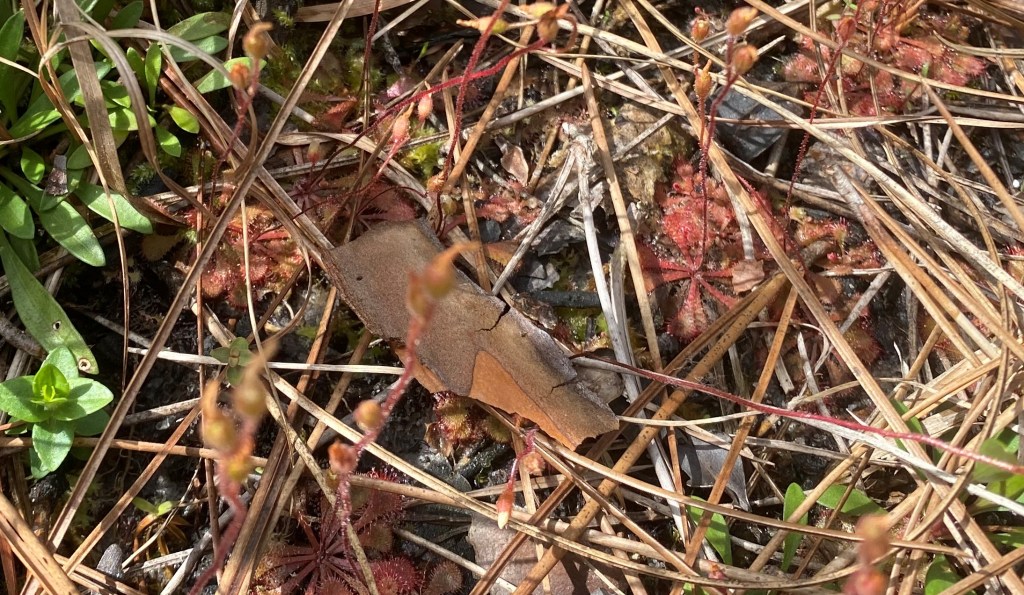
Looking down, you spot tiny reddish spots the size of a quarter, obscured by pine needles.  These are sundews, which catch and digest insects on their sticky rosette leaves.  Your new vantage point as you squat down to observe these tiny herbaceous carnivores allows you to notice the glistening sand. You didn’t realize how wet the soil was, but now you see your last footprint is filling with water.  There is no water’s edge here, just a gradual gradient that dips and rises between “dry” land and standing water.  A fallen pine provides a precarious walkway for a few yards, yet you will get wet feet soon enough. 

Sundews

Off to your left, you see what you came for: a cluster of meter-long yellow pitcher plants (aka Trumpets).  Like sundews, pitcher plants are carnivorous, digesting insects to supplement their nutritional needs on poor, wet soils.  Attracted by the scent of nectar,  bugs alight within the leaf tube, where the waxy surface and downward-facing hairs slide the victim deeper in.  Eventually, the insect falls into a pool of digestive fluid, where it drowns and dissolves.  You also see the less lethal flowers among the pitchers; they too lure pollinators in, but allows them to escape after being dusted with pollen.

Your old-timer guide tells you he remembers, back in the 80’s, driving down the interstate and seeing fields of pitcher plant trumpets for mile upon unbroken mile.  But agriculture, industrial logging, and other development made the land inhospitable for these persnickety plants.  These bogs feature shallow, consistent, year-round water supply, and even a tire rut (or repeated human traffic) can alter the hydrology enough to make a spot unsuitable.  This particular woodland is protected from development and burned periodically to keep it open. 

Management burn. Photo by Joe Burnam, Ga DNR

Managers ran a prescribed fire through this bog last June, and already some bays, gallberry, and other shrubs are making their presence known.  A few years without fire would change the plant makeup of this woodland and threaten pitcher plants, sundews, sunny bells, and most of the plant and animal diversity you find here today. 

Your guide says it’s time to head out.  Carefully picking your way to “higher” ground, you find a footpath and say good day to the pitcher plant bog.  As you reach the dirt road you drove in on, you see the highway.  Cars pass by, driven by people with no interest in places like a pitcher plant bog.  It’s sad because they can’t appreciate the intricate, rich, and delicate web of life that still exists.  But perhaps it is also fortunate, because places like these tend to suffer when they receive too much human attention.

Additional Resources:

Longleaf Pine Ecosystem from Wikipedia

Perched and Pondering

Many hikers are on a mission.  I know I often am.  You have to have a determined focus to reach the set goal when your legs suggest now would be a great time to take a long break.  But when you reach that summit, stand by that waterfall, get your selfie by that marker – then what?  When time allows, I like to spend some time just soaking up the scenery, both distant and at my feet. 

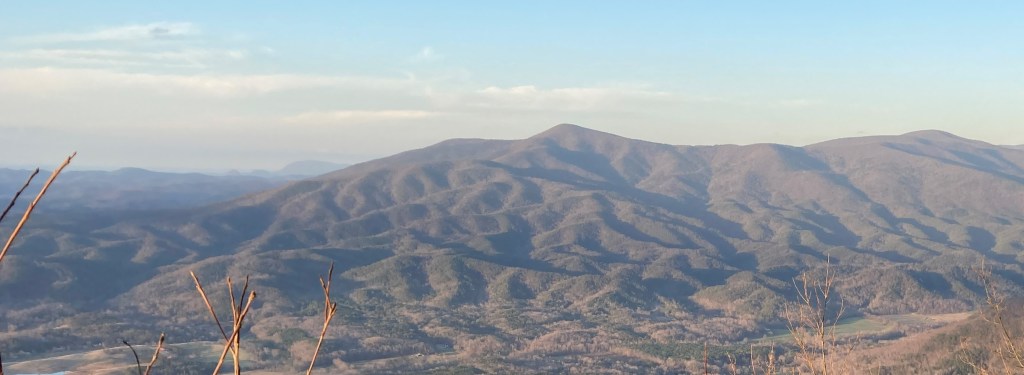
Such is the case at the end of February, as I climb the short trail past the stone fire tower and out to the overlook on Fort Mountain.  It is one of the sentinels of the Blue Ridge Mountains, glaring westward at the low wavelike mountain ridges breaking across the wide valley.

The Fort Mountain overlook is a series of stone outcropping on which the parks department built wooden platforms for people to stand and appreciate the view from some 1800 feet above the valley floor.  Near the platform is a boulder resembling a rough chair.  I fancy it to be my bardic throne, to perch on and ponder whenever I find myself in that corner of the state.  I, who fidgets after ten minutes in front of the television, find new reserves of patience in this place amid the stones lichens and briers at the edge of air. 

When the wind stills a moment, I hear the soft rush of water hundreds of feet below.  I enjoy the novelty of watching a buzzard soaring beneath me.  And shadows lengthen. 

There were reminders of humanity, of course.  The steady roar of the distant interstate and nearer highway carries on the wind.  Much closer visitors to the mountain cough and sneeze, and occasionally thump past on the boardwalk between stairs and platform.  But they sweep the vista with their eyes, and after five minutes they take their selfies and return the way they came.  The disturbances come less often as the evening progresses and dinnertime nears.

To the northeast, Grassy Mountain spreads low and wide with hollows upon hollows and fractalling folds in the mantle of trees. I am content to watch the shadows form in those folds, like the substance of the incipient evening growing in the crevices where the waning sun can no longer reach.

Time passes and the tide of shadow washes across the valley, not as a line on the shore, but in fits and starts.  I watch a level field as the light fades all at once, then follow forest-shaped shadows creeping in a jagged line up a hillside clearing.  At length, the sun retreats from my chair and the woods behind me, while still lighting the shoulders and summit of Grassy Mountain.  

The final moments of daylight are muted as the sun falls behind a hazy cloud cover.  Only the very top of Grassy Mountain shows the faintest traces of sunset’s glow.  After a good two hours, the curtain has gone down on this act; I will navigate the rocky trail before the light fails and the stars begin their dance.

Only a few moments are necessary to “claim” a view. But I’ve climbed this trail many times and  seen this mountain in various moods over the last three decades.  There is much more to see if I devoted my time to it. But if I don’t get up this way for a few years, I can be reasonably sure that the trail, the boulder, and the view will still be waiting should I have an hour or two to spare.

The next time you visit some landmark, set aside time to actually be there, to let it sink into your senses and leave a proper impression.  If you don’t get to know the spirit of a place, can you really say you’ve been there?