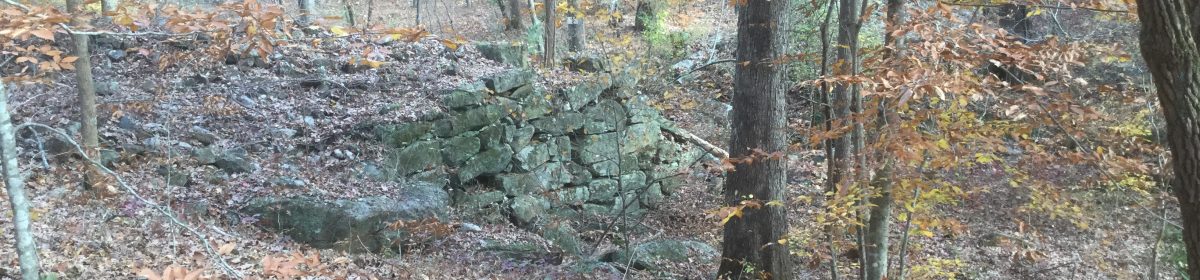
Oak Savannas: Rediscovering an Old Idea

As stated in the past, fire is a key element in shaping a forest or grassland.  Prairies in the west and south and longleaf savannas have been discussed previously.

Thinning and burning are well-known and critical practices for anyone wanting to manage pinelands for wildlife in general and deer and bobwhite quail in particular.  But you may be surprised to learn that thinning and burning can be just as important in upland oak stands.

The idea of burning hardwoods — on purpose! — was unheard of in my college days.  Oak savanna management seems to get more discussion among conservation communities in the Midwest, which Aldo Leopold poetically described as the battleground of a 20,000-year war between prairie and forest.  But there is archeological and botanical evidence of open woodlands throughout the South before farming and development changed the landscape.  We have seventeenth century accounts of savannas and open plains in the upland Carolinas, eighteenth century records of bison in Piedmont Georgia, and reports of hilly grasslands with scattered pines and oaks; naturalist William Bartram often alluded to natural strawberry fields that dyed the legs and feet of his horses in his botanical journeys through the southeast in 1776. 

It is clear that fire, whether lightning-caused or set by the native population, maintained open woodlands across Georgia.  Conversion of land to agriculture or other development altered the landscape before there was any opportunity for photographic evidence of its open character; subsequent abandonment of farmland and fire suppression in the 20th century resulted in the dense forests that many mistake for our land’s “natural,” precolonial state.

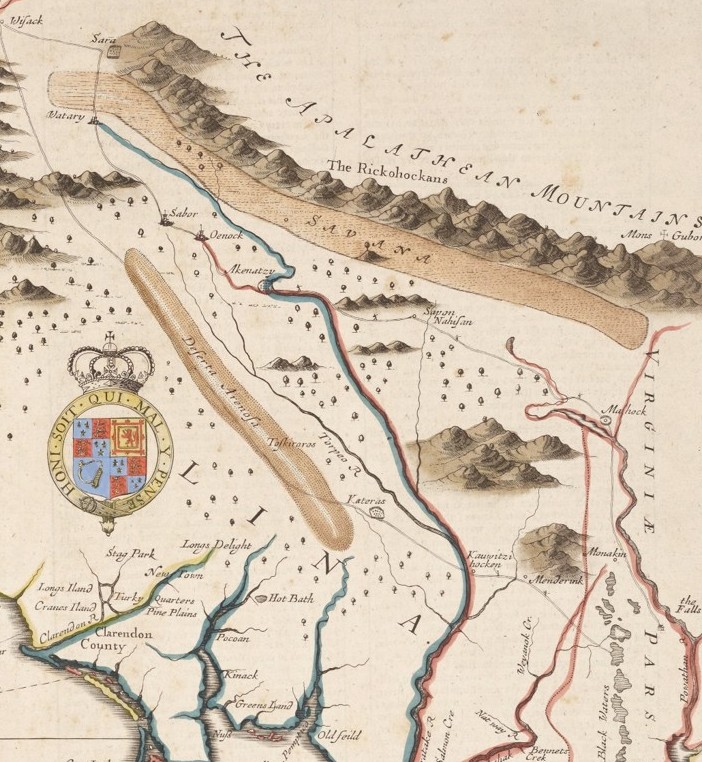
Map of Lederer’s travels, c.1670
Savanna marked in the Carolina Piedmont
What is a Savanna?  What is a Woodland? We define whether an area is a savanna, woodland, or forest based on a measurement of the canopy closure – that is, how much of the sky is obscured by vegetation in the tree canopy when viewed from a single spot.  A forest has 80% or more canopy closure, while a woodland has 30-79% canopy closure.  A savanna has 10-29% canopy closure; less than 10% canopy is considered a prairie.
Hornaday’s map showing the retreat of bison from the southeast.

How is this relevant to land managers today?  Although the landscape has changed considerably in the intervening time, the habitat requirements of deer, turkey, quail, and other species haven’t.

Lake Russell Wildlife Management Area, Georgia

Just like closed-canopy pine stands, mature hardwood forests lack diverse groundcover. Quail need that mix of native grasses and broadleaved forbs, but so do deer and turkeys – more so than many hunters realize.  Managing part of a property as an open woodland or oak savanna will provide valuable cover and forage for deer – not to mention food for pollinators, and insects for poults and chicks.  In the Piedmont, where most open lands are either cropfields or hayfields, there just isn’t much year-round native forage. 

When creating an oak savanna as with creating a pine savanna, the first step involves cutting unwanted trees.  Hilltops and slopes with southern and western exposures are warmer and drier than northern slopes and valleys, making them good candidates for a fire-managed woodland.  If the trees are merchantable, you will have to make sure the contractor is aware that you want to leave some of the most valuable trees – oaks, and particularly white oaks.  If your tract is too small or the trees are not mature enough to interest timber buyers, you can cut down or girdle unwanted stems yourself until you reach the desired density.  An immediate follow-up with the appropriate herbicide will usually be necessary to control stump sprouting and seedling release. 

Birdwatcher in an oak woodland, Fontenelle Forest, Nebraska

The land is always growing towards a climax forest, so frequent disturbance on the ground is key to renewing new ground cover and keeping tree saplings from filling in the open spaces.   As you know, fire is one of a wildlife manager’s most important tools.

“But won’t I burn up my hardwoods?” I hear you say.  It is true that some hardwoods – beeches and maples, for example – are not fire-tolerant.  Others, such as most oaks and particularly post oak and blackjack oak, have thicker bark and heal quickly from injuries.  The shortleaf pine, an upland native, is more fire-resistant than loblolly pine and fits in well with this savanna scenario.   

Like any tool, it can produce different results depending on how it is used. Work with a forester to put together a burn plan that will help you achieve your wildlife habitat goals safely.

Additional Resources

Ecology and Management of Oak Woodlands and Savannahs (a pdf)

Fire in Eastern Oak Forests — a Primer (pdf)

Georgia Department of Natural Resources’ page on fire in the many ecoregions of the state.

The Piedmont’s Lost Prairie

Southeastern Grassland Institute

Siding With The Grasses

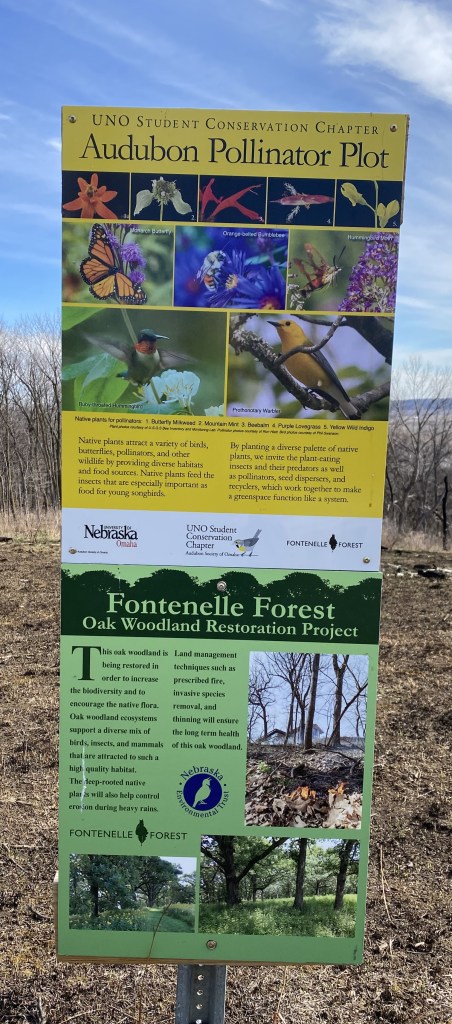
As mentioned in the previous post, I was in Omaha a week ago.  After conducting my business, I planned to treat myself by visiting Neale Woods to see the slice of tallgrass prairie the naturalists at Fontenelle Forest were restoring.  Upon arrival, I was momentarily disappointed to discover that the grassland and much of the woods had been put to the torch only a couple of weeks earlier.

I say momentarily disappointed, but I’d add a naturalist’s delight.  This was an opportunity to get a better look at the efforts to recover a corner of prairie from a century and a half of neglect.

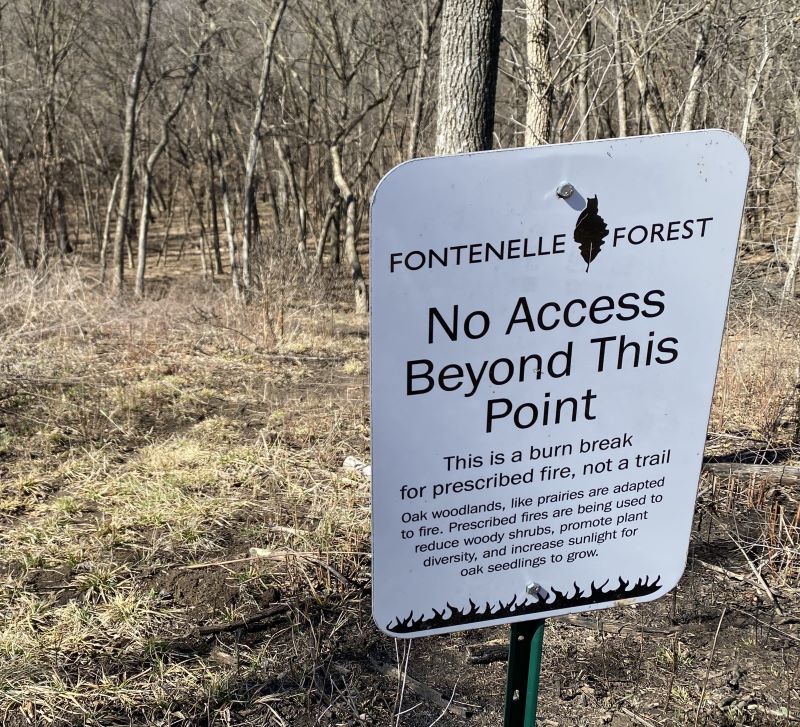
The prairies and oak savannas of the Midwest, like the pine savannas of the Southeast, are by their nature constantly under threat from ecological succession.  Shrubs and trees push towards the interior in a never ending campaign, threatening to block the sunlight from all vegetation laying closer to the ground.  Fire – from lightning and anthropogenic sources – was always the prairie’s greatest weapon of defense and conquest in what Aldo Leopold termed the “prairie war” between grassland and forest.  When the sodbusters began plowing the dark prairie soil to grow crops, they also banished fire from the uncropped land – for fire endangered buildings and livestock, not to mention the trees that offered their wood to the settlers and later to industry.  And so it was that many oak savannas, through deliberate fire exclusion and general neglect, grew thick canopies — stealing sunlight from the grasses and forbs that needed it. 

The prairie lost all the land that could be farmed.  Without its ally, fire, it surrendered the rest to the forest.   Even the oak savannas, a neutral ground of sorts where grasses and trees coexisted, reverted to forest as less fire-tolerant tree species crowded in to create closed-canopy forests. Of the 50 million acres of oak savanna existing in the middle reaches of the United States and southern Canada prior to European settlement, only around 30,000 acres remain in scattered pockets.

However, the pendulum is shifting back a fraction. In recent decades, knowledge of the elements and interactions of this hybrid of prairie and woodland community have been joined with a will to preserve or recreate said hybrid. 

In Neale Woods, it began with the setting aside of loess hills ill-suited for farming. Then came the restocking of prairie plants in openings in the tree canopy.  Now as I looked around, I saw evidence of the continuing efforts to create an open oak savanna.  Low stumps, which would have been hidden by tall grass but were easily seen in the ash, showed the ecologist’s direct interventions against individual trees.  Larger trunks, though still standing, were neatly girdled – not indiscriminately, only individuals or small clusters, just at the margins of existing openings.  And of course, there was prescribed fire, free to do its work within the confines of subtle firebreaks.  It burned away leaf litter, scarifying forb seeds and exposing bare soil for the next generation of ground cover.  Some tree seedlings died, others were topkilled.  Fire found chinks in the bark armor of some older trees, burning deeper wounds. 

Girdled trees

Sounds catastrophic, perhaps.  But for the flora and fauna adapted to fire long before the axe or plow made their marks, fire is a part of life – a trial to be periodically overcome but which leaves the survivors in better shape.  The larger bur oaks are nearly impervious to the low-running grass fires and were scarcely troubled; they will have less competition for roots and perhaps for sky.  The mountain mint and bloodroot, the beebalm and bluestems will grow vigorously.  Wildlife, including the rabbit whose droppings I saw by the trail or the wild turkeys that I watched foraging for baked acorns and roasted insects, make use of the invigorated ground cover.  Nectar-feeders, from monarch butterflies to longhorn bees, will fill the air come summer, as will the songbirds who arrive to feed in the humming air above the prairie.  The blackened crowns of the native grasses were already sprouting green sprigs, promising a return to tall grasses waving in the summer wind.

I commend the biologists and their supporters who are bringing back the oak-grassland savanna in this corner of Nebraska.  In the war between forest and prairie, these conservationists have sided with the grasses.

Additional Information:

News report on this fire

A view of Neale Woods in October

A brief view during the growing season.

Fontenelle Forest, stewards of Neale Woods.

Lighter Wood

Lighter wood.  Fatwood.  Fat lighter’d.  Heart pine. The woodsman’s friend, a natural fire starter.  Burns hot, even when wet. 

What is it? 

There are a number of pine species under the umbrella of “southern yellow pine.”  They tend to be more resinous than other pines, and much more than most hardwoods.  This quality was of great value in the 18th-19th centuries and was used to produce oils, pitches, and resins for caulking planks and waterproofing ropes and canvas. So valuable were these products that they were termed “naval stores” and considered a strategic resource critical for maintaining ships of war in the Age of Sail. While wooden navies are a thing of the past, these pine-based compounds are still used in a variety of products from cleaning oils to varnish.

Log of solid fatwood

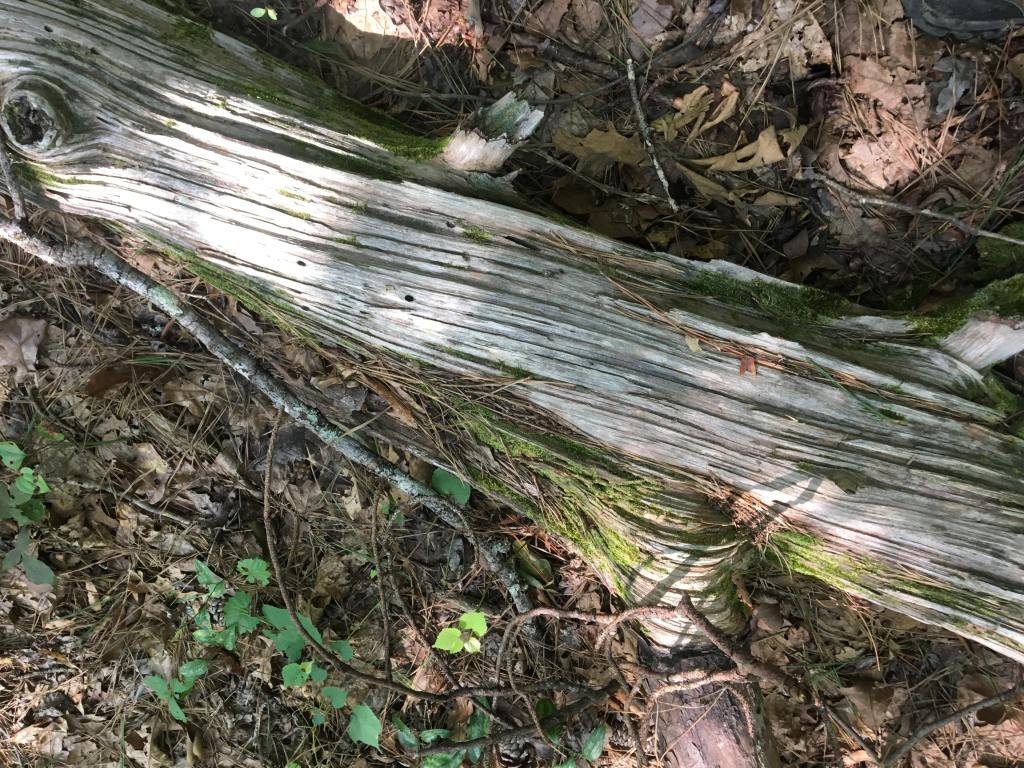
As pines grow, they add sapwood beneath the bark, expanding the girth of the tree.  The cells in the interior die, forming the heartwood of the tree.  In yellow pines, the heartwood is impregnated with the resin, making it very hard, rot-resistant, and highly flammable.  When a mature pine dies, the sapwood will decay over time, leaving the gray bones of the heartwood.  Often, the base of early limbs will remain as pine knots or “lighter knots.”  Slice open the scabrous surface, and you’ll see golds and reds of tree rings soaked in resin.  Smell the cut – that’s the scent of turpentine, and very distinctive.

Longleaf pine log– the darker wood is the heartwood

Here in Georgia, longleaf and slash pines were the best producers of lighter wood; they were largely found in the Coastal Plain.  In the Piedmont, shortleaf, while not as prolific of a sap producer, also creates fatwood.  And loblolly can now be found all over the state, although rarely is it left to grow long enough to develop lighter except in its stump.

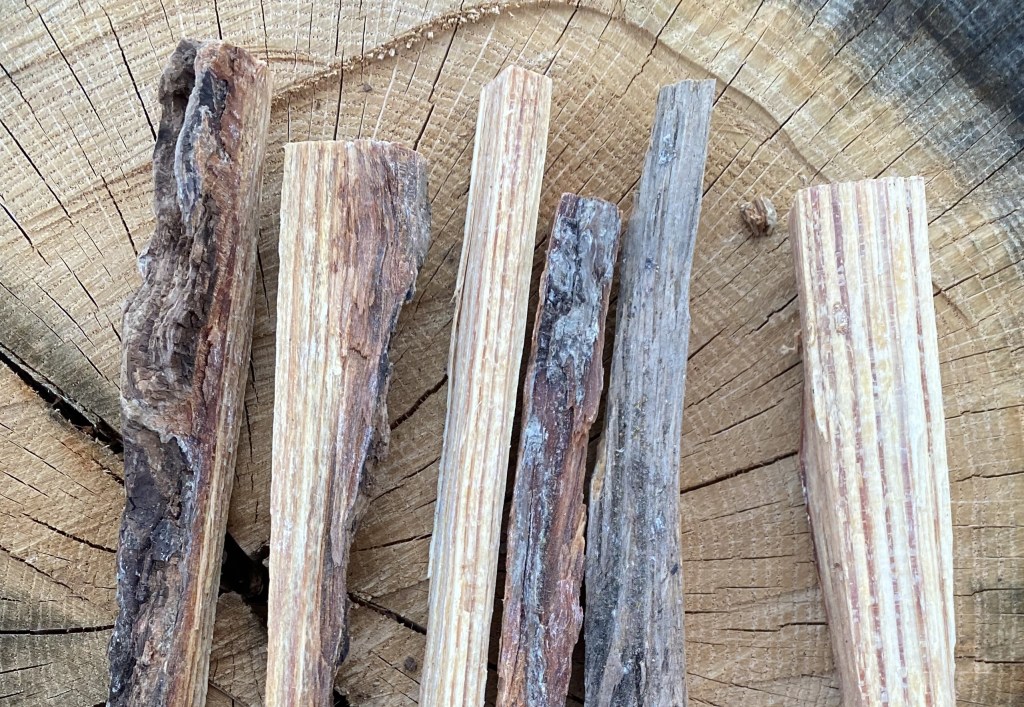
Lighter log split into sticks

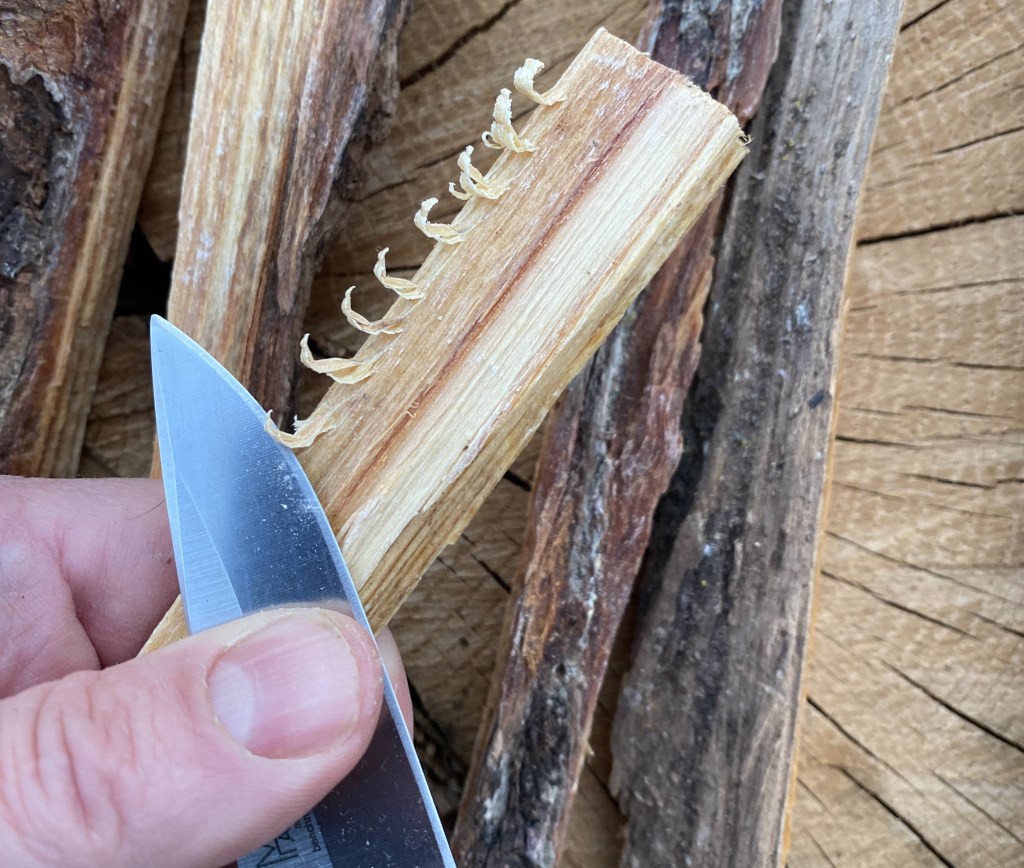
Fatwood burns hot — hot enough to set larger logs on fire.  That’s what makes it a prime kindling wood, even when damp. However, use it with caution and sparingly.  Shavings from a piece of lighter wood will be set alight by tinder and in turn burn other kindling. Larger pieces will light larger branches directly.  Fatwood is commercially available in small sticks, maybe ½” on a side.  You do not want to toss a large chunk on the fire.  You certainly don’t want to put large pieces in a wood stove – seriously, the intense heat could damage the stove.  Also, the pine resins exude thick, oily smoke when burned, so you don’t want to cook over a fire until all the lighter has burned away – unless you like using turpentine and soot for seasoning.

“Feathering” the wood to make it catch fire faster.

Lighter wood has been part of the fire kit since I was old enough to be trusted with matches.  But not everyone is familiar with it (otherwise, why would I write this?).  I’ll close out with a story from the time my Dad took some students on a field trip.  He asked one of them to find some lighter wood to start the fire.  The young man returned with an armload of punky old branches.  “Couldn’t you find any lighter wood?” he asked the student; newbie hefted the dry, rotten sticks and replied, “Well, I couldn’t find wood any lighter than this!”

Shortleaf stump

Preaching to Deniers

Back in college, I had a friend that would believe pretty much anything nature-related I told him. I was the biologist-in-training, after all (I didn’t abuse that trust.  Honest).  When he asked if male white-tailed deer grew a new tine on their antlers every year, I explained how the bone of antlers is covered in fine fur and vascularized, growing from nubbins to full size in the space of half a year.  At that point, the soft tissue dries and is rubbed off, leaving the hard bone.  The antlers don’t grow any more, but stay on the deer’s head until well into winter, when they fall off.  Then the cycle starts anew, and the buck, now a year older, may well grow a larger set of antlers.

Fast forward a decade or so.  I was a biologist at some expo or another; the table was decked with bones, tortoise shells, snake skins, and other bits of natural detritus with which to engage the public in conversations about how cool nature is. A woman came by, looking with mild distaste at my display.  At last, she pointed at the shed antler I’d picked up in the woods.  “Did you kill that deer?” she demanded.  I launched into my spiel on the antler growth cycle with the enthusiasm of a young professional naturalist.  I ended my micro lecture with a verbal coda indicating how interesting I found the whole process.

“Uh-huh.”  Not the reaction I was expecting.  She clearly didn’t buy a word that I said, because I was certainly lying to cover up evidence of my Bambicide.  Nonplused, I showed her the burr, running my finger over the rough transitional surface where the antler detached from the pedicle on the buck’s head; it was obviously not sawn off a dead deer.  Still didn’t matter.  I felt the weight of her judging gaze as she proceeded to visit another table featuring less unsavory characters than government biologists like me.

Earlier this week, I was talking with someone about one aspect of my job: advocating for certain suites of native plant species, a process that often involves removing non-natives as well as native species of a different seral community.  I went on to say that forest thinning and regular regimes of prescribed burning are standard management tools in the southeastern US. Foresters and wildlife biologists are trying to create openings in forests to bring back endangered animals, but ironically those plans are halted by lawsuits from well-intentioned “nature lovers” who think all forests should be climax forests, and that any tree cutting was only for the profit of the timber industry.

My correspondent suggested, “Maybe the scientists could do some educational outreach and turn the nature lovers into volunteers. When folks understand the science, they become great advocates.”

Oh, one would believe so.  And don’t think we don’t do outreach.  Here’s a secret about biologists: we are often very knowledgeable introverts.  One of the things that draws us to a career in the outdoors is limited contact with people.  Further, a biologist often knows that a casual question from a visitor at a booth will have an answer that encompasses an hour’s lecture of foundational background, examples, and counter-examples.  They must mentally distill this into a 20-second soundbite that still sounds convincing to the layman. 

And even if we were all ecological advocates with the eloquence of Carl Sagan, delivery of the message is only half the battle.  The receiver still must accept it, and there are several barriers to overcome.

Let’s start with the power of emotion.  Emotion is immediate and viscerally satisfying, while one must be patient and discerning with facts.  I can point to a browse line and explain why humans must cull a deer herd, but weighed against a photo of a hunter-killed deer I may well lose the argument.  My coworkers can list the plant and animal species endemic to a longleaf savanna ecosystem, but can that compete with the image of the charred, barren forest floor that is periodically  necessary to preserve those species?

The next hurdle is the cognitive bias. Certain members of the public dismiss our voices, particularly in the last couple of decades.  Is it because they’ve been lied to by dishonest authorities? Because they’ve been trained by fringe news sources to assume anyone coming out of a university has a hidden agenda?  We can’t be certain of the reason, but the result – skepticism veering into denial – is evident.

Finally, there is the willingness to change.  This seems to be the highest hurdle.  The ability to change one’s opinion when presented with new facts seems as rare and as valuable as any superpower.  The shed-denier at the beginning of this essay is but one of many I’ve encountered in person or via social media. “I’m entitled to my opinion” is acceptable in matters of personal taste, but too many in today’s society take it to mean, “My ignorance is as valid as your specialized knowledge.”

If you are reading this, likely you are part of the choir I’m preaching to; you’re nodding because you’ve probably had run-ins with the arrogantly ignorant folks who believe their emotional opinion overrules your fact-based assertion. But if I am fortunate enough to capture a pair of fresh eyes linked to an open mind, please believe that I am not getting paid under the table by Big Timber.  My interest in nature began with reading about dinosaurs as a toddler and has never waned.  If I tell you something about the natural world, it’s what I believe to be true.

I have been around long enough to know there are no simple solutions.  Improving habitat for one species may be detrimental for another. One of the more difficult parts of a biologist’s job is to condense this knowledge into an elevator pitch that will enlighten someone who may be happier in the dark.

Pitcher Plant Bog

It’s morning in late April, and spring is in full swing in the southwestern corner of Georgia. The air is warm without being oppressive, but summer is too impatient a season for that state to last long. 

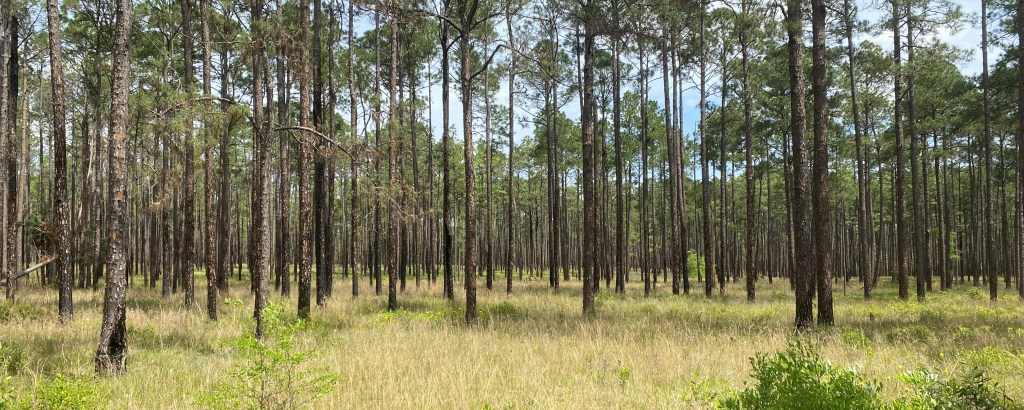
You stand in a broad, open woodland of longleaf and slash pines; a little crowded to be a proper savanna, but open enough to allow a rich mix of groundcover species. This land was clearcut in the 1940s, but unlike most of the land around it, it wasn’t converted to agriculture.  In fact, roughly a square mile (barely a postage stamp on the greater landscape) around this spot is protected as a state wildlife management area.  This is fortunate, for you get to see a remnant of this vanishing ecosystem in a more or less functional state.

When nature-watching, careful attentiveness to your surroundings is key.  A quick sweep of this woodland, and the casual observer sees a broad expanse of grasses broken here and there by clumps of shrubs.  But standing within that groundcover forces a change of perspective. One reason, of course, is that some of the more mobile denizens of the forest don’t appreciate being stepped on and will tell you so, painfully.  Others, more vulnerable, are unable to defend against a boot but still worthy of recognition and protection.  

Without close attention, you would have missed the fingernail-sized puff of pink on the ground between the deerberry and the wiregrass clump.  The sensitive brier has bipinnately compound leaves snap shut and droop suddenly when touched.  Perhaps this serves to startle herbivores or shake off leaf-munching insects, but also entertains a youth with woodwise curiosity. 

The flowers rising between grass clumps host wild bees and bright butterflies as they make the rounds; less noticeable are the beetles, flies and wasps that also sip the nectar in exchange for pollen transport.

Toothache grass

The change in elevation is too slight for a Piedmont hill-dweller to notice, but a close eye on the vegetation reveals it.  Wiregrass gives way to dropseed and toothache grass, and then to rushes.  In a matter of inches of height, the upland has become bog, and a new suite of plants surrounds you.

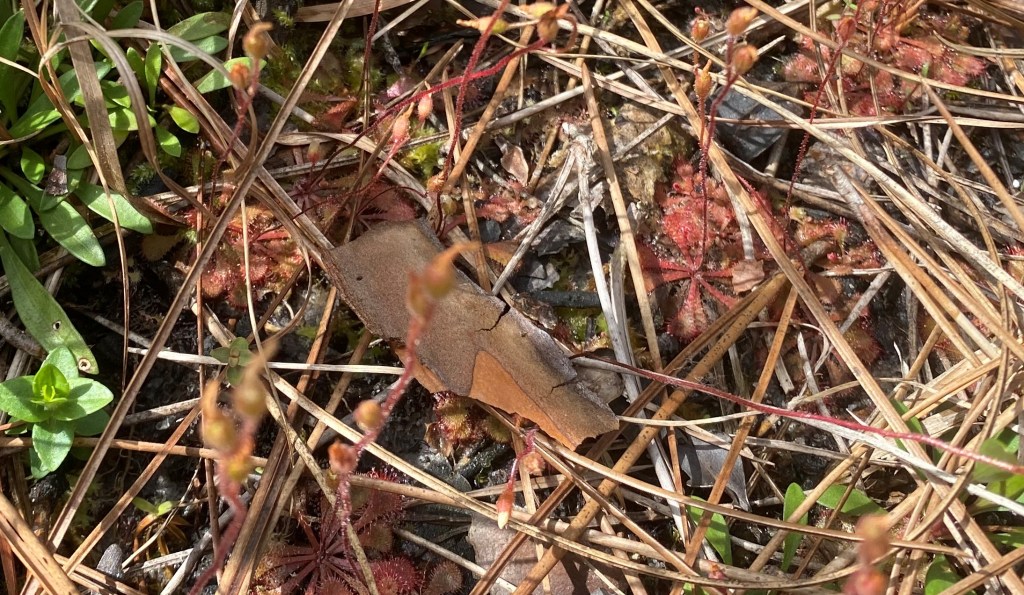
Looking down, you spot tiny reddish spots the size of a quarter, obscured by pine needles.  These are sundews, which catch and digest insects on their sticky rosette leaves.  Your new vantage point as you squat down to observe these tiny herbaceous carnivores allows you to notice the glistening sand. You didn’t realize how wet the soil was, but now you see your last footprint is filling with water.  There is no water’s edge here, just a gradual gradient that dips and rises between “dry” land and standing water.  A fallen pine provides a precarious walkway for a few yards, yet you will get wet feet soon enough. 

Sundews

Off to your left, you see what you came for: a cluster of meter-long yellow pitcher plants (aka Trumpets).  Like sundews, pitcher plants are carnivorous, digesting insects to supplement their nutritional needs on poor, wet soils.  Attracted by the scent of nectar,  bugs alight within the leaf tube, where the waxy surface and downward-facing hairs slide the victim deeper in.  Eventually, the insect falls into a pool of digestive fluid, where it drowns and dissolves.  You also see the less lethal flowers among the pitchers; they too lure pollinators in, but allows them to escape after being dusted with pollen.

Your old-timer guide tells you he remembers, back in the 80’s, driving down the interstate and seeing fields of pitcher plant trumpets for mile upon unbroken mile.  But agriculture, industrial logging, and other development made the land inhospitable for these persnickety plants.  These bogs feature shallow, consistent, year-round water supply, and even a tire rut (or repeated human traffic) can alter the hydrology enough to make a spot unsuitable.  This particular woodland is protected from development and burned periodically to keep it open. 

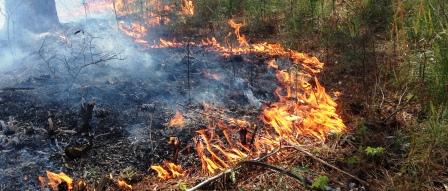
Management burn. Photo by Joe Burnam, Ga DNR

Managers ran a prescribed fire through this bog last June, and already some bays, gallberry, and other shrubs are making their presence known.  A few years without fire would change the plant makeup of this woodland and threaten pitcher plants, sundews, sunny bells, and most of the plant and animal diversity you find here today. 

Your guide says it’s time to head out.  Carefully picking your way to “higher” ground, you find a footpath and say good day to the pitcher plant bog.  As you reach the dirt road you drove in on, you see the highway.  Cars pass by, driven by people with no interest in places like a pitcher plant bog.  It’s sad because they can’t appreciate the intricate, rich, and delicate web of life that still exists.  But perhaps it is also fortunate, because places like these tend to suffer when they receive too much human attention.

Additional Resources:

Longleaf Pine Ecosystem from Wikipedia

Destroying the Woods to Save Them

This title for this essay was inspired by an infamous phrase quoted by war correspondent Peter Arnett.  Bến Tre City had been heavily bombed and shelled in an effort to drive out the occupying Viet Cong, and an unnamed officer remarked that “It became necessary to destroy the town to save it.”

How is that relevant?  Every year, smoke rises from forests in the coastal plain.  Some folks might be appalled to see forest managers with drip torches, running strings of fire through their woods.  It looks like a case of destroying the woods, but we really are trying to save it.

fire front

In south Georgia we have the remnants of an ecosystem  maintained through natural and man-caused fire (The former by lightning, the latter by Native Americans and later by the settlers who supplanted them).  The longleaf pine, one of our more fire-tolerant trees, thrives in a community which is not only well-adapted to frequent fire, but encourages its spread.  Depending on where the particular habitat is, there may  scores of plant species mixed together: bunch grasses, legumes, wildflowers and other forbs– including many not found anywhere else.   The fauna of these communities are equally rich and varied, and include a number of  grassland birds such as bobwhite quail, meadowlarks, field sparrows, and indigo buntings.  Some threatened and endangered plants and animals are only  found in this ecosystem.

What brings these species together to form a community? In the highly competitive natural world, resilience to fire gives these species an edge over others. Vegetation that can survive periodic burning enjoys the benefits of  abundant sunlight and less competition; highly flammable parts such as dried grass and pine needles actually promote a fire’s spread.  The insects, birds, reptiles, and mammals present here have evolved to exploit the local vegetation’s bounty of seeds, fruit, and accompanying insects; those animals who aren’t fleet enough to escape the flames will utilize burrows or make their own (literally hundreds of species of invertebrates, reptiles, mammals and even birds will find shelter in gopher tortoise burrows).

Now, you’ve probably seen the western fires, with roiling smoke and flames tearing through the treetops.  That’s not what we’re talking about here.  Generally speaking, we see low-intensity fires in frequently-burned longleaf forests – flames rising to three or four feet high.  The grasses, fallen pine needles and other detritus act as fuel to carry fire across the landscape, killing hardwood seedlings and any other plants that aren’t adapted to fire  (and occasionally some that are – survival of the fittest and all that).tall timbers Continue reading “Destroying the Woods to Save Them”