Oak Savannas: Rediscovering an Old Idea

As stated in the past, fire is a key element in shaping a forest or grassland.  Prairies in the west and south and longleaf savannas have been discussed previously.

Thinning and burning are well-known and critical practices for anyone wanting to manage pinelands for wildlife in general and deer and bobwhite quail in particular.  But you may be surprised to learn that thinning and burning can be just as important in upland oak stands.

The idea of burning hardwoods — on purpose! — was unheard of in my college days.  Oak savanna management seems to get more discussion among conservation communities in the Midwest, which Aldo Leopold poetically described as the battleground of a 20,000-year war between prairie and forest.  But there is archeological and botanical evidence of open woodlands throughout the South before farming and development changed the landscape.  We have seventeenth century accounts of savannas and open plains in the upland Carolinas, eighteenth century records of bison in Piedmont Georgia, and reports of hilly grasslands with scattered pines and oaks; naturalist William Bartram often alluded to natural strawberry fields that dyed the legs and feet of his horses in his botanical journeys through the southeast in 1776. 

It is clear that fire, whether lightning-caused or set by the native population, maintained open woodlands across Georgia.  Conversion of land to agriculture or other development altered the landscape before there was any opportunity for photographic evidence of its open character; subsequent abandonment of farmland and fire suppression in the 20th century resulted in the dense forests that many mistake for our land’s “natural,” precolonial state.

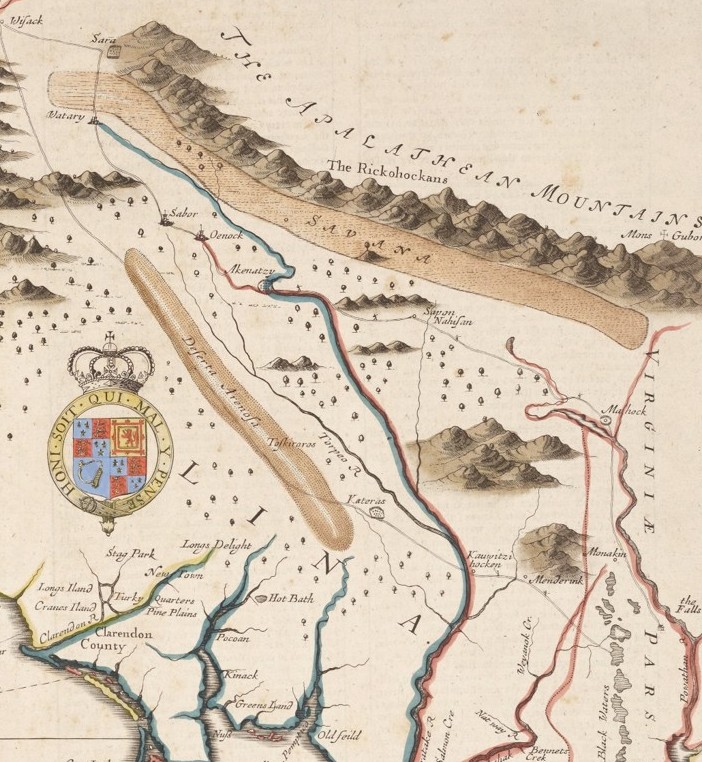
Map of Lederer’s travels, c.1670
Savanna marked in the Carolina Piedmont
What is a Savanna?  What is a Woodland? We define whether an area is a savanna, woodland, or forest based on a measurement of the canopy closure – that is, how much of the sky is obscured by vegetation in the tree canopy when viewed from a single spot.  A forest has 80% or more canopy closure, while a woodland has 30-79% canopy closure.  A savanna has 10-29% canopy closure; less than 10% canopy is considered a prairie.
Hornaday’s map showing the retreat of bison from the southeast.

How is this relevant to land managers today?  Although the landscape has changed considerably in the intervening time, the habitat requirements of deer, turkey, quail, and other species haven’t.

Lake Russell Wildlife Management Area, Georgia

Just like closed-canopy pine stands, mature hardwood forests lack diverse groundcover. Quail need that mix of native grasses and broadleaved forbs, but so do deer and turkeys – more so than many hunters realize.  Managing part of a property as an open woodland or oak savanna will provide valuable cover and forage for deer – not to mention food for pollinators, and insects for poults and chicks.  In the Piedmont, where most open lands are either cropfields or hayfields, there just isn’t much year-round native forage. 

When creating an oak savanna as with creating a pine savanna, the first step involves cutting unwanted trees.  Hilltops and slopes with southern and western exposures are warmer and drier than northern slopes and valleys, making them good candidates for a fire-managed woodland.  If the trees are merchantable, you will have to make sure the contractor is aware that you want to leave some of the most valuable trees – oaks, and particularly white oaks.  If your tract is too small or the trees are not mature enough to interest timber buyers, you can cut down or girdle unwanted stems yourself until you reach the desired density.  An immediate follow-up with the appropriate herbicide will usually be necessary to control stump sprouting and seedling release. 

Birdwatcher in an oak woodland, Fontenelle Forest, Nebraska

The land is always growing towards a climax forest, so frequent disturbance on the ground is key to renewing new ground cover and keeping tree saplings from filling in the open spaces.   As you know, fire is one of a wildlife manager’s most important tools.

“But won’t I burn up my hardwoods?” I hear you say.  It is true that some hardwoods – beeches and maples, for example – are not fire-tolerant.  Others, such as most oaks and particularly post oak and blackjack oak, have thicker bark and heal quickly from injuries.  The shortleaf pine, an upland native, is more fire-resistant than loblolly pine and fits in well with this savanna scenario.   

Like any tool, it can produce different results depending on how it is used. Work with a forester to put together a burn plan that will help you achieve your wildlife habitat goals safely.

Additional Resources

Ecology and Management of Oak Woodlands and Savannahs (a pdf)

Fire in Eastern Oak Forests — a Primer (pdf)

Georgia Department of Natural Resources’ page on fire in the many ecoregions of the state.

The Piedmont’s Lost Prairie

Southeastern Grassland Institute

Falling Acorns

Although summer has continued its fierce rearguard action well past a reasonable concession date, autumn is here.  True to the colloquial name, “fall”, the trees are divesting themselves. But I’m not talking about leaves; there is still a lot of green in the trees at the moment.  I’m looking at acorns, specifically white oak acorns.

The white oak (Quercus alba) is an all-around excellent tree.  Large, long-lived, and handsome, much can be said about this species and its lumber (including being crucial for bourbon barrels and earning USS Constitution its “Old Ironsides” nickname).  But on this October day I want to talk about the nut of the oak. 

White oaks are the flagship of a cluster of species known as the white oak group (which include English oak, burr oak, post oak, overcup oak, and scores of others), as opposed to the red oak group (locally represented by the southern red oak, northern red oak, water oak, pin oak, and others). White oaks produce acorns on a one-year cycle – that is, spring blooms will develop into acorns in the early autumn, while red oaks take two years to produce.  Red oak acorns tend to drop later in the season, and are much more bitter due to the higher tannin content.  On the plus side, red oak acorns will be available to deer during the hungry months before green-up, while white oak acorns germinate soon after hitting the forest floor.

White oak acorns have been falling in prodigious quantities for a couple of weeks now.  The tree which stands closer to the house than the deer like to venture has carpeted the ground with the leathery brown nuts. This is definitely a good mast year (“mast” is the collective term for nuts, berries and seeds from trees that are eaten by wildlife) for white oaks.  You see, oak mast production is hit-and-miss; several years may go by before there is a bumper acorn crop for a given locale and species.  Acorns are sought after by a great many birds and mammals, so on an average year few if any acorns will actually make it to germination.  Periodically, a super-abundant crop of acorns will flood the market as it were, providing more nuts than wildlife can consume or stockpile, and increasing the chance that a tree’s attempt at reproducing will be successful.  Naturally, the extra food is welcomed by turkeys, deer, squirrels, jays, and other hungry critters.  It’s good for wildlife when there are several oak species in the local forest – if the northern red oak is a bust this fall, perhaps the scarlet oak will be a boom. 

This is a good year for the critters to fatten up on white oak acorns.  We’ll soon see if the red oaks will call, raise, or fold.

Windthrown

How is a climax forest renewed?  How does it go from dense overstory canopy to grasses, forbs, and tree seedlings?  Nowadays, the chainsaw is the chief instrument of change.  Beyond human actions, the likely sources for canopy-opening are fire (from lightning) and wind.  My corner of the Piedmont met the latter last week.

It was likely a straight-line wind barreling ahead of a thunderstorm, although a small tornado was possible. It came with freight train roar and the snap and crash of century-old trees. A morning’s survey of the damage revealed windthrows and snapped tops, in singles and groups.  A few widowmakers will merit wary observation in the weeks to come. 

Here, the red oaks were more likely to be thrown, while white oaks usually snapped.  I suspect this is in part due to the root systems – while all oaks spread lateral roots beyond their canopy driplines, white oaks delve deeper into the soil, chasing water and anchoring themselves more firmly that their red kin.

Below is the most impressive root ball I found today.  Look closely on the right side.  That two-tone walking stick with the black cap on top is five feet tall.  Using that for scale, the web of roots hold a block of soil over 20 feet wide!  It’s clear that the roots extended 10 or 15 feet beyond that.

The windthrows give us an opportunity to look at the soil profile.  The leaf litter and decayed organic material mixes with mineral soil to create a rather thin topsoil layer; here, litter and topsoil measure around four inches. Below that is the clay-rich loam common to this area – stripped of rich topsoil by a century or two of poor land management.  After decades of rest, this spot has recovered a scant few inches of organic soil.

The logs will do their part, as insects and fungi convert wood to soil.  However, the falling giants create a more immediate change.  The new gaps in the canopy break the sunlight blockade which the dominant trees impose upon everything below them.  Unbroken canopy is not a hospitable place for shade-intolerant plants; apart from the hardy muscadines, there is little green to be found on our forest floor. Yearly, pine seedlings rise and die in short order, starved of the sun’s energy.  Even oak, hickory, and beech seedlings struggle to subsist on whatever only dappled or filtered light reaches them.  These hardwoods may spend many years in a shrubby state, if they don’t succumb to solar neglect.  But things change when a gap opens in the canopy.  Sun-fed trees get a sudden boost of energy and growth, reaching towards the sky. 

Where there is a gap vacated by two or three trees,  and a dozen or more seedlings pushing through the leaf litter, there will eventually be competition for that space.  Assuming no more disturbances, a decade or so will find the trees trying to outgrow each other – overtopping their neighbors and claiming the underground real estate until the victorious few take their place in the canopy.

I won’t be here to see the outcome, but I’m betting on the oak. Regardless, so long as people leave this forest alone, the gradual renewal of the climax forest will continue on every acre.

Preaching to Deniers

Back in college, I had a friend that would believe pretty much anything nature-related I told him. I was the biologist-in-training, after all (I didn’t abuse that trust.  Honest).  When he asked if male white-tailed deer grew a new tine on their antlers every year, I explained how the bone of antlers is covered in fine fur and vascularized, growing from nubbins to full size in the space of half a year.  At that point, the soft tissue dries and is rubbed off, leaving the hard bone.  The antlers don’t grow any more, but stay on the deer’s head until well into winter, when they fall off.  Then the cycle starts anew, and the buck, now a year older, may well grow a larger set of antlers.

Fast forward a decade or so.  I was a biologist at some expo or another; the table was decked with bones, tortoise shells, snake skins, and other bits of natural detritus with which to engage the public in conversations about how cool nature is. A woman came by, looking with mild distaste at my display.  At last, she pointed at the shed antler I’d picked up in the woods.  “Did you kill that deer?” she demanded.  I launched into my spiel on the antler growth cycle with the enthusiasm of a young professional naturalist.  I ended my micro lecture with a verbal coda indicating how interesting I found the whole process.

“Uh-huh.”  Not the reaction I was expecting.  She clearly didn’t buy a word that I said, because I was certainly lying to cover up evidence of my Bambicide.  Nonplused, I showed her the burr, running my finger over the rough transitional surface where the antler detached from the pedicle on the buck’s head; it was obviously not sawn off a dead deer.  Still didn’t matter.  I felt the weight of her judging gaze as she proceeded to visit another table featuring less unsavory characters than government biologists like me.

Earlier this week, I was talking with someone about one aspect of my job: advocating for certain suites of native plant species, a process that often involves removing non-natives as well as native species of a different seral community.  I went on to say that forest thinning and regular regimes of prescribed burning are standard management tools in the southeastern US. Foresters and wildlife biologists are trying to create openings in forests to bring back endangered animals, but ironically those plans are halted by lawsuits from well-intentioned “nature lovers” who think all forests should be climax forests, and that any tree cutting was only for the profit of the timber industry.

My correspondent suggested, “Maybe the scientists could do some educational outreach and turn the nature lovers into volunteers. When folks understand the science, they become great advocates.”

Oh, one would believe so.  And don’t think we don’t do outreach.  Here’s a secret about biologists: we are often very knowledgeable introverts.  One of the things that draws us to a career in the outdoors is limited contact with people.  Further, a biologist often knows that a casual question from a visitor at a booth will have an answer that encompasses an hour’s lecture of foundational background, examples, and counter-examples.  They must mentally distill this into a 20-second soundbite that still sounds convincing to the layman. 

And even if we were all ecological advocates with the eloquence of Carl Sagan, delivery of the message is only half the battle.  The receiver still must accept it, and there are several barriers to overcome.

Let’s start with the power of emotion.  Emotion is immediate and viscerally satisfying, while one must be patient and discerning with facts.  I can point to a browse line and explain why humans must cull a deer herd, but weighed against a photo of a hunter-killed deer I may well lose the argument.  My coworkers can list the plant and animal species endemic to a longleaf savanna ecosystem, but can that compete with the image of the charred, barren forest floor that is periodically  necessary to preserve those species?

The next hurdle is the cognitive bias. Certain members of the public dismiss our voices, particularly in the last couple of decades.  Is it because they’ve been lied to by dishonest authorities? Because they’ve been trained by fringe news sources to assume anyone coming out of a university has a hidden agenda?  We can’t be certain of the reason, but the result – skepticism veering into denial – is evident.

Finally, there is the willingness to change.  This seems to be the highest hurdle.  The ability to change one’s opinion when presented with new facts seems as rare and as valuable as any superpower.  The shed-denier at the beginning of this essay is but one of many I’ve encountered in person or via social media. “I’m entitled to my opinion” is acceptable in matters of personal taste, but too many in today’s society take it to mean, “My ignorance is as valid as your specialized knowledge.”

If you are reading this, likely you are part of the choir I’m preaching to; you’re nodding because you’ve probably had run-ins with the arrogantly ignorant folks who believe their emotional opinion overrules your fact-based assertion. But if I am fortunate enough to capture a pair of fresh eyes linked to an open mind, please believe that I am not getting paid under the table by Big Timber.  My interest in nature began with reading about dinosaurs as a toddler and has never waned.  If I tell you something about the natural world, it’s what I believe to be true.

I have been around long enough to know there are no simple solutions.  Improving habitat for one species may be detrimental for another. One of the more difficult parts of a biologist’s job is to condense this knowledge into an elevator pitch that will enlighten someone who may be happier in the dark.

Pitcher Plant Bog

It’s morning in late April, and spring is in full swing in the southwestern corner of Georgia. The air is warm without being oppressive, but summer is too impatient a season for that state to last long. 

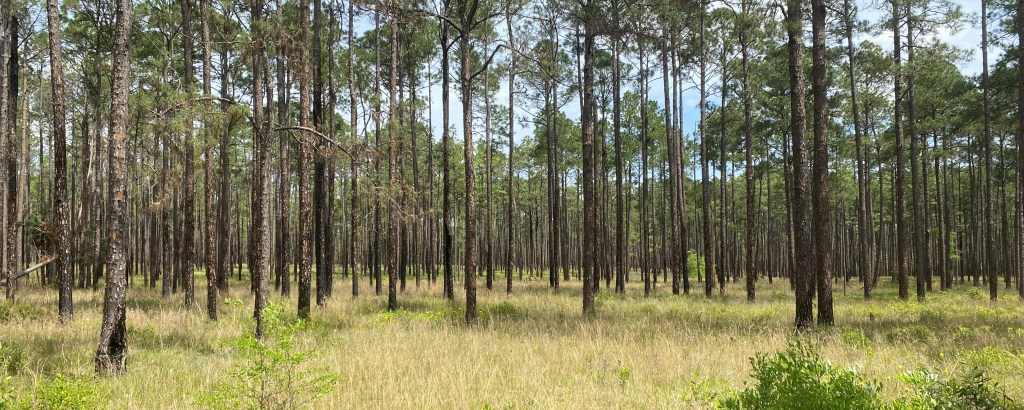
You stand in a broad, open woodland of longleaf and slash pines; a little crowded to be a proper savanna, but open enough to allow a rich mix of groundcover species. This land was clearcut in the 1940s, but unlike most of the land around it, it wasn’t converted to agriculture.  In fact, roughly a square mile (barely a postage stamp on the greater landscape) around this spot is protected as a state wildlife management area.  This is fortunate, for you get to see a remnant of this vanishing ecosystem in a more or less functional state.

When nature-watching, careful attentiveness to your surroundings is key.  A quick sweep of this woodland, and the casual observer sees a broad expanse of grasses broken here and there by clumps of shrubs.  But standing within that groundcover forces a change of perspective. One reason, of course, is that some of the more mobile denizens of the forest don’t appreciate being stepped on and will tell you so, painfully.  Others, more vulnerable, are unable to defend against a boot but still worthy of recognition and protection.  

Without close attention, you would have missed the fingernail-sized puff of pink on the ground between the deerberry and the wiregrass clump.  The sensitive brier has bipinnately compound leaves snap shut and droop suddenly when touched.  Perhaps this serves to startle herbivores or shake off leaf-munching insects, but also entertains a youth with woodwise curiosity. 

The flowers rising between grass clumps host wild bees and bright butterflies as they make the rounds; less noticeable are the beetles, flies and wasps that also sip the nectar in exchange for pollen transport.

Toothache grass

The change in elevation is too slight for a Piedmont hill-dweller to notice, but a close eye on the vegetation reveals it.  Wiregrass gives way to dropseed and toothache grass, and then to rushes.  In a matter of inches of height, the upland has become bog, and a new suite of plants surrounds you.

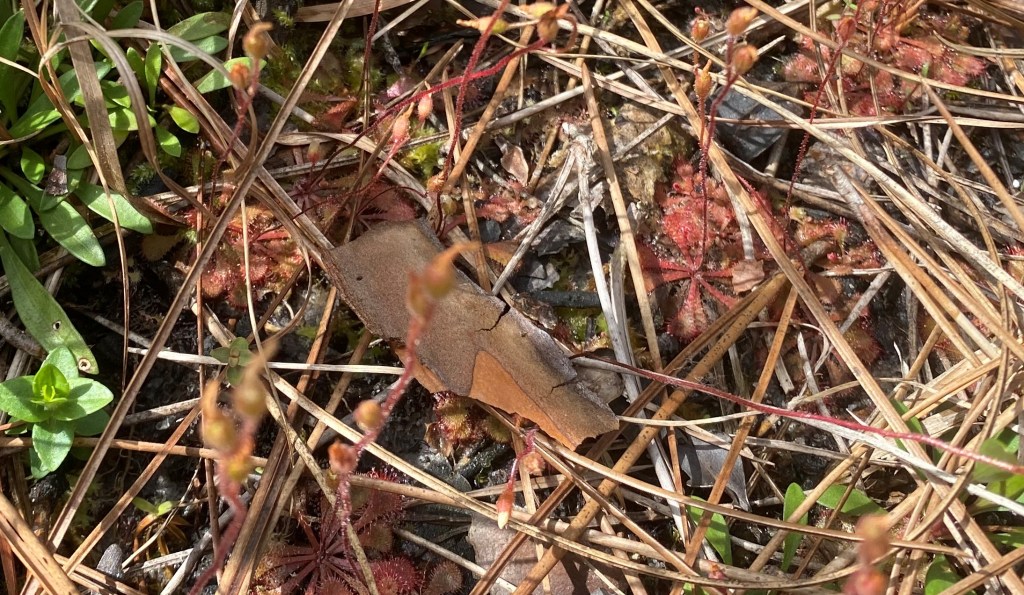
Looking down, you spot tiny reddish spots the size of a quarter, obscured by pine needles.  These are sundews, which catch and digest insects on their sticky rosette leaves.  Your new vantage point as you squat down to observe these tiny herbaceous carnivores allows you to notice the glistening sand. You didn’t realize how wet the soil was, but now you see your last footprint is filling with water.  There is no water’s edge here, just a gradual gradient that dips and rises between “dry” land and standing water.  A fallen pine provides a precarious walkway for a few yards, yet you will get wet feet soon enough. 

Sundews

Off to your left, you see what you came for: a cluster of meter-long yellow pitcher plants (aka Trumpets).  Like sundews, pitcher plants are carnivorous, digesting insects to supplement their nutritional needs on poor, wet soils.  Attracted by the scent of nectar,  bugs alight within the leaf tube, where the waxy surface and downward-facing hairs slide the victim deeper in.  Eventually, the insect falls into a pool of digestive fluid, where it drowns and dissolves.  You also see the less lethal flowers among the pitchers; they too lure pollinators in, but allows them to escape after being dusted with pollen.

Your old-timer guide tells you he remembers, back in the 80’s, driving down the interstate and seeing fields of pitcher plant trumpets for mile upon unbroken mile.  But agriculture, industrial logging, and other development made the land inhospitable for these persnickety plants.  These bogs feature shallow, consistent, year-round water supply, and even a tire rut (or repeated human traffic) can alter the hydrology enough to make a spot unsuitable.  This particular woodland is protected from development and burned periodically to keep it open. 

Management burn. Photo by Joe Burnam, Ga DNR

Managers ran a prescribed fire through this bog last June, and already some bays, gallberry, and other shrubs are making their presence known.  A few years without fire would change the plant makeup of this woodland and threaten pitcher plants, sundews, sunny bells, and most of the plant and animal diversity you find here today. 

Your guide says it’s time to head out.  Carefully picking your way to “higher” ground, you find a footpath and say good day to the pitcher plant bog.  As you reach the dirt road you drove in on, you see the highway.  Cars pass by, driven by people with no interest in places like a pitcher plant bog.  It’s sad because they can’t appreciate the intricate, rich, and delicate web of life that still exists.  But perhaps it is also fortunate, because places like these tend to suffer when they receive too much human attention.

Additional Resources:

Longleaf Pine Ecosystem from Wikipedia

Gone With The Rain

Many moons ago, I was on a van with my college Soils class, riding past farmland south of Athens. One of the students hailed from the Midwest.  Surveying newly-tilled, rusty-red earth, she asked the professor, “Do you have any soil here?”  All the southerners laughed, but it’s a fair question, and one with a depressing answer.

It’s been called “one of the most significant environmental disasters to occur in the state.” The evidence is all around, in forest and river, and indeed the consequences can be seen in how limited our choices of land use are today.

Most soil profiles have several distinct layers, or horizons.  The O (organic) layer and A (surface or topsoil) layer contain most of the accessible minerals, organic material, water-storing pores, microbial life…everything that makes soil valuable for plant life.  The Georgia red clay, synonymous with southern dirt,  is the B or subsoil layer; it contains very little organic material and is stingier both with nutrients and water.  In much of the south, and especially in the Piedmont, we simply have little to no topsoil.  But this was not always the case.

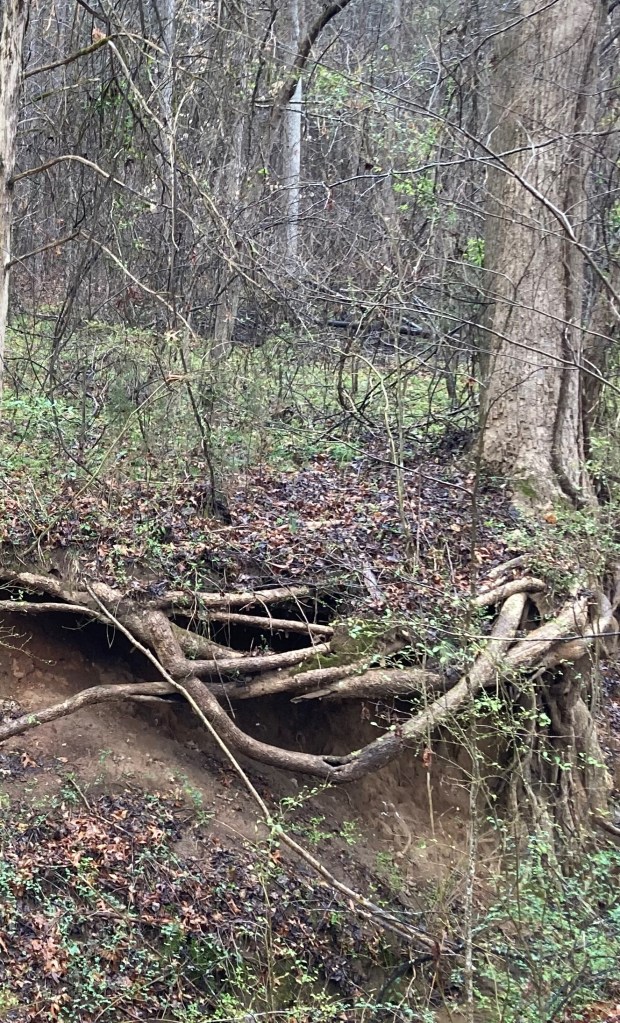
Tree being undermined on a bank

Think back to the first half of the 19th century.  The native peoples were swept out, and settlers opened the forests and savanna.  The supply of land seemed inexhaustible, so it was deemed more important to wrest what one could from the soil than to tend it carefully.  Cotton was the primary cash crop, and straight furrows were easier than rows that curved to follow the contour of the land.  Rains came and washed away centuries worth of topsoil, hastening the decline of fertility and forcing farmers to abandon exhausted farms for new ground. By mid-century, many upland farms had lost their topsoil completely and farmers were trying to coax crops from subsoil. The problems compounded as the lost soil washed into waterways.  Millponds filled with silt; rivers clogged up with earth, increasing flooding. There were some efforts to control erosion – contour farming and planting pines, for example – but war put those efforts on the back burner. 

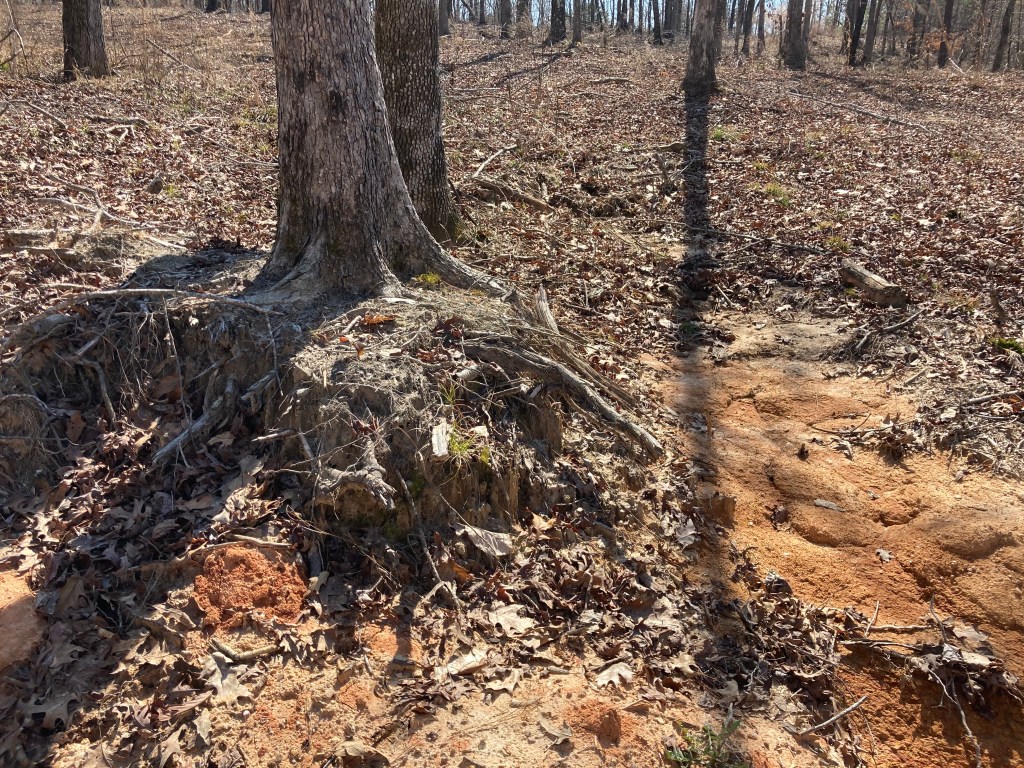
Recent erosion leaves only a rootball on this oak

Subsequent decades follow a pattern of waning agriculture, a rise of forests, a clearing of forests, and a new rise of agriculture.  Poor farmers trying to coax crops from even poorer land was the recipe for a cycle of poverty and destitution.  In my lifetime I have seen the cycle more or less continue, with eroding fields planted in pines or left to grow wild; some of those stands have since been cleared again for agriculture or other developments. Erosion is still a pervasive issue.

Take a look at this creek in the Georgia Piedmont. See the broad slabs of stones and smaller rocks in the creek? That’s likely the natural base level of the creek, about where it would have been two centuries ago. See the 10’+, nearly-vertical banks? Those are largely composed of earth that has eroded from the surrounding hills due to clearing, development and poor farming practices.  Steep banks of silt such as these are unfortunately a common feature of creeks and rivers in much of Georgia.

I’ve been told that one reason for the University of Georgia’s location at the turn of the 19th century was the clear waters and abundant fishing on the Oconee River.  Current students may be forgiven for assuming the steep banks and opaque brown water is the natural state of Piedmont rivers.   Not that many years ago, crews dredged behind the dam at Whitehall Forest; 20 feet down into the muck, they came upon a sawn tree stump!

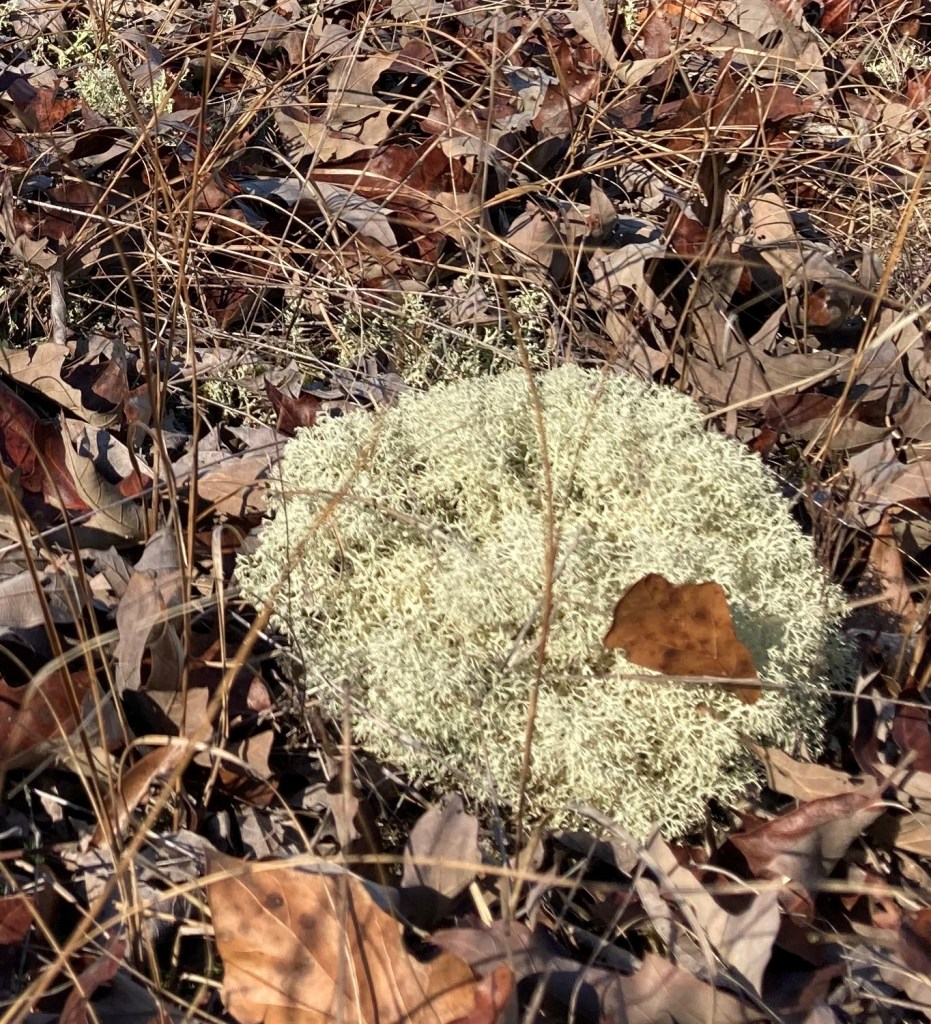
I drive past so much land with stubby, slow-growing pines or thickets of spindly sweetgums and scrawny oaks, with little on the ground beyond stubborn tufts of grass or reindeer moss – a lichen that even as a kid I learned to associate with poor soil. Across the land, gullies – some bandanged by leaves and brush, others bare gashes that continue to hemorrhage soil – remind us of the natural wealth lost through ignorance, indifference, or greed. 

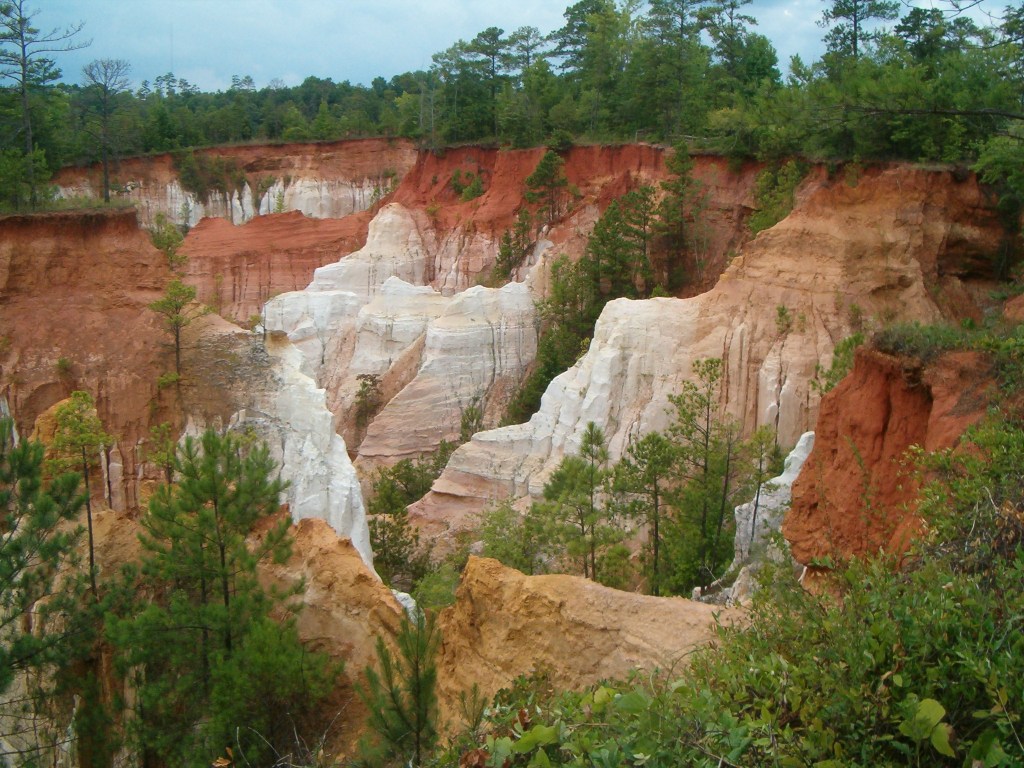
But I haven’t visited the most famous monument to this human-enabled catastrophe: Providence Canyon.  What started in the mid-1800s as series of gullies a few feet deep have become a fan-shaped series of canyons spanning hundreds of acres and plunging up to 150 feet below ground level.  The super-gullies continue to gnaw at the land around them, extending further every year. It is sometimes called the “Little Grand Canyon,” as if its existence was a point of pride and not the most visible scar of a curse our ancestors bequeathed to us.

Photo by Ronnie Honerkamp

I see turn-of-the-century farm houses, mobile homes, and dilapidated ranch style dwellings lining the backroads I travel. Around these homes are either pine stands or clearcuts, for the hard, gullied subsoil is neither fertile enough for seasonal crops nor (in some cases) level enough to run a tractor. The preponderance of political banners touting modern lost causes suggests to me where these folks stand on the subject of climate change. They are willfully ignorant of the effects that human irresponsibility will have on their descendants; yet I suspect that they are innocently ignorant of the impoverishment bequeathed to them by their own forebears.

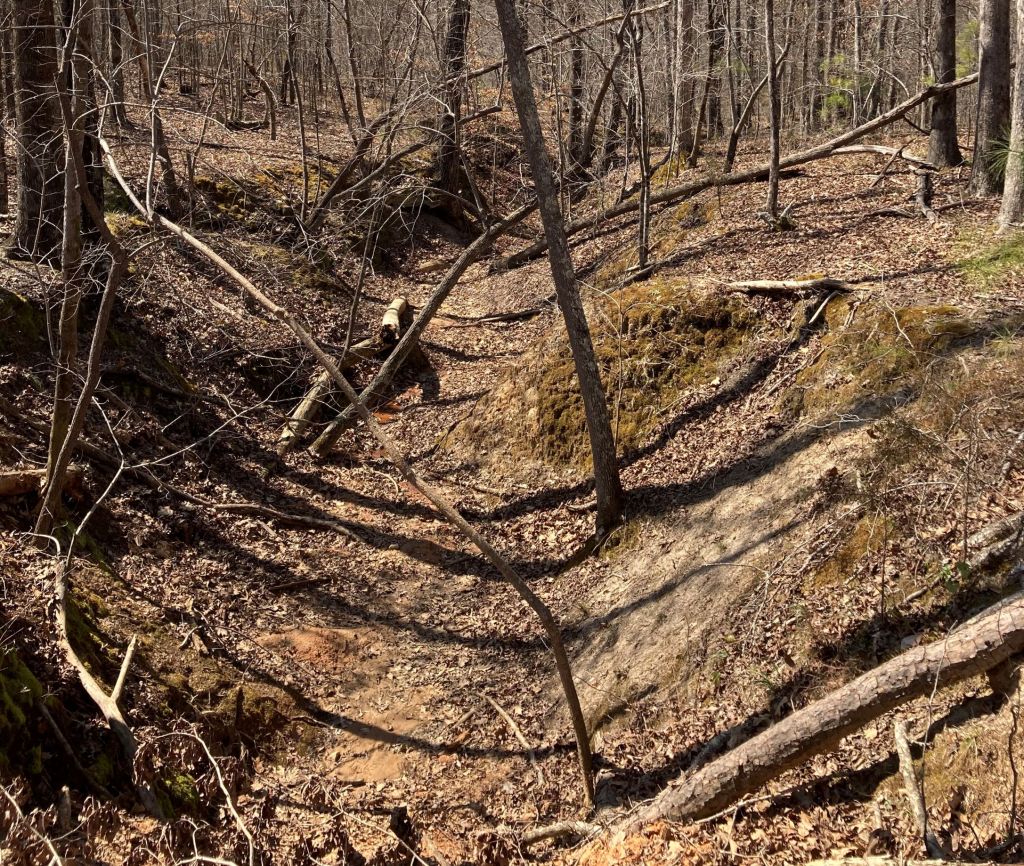
A 8′-10′ deep gully. It still carries soil away when it rains.

Outliving His Home

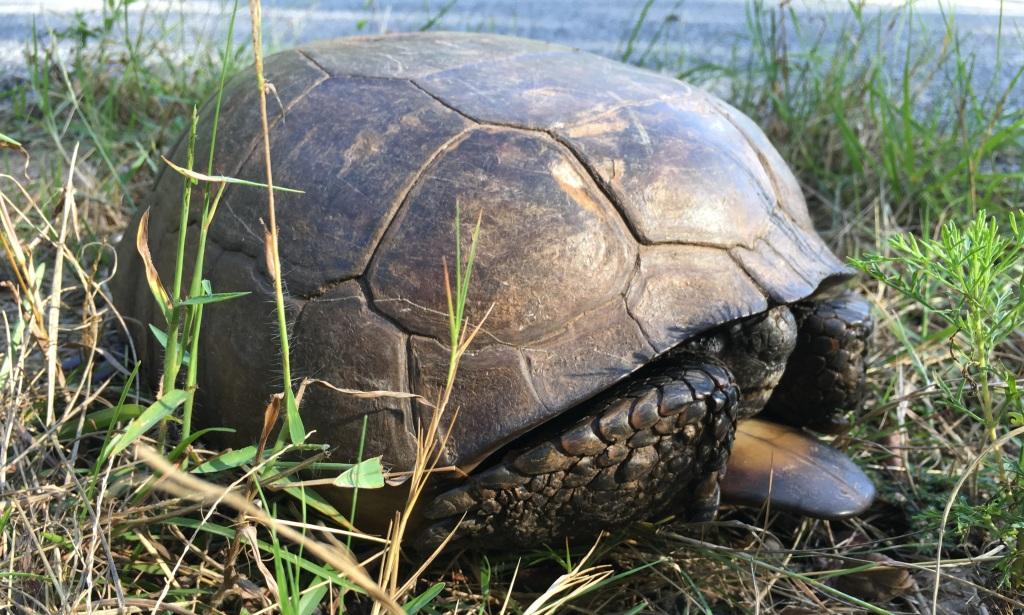
Consider the gopher tortoise (Gopherus polyphemus).  It’s the state reptile of Georgia, and its burrows were once common in the deep sands of  the coastal plain of the southeastern U.S.   Growing to a foot long and weighing  12 pounds or so, the hardy reptiles subsist on grasses, forbs and fruits in upland pine savannah and sandhills. Gopher tortoises are a keystone species, meaning many other species depend on them.  In fact, hundreds of different animal species – insects, amphibians, reptiles, mammals, and even birds – use tortoise burrows for shelter from fire or weather. tortoise burrow

But what happens when their world changes around them?  In the last century or so, humans have significantly altered the landscape.  They removed fire, the element which maintained the grasslands and open woodlands.  They planted thick monocultures, first of annual crops, then of dense stands of pines.   They planted buildings, run fences,  and laid pavement over land where tortoises and their grassland companions once traveled freely.

My experiences with tortoises have been largely in the “you just missed them” category.  More than once, I’ve felt like I should be  bearing  my clients a telegram: “We regret to inform you…”  Several absentee landowners have proudly told me about the tortoises on their place, but when we visited could only show me crumbled burrows  veiled with cobwebs and old leaves.   When I couldn’t fulfill my objective to educate a landowner on how to improve the habitat for their tortoises, I was left to tell them why the reptiles were no longer there.  That clearcut pine forest, grown up in scrub?  Those woods that haven’t been burned since Reagan was in office?  Those holes in the pasture you kept filling in?  Yeah, that’s why you have no gophers.

Tortoises are hardy enough to survive on sparse rations, and can live as long as humans.  They’re also stubborn, and may cling to their burrow even when the habitat vanishes around them.  I’ve seen an active  tortoise burrow in the middle of a 20-year-old loblolly pine stand, with nothing but pine straw for a hundred yards in any direction.

Another man proudly showed me some burrows  crowded together on the cut bank of a woods road;   After looking around, I pointed out that all the surviving tortoises had left the surrounding 100 acres (now  had grown thick and scrubby since the woods were logged) and were clinging to the last open land for a quarter mile in any direction.  All of the burrows were large, indicating mature individuals.  Unless the land is again managed for open native woodland, that remnant colony will pass away with the last of those elders.

I recently noticed a old male tortoise on the shoulder of a country road.  It was just crossing the white line when I saw it, and was fortunate that the next two drivers veered to miss it.  I carried it across the road and gave it a quick once-over. The growth rings on the venerable fellow’s carapace had worn smooth, but it bore some scratches suggesting the shell had been put to the test in the recent past.  Looking around, I could see nothing but canopied woods around me ­– creek bottom hardwoods to one side, volunteer pines on the other.  When the tortoise was young, there may have been native rangeland to spare, but this poor fellow had outlived its habitat. This steep, mowed shoulder may well have been its only feeding ground.  This old campaigner was likely as old as I am, but negotiating that 2-lane is a hazard beyond any its ancestors faced.  So long as drivers  continue to miss it, and dogs and men refrain from trying to eat it, this living monument will continue to plod along, foraging where it can before returning to the shelter of a well-loved burrow.  When its time comes, it will leave a bleached shell to mark the local loss of a creature that will likely never tread that patch of Georgia again.tortoise 1

For more information:

About the early successional habitat the gopher tortoise need.

Educational materials and landowner resources from the Gopher Tortoise Council, a non-profit organization dedicated to the study and conservation of this amazing reptile.

A presentation on the gopher tortoise, including what to do if you find one.

Smoothing the Scars


Wall and vine

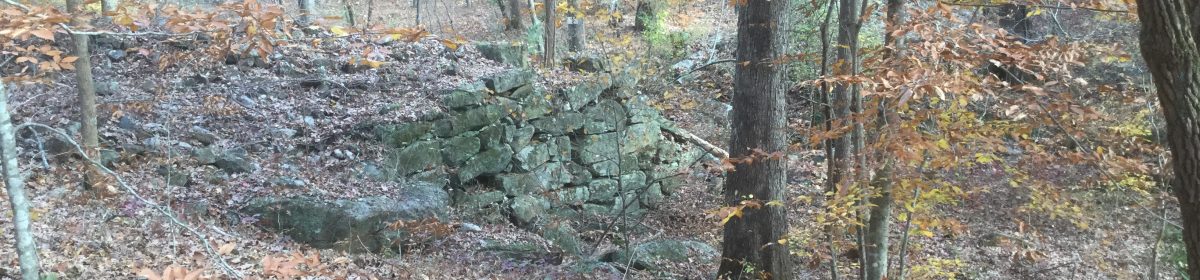
Although I live in the Coastal Plain of middle Georgia, my family has 200 acres of woods in the Piedmont region of northern Georgia. It is a beautiful property, with stately oaks, hickories, and beeches, but the sharp eye can see the wounds Nature has scabbed over.  Everywhere are gullies and thin rocky soil where farmers asked more of the land than it could provide. Here is a the hole where a moonshiner kept his still, and there is the echo of a sunken road now paved with oak leaves.  An old wall by the creek — probably the remains of a bridge, or possibly a mill dam — is a focal point for my visits when I journey back there every few months.   Humans have altered the landscape to suit their desires for nearly as long as they’ve walked these lands,  and they’ve been especially good at it in the last three hundred years.  Yet, as always, Nature makes do.  Plant succession will turn a fallowed field to a pine woodland in a score of years, so what hope does a Mississippian mound complex have against Nature with a thousand years to work with?

woods road

Creeping Autumn

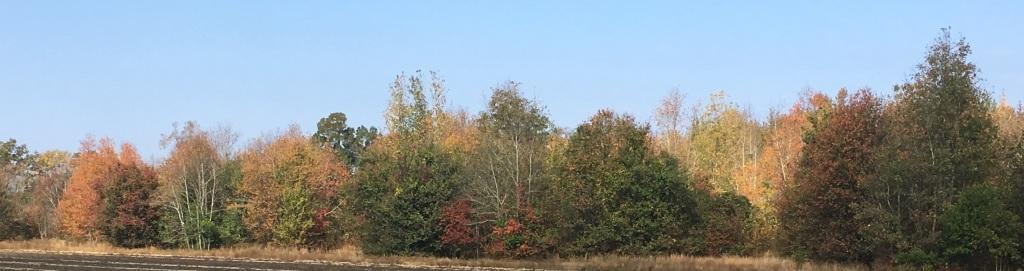
Ah, Autumn in south Georgia.  It’s taking its own sweet time, hitting the snooze button more than once.  The high here didn’t reliably drop below the 80s until after mid-October.  Something vaguely resembling a chill is in the air, but the trees seem disinclined to respond.   Driving through several counties today, I noted a distinct lack of organization in the forest.  Some leaves were changing halfheartedly; this oak was  green save for a brilliant cluster on the end of a branch, while that yellow sweetgum was surrounded by  more-or-less green cousins.  An occasional splash of red marked a sassafras that was tired of waiting.  Some don’t even try, like that persimmon that quietly darkens until it withers.  Other trees brighten only a few days before fading brown.   By and large, though, the hardwoods were as green as the pines.  Things will change in the next couple of weeks, but this isn’t the deep north woods…weak fall

Update:  what a difference a week makes. Still patchy, but more of the trees are hopping on the bandwagon.  According to the prediction maps, we are in the peak time for fall color here.  Temperatures are moderating, so that’s the important thing.

fall color 2
November 4th

Siren Spring

In the way-down end of Alabama sits the Solon Dixon Forestry Education Center, a  5300- acre property dedicated to research and education about the ecology of lower coastal plain landscapes.  The workshop I attended last spring was worth an educational blog report in itself, but it wasn’t the group classes or field trips that garnered the strongest memories of that place.

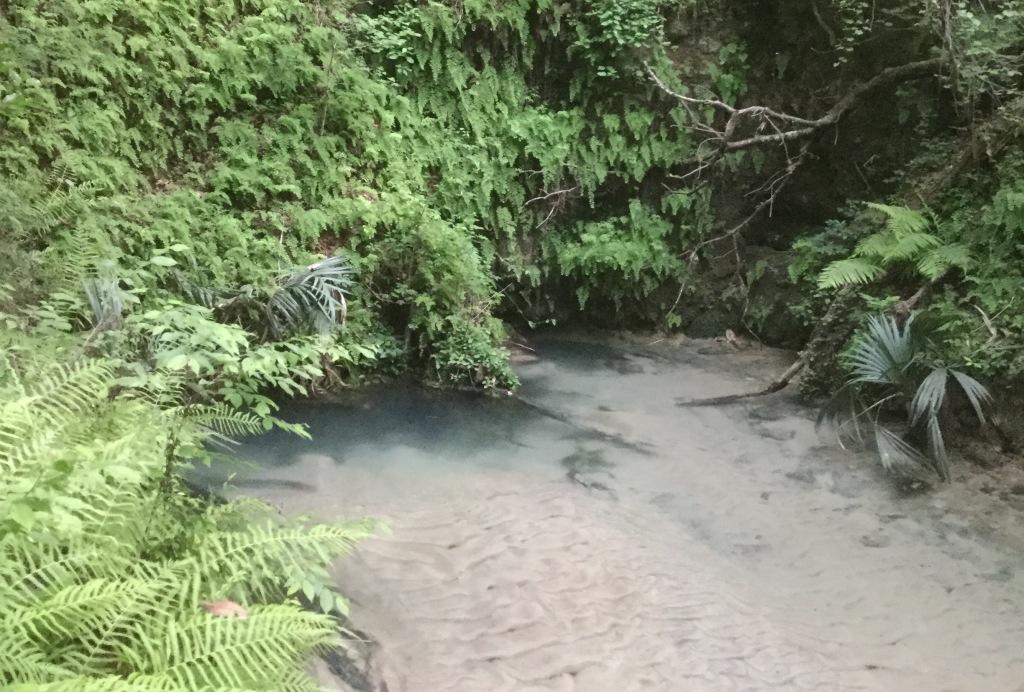
Each evening after supper, the participants were at leisure to walk around the property or make the twenty-minute drive into the nearest town.  One of the staff told me about a spring off one of the back trails, so, with hiking stick in hand. I strolled past the sinkhole lake and into the woods to find it.  The young planted pines gave way to lush hardwood canopies, and I heard the chuckling of running water.  Beside the trail, weathered stairs descended 20 or so feet to the stream.  In a land of blackwater rivers, I was surprised to find the clear, bluish water streaming out of the wall of a greenery.  The interpretive sign at the top of the stairs stated that this spring and its smaller neighbor produce 15,000 gallons per minute of 67 degree F water, running some 350 feet before disappearing back into the ground.   It was clear, tinted blue, and wonderful to visit.

Spring

I couldn’t resist; in short order the boots came off and I stepped into the cool stream a hundred feet or so downstream from where the water rose.   My feet glowed pale blue beneath the surface, and my first step disturbed the detritus of waterlogged bark and leaves at the base of the stairs.  I felt them roll over my feet, and then noticed a rhythmic poking  against my ankle on the leeward side.  Lifting back out and letting the surface smooth, I noticed four or five fish darting around.  By the interpretive sign, I guessed they were Dixie chub. I listened to the rushing of water beyond the downstream bend, felt the flow across my calves, and breathed  A few minutes later, I was back on land, donning my boots as another workshop attendee came down the stairs.  He looked appreciatively but briefly over the spring, then headed on.  I meandered up the path toward the spring, stopping to measure the water’s depth at a narrow point (the part I could reach was probably above 4 feet on my staff).    I was surprised to see a mountain laurel flowering, a mere fifty miles from the Gulf of Mexico.    The sign uphill  warned against tearing up the banks looking for sharks teeth; there was plenty of evidence that the sign went unheeded.  For one who is content to bask in the atmosphere of the cove, it saddened me that others would damage it for trinkets – but we all are guilty of this, either directly or at a remove.

At the spring, I succumbed to temptation and waded in to the shallower pool.  I meant to only wade a little way, but the spring me to get just a little closer…just a little closer… until I was thigh-deep and  balanced on rocks within arm’s length from the fern-covered cliff wall.  At my feet, I could  make out deep blue gaps where the springwater rushed out.  The siren song of the narrow cavern  beckoned me to take the plunge and float in the upwelling.  Instead, I stood there and quietly tried to absorb the moment, watching the water roil, the sand swirl.

Spring mouth

Scattered lightning bugs flashed in the failing light as I headed up the bank and back to the dirt road. There was no sound of humanity until I was nearly to the paved road, when I heard the distant moan of a train.