
I was early for a meeting in Wilkes County. With some time to kill, I followed the distant but pervasive sound of (pardon the geek reference) a phaser pistol overloading. I parked where a neighborhood met a wooded drain, and from a roadside swamped by wisteria, I heard the steady, whining drone of untold numbers of cicadas, all looking for love.

Like many insects, cicada adulthood is merely a fraction of the insects’ total lifespan. After hatching from eggs drilled into tree twigs, the nymphs fall to the ground. They burrow in and live in the earth for from as little as one to as many as 17 years, surviving by drinking sap from tree roots. When the time comes, the nymphs climb up trees, poles, grass, or whatever they find to get a little elevation. They split the back of their exoskeletal skin and molt. Once the new exoskeleton hardens and the wings straighten and dry, they fly off to find a mate. The males do all the calling; I can’t fathom how a female chooses one among the cacophony. Cicadas do take time to feed, drinking plant juices, but don’t do much damage considering their numbers. They don’t bite or sting, although the deep buzz of a low-flying cicada can be startling.
Georgia is home to 20 or so “annual” species of cicada, so called because adults appear every year. After spending less than half a dozen years in the darkness, these large insects appear in the heat of the summer, buzz around in their millions for a few weeks, and then die. They are often dull-colored or camouflaged, and more likely to be heard than seen until we find them dead on the ground at the end of their final sprint.

There are also six species known as “periodic” cicadas. These black and orange insects spend 13 to 17 years as nymphs before rising to deafen the neighbors. While some annual cicadas appear every year, the periodic cicadas all rise together in tremendous broods. This year, the trillions of members of 13-year Brood XIX are keeping folks awake from Virginia to Louisiana and up into the Midwest (Broods are multi-state masses of periodic cicadas that all rise in the same summer. A 17-year group known as Brood XIII has also risen this year in the upper Midwest).
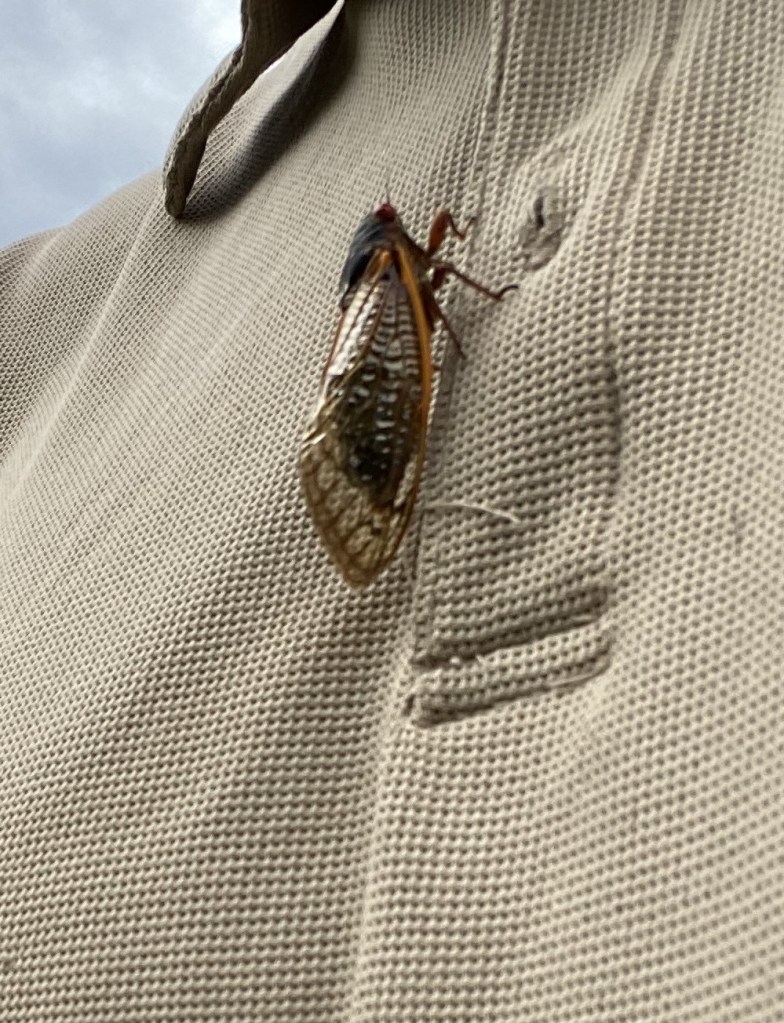
My first close contact took place just as I stepped from the truck; an orange-eyed critter landed on my shirt and stayed put for a couple of minutes before getting spooked and flying off. Once I started looking, I saw the empty husks everywhere – dozens on a branch, sometimes one on each side of a leaf! And while the trees ahead of me housed the vast majority of cicadas, there were several specimens amongst the shells at my feet, mostly unbothered by me even at close range.

And the air was full of the wailing siren of cicada courtship. Did they reach the estimated one million per acre in these woods? All that noise suggested it was a possibility. At close range, cicada calls can reach 90-100 decibels, or as loud as a power drill! I was as close as I needed to be to the unearthly courting cries.
After a while, I set about collecting some of the exoskeletons (because that’s the sort of thing I do). A 15-foot strip of roadside netted me several dozen husks, and there were others in view that I didn’t harvest.
I took my collection back to the truck; it was time for my meeting, and the cicadas had their own business to attend.

Further Information



 Towards the Moon or To the Sun
You must be logged in to post a comment.