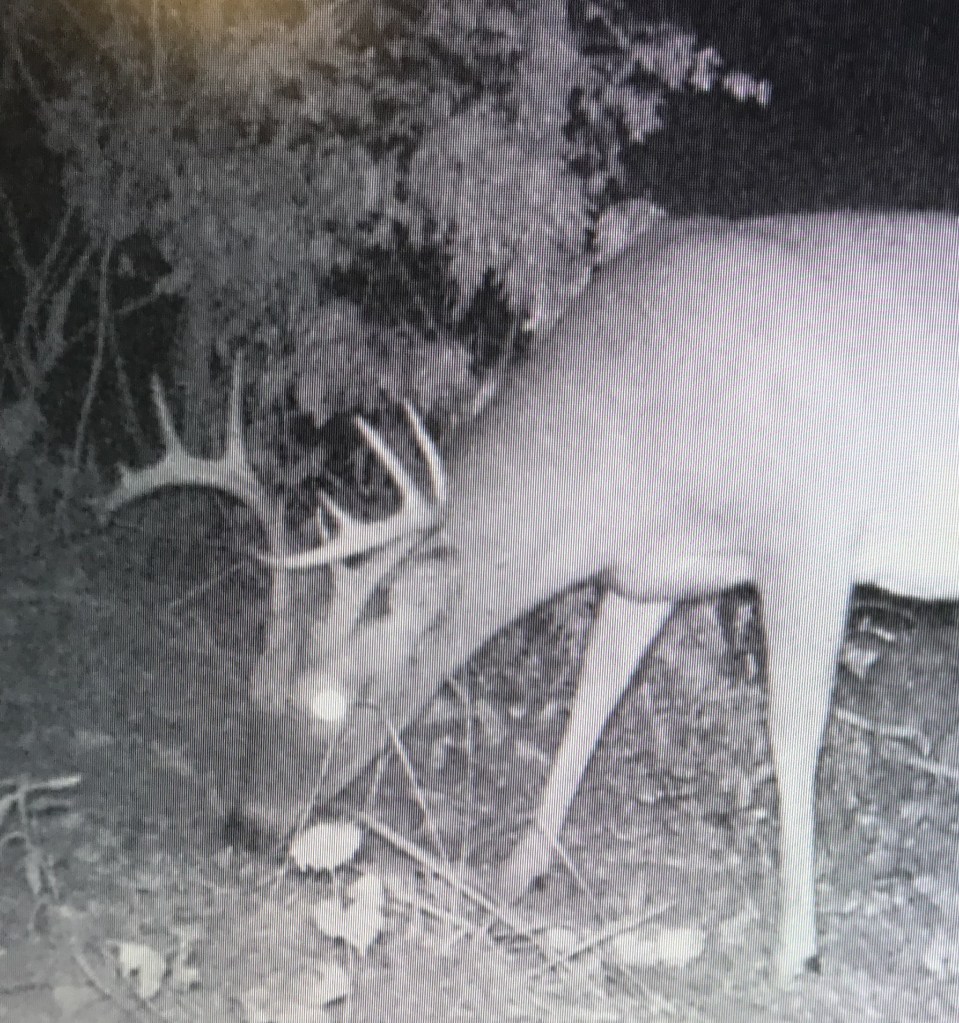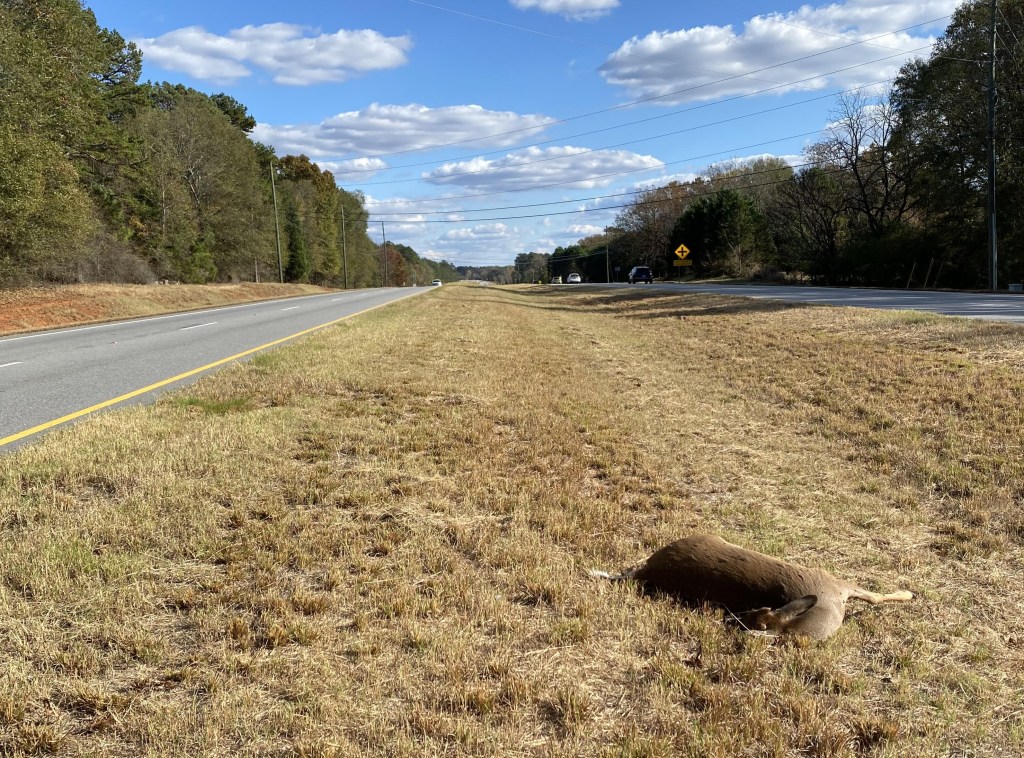
Have you ever hit a deer? Depending on the circumstances, the results can range from inconvenient to catastrophic for the driver — and usually worse for the animal.
For most of the summer, I’ve seen does and fawns serenely nibbling greenery on the wide road shoulders and ignoring passing vehicles. These aren’t the critters to worry about; rather, it is the travelers – those deer with somewhere to be, that aren’t paying attention to where they’re going, that are panicked by the searing bright headlights and the roar of engines – that are imperiled when crossing the asphalt. And while victims of these vehicle-animal intersections are common enough on the sides of highways and back roads, the frequency peaks in the autumn. Why is that? More reckless driving? The time change? Young deer club initiation ritual? Actually, the reason is most likely hormonal.
I’m near a university town, so let’s look at a familiar example. Take some individually-(reasonably)-responsible college kids and put them together in the noisy, alcohol-soaked hormonal haze that is beachfront Florida during spring break. Imagine all the delights the still-developing frontal lobes are tempted with, unchecked by wiser authority figures. Imagine the skyrocketing level of YOLO stupidity that propagates like a runaway nuclear reaction. Now imagine you are a 200-pound male deer whose entire decision-making process has been reduced to the choices of “chase the girls” and “fight the boys.”
Yes, Fall is the white-tailed deer’s spring break, and normal impulses (like looking for food and watching for danger) are offline. Canny bucks that normally sneak like ghosts through dense underbrush are now barreling across roads. The does you normally see serenely nibbling on the roadsides are likewise dashing over pavement. As a result, unfortunate deer-car interactions spike at this time of year.
The peak of the breeding season coincides with the peak of collisions. If you live in Georgia, you can look to the rut map, based on a UGA study of deer/car collisions, to see when the danger is highest in your county. As the rut fades away, bucks will return to their gray-ghost sneakiness, and does will have fewer reasons to run headlong into roadways.
Always be mindful of deer, but extra vigilance is required during the deer’s spring break.
Although summer has continued its fierce rearguard action well past a reasonable concession date, autumn is here. True to the colloquial name, “fall”, the trees are divesting themselves. But I’m not talking about leaves; there is still a lot of green in the trees at the moment. I’m looking at acorns, specifically white oak acorns.
The white oak (Quercus alba) is an all-around excellent tree. Large, long-lived, and handsome, much can be said about this species and its lumber (including being crucial for bourbon barrels and earning USS Constitution its “Old Ironsides” nickname). But on this October day I want to talk about the nut of the oak.
White oaks are the flagship of a cluster of species known as the white oak group (which include English oak, burr oak, post oak, overcup oak, and scores of others), as opposed to the red oak group (locally represented by the southern red oak, northern red oak, water oak, pin oak, and others). White oaks produce acorns on a one-year cycle – that is, spring blooms will develop into acorns in the early autumn, while red oaks take two years to produce. Red oak acorns tend to drop later in the season, and are much more bitter due to the higher tannin content. On the plus side, red oak acorns will be available to deer during the hungry months before green-up, while white oak acorns germinate soon after hitting the forest floor.
White oak acorns have been falling in prodigious quantities for a couple of weeks now. The tree which stands closer to the house than the deer like to venture has carpeted the ground with the leathery brown nuts. This is definitely a good mast year (“mast” is the collective term for nuts, berries and seeds from trees that are eaten by wildlife) for white oaks. You see, oak mast production is hit-and-miss; several years may go by before there is a bumper acorn crop for a given locale and species. Acorns are sought after by a great many birds and mammals, so on an average year few if any acorns will actually make it to germination. Periodically, a super-abundant crop of acorns will flood the market as it were, providing more nuts than wildlife can consume or stockpile, and increasing the chance that a tree’s attempt at reproducing will be successful. Naturally, the extra food is welcomed by turkeys, deer, squirrels, jays, and other hungry critters. It’s good for wildlife when there are several oak species in the local forest – if the northern red oak is a bust this fall, perhaps the scarlet oak will be a boom.
This is a good year for the critters to fatten up on white oak acorns. We’ll soon see if the red oaks will call, raise, or fold.
“You can’t eat the antlers.” It’s a way of saying to hunters that obsess over taking the buck with the largest rack that a doe will probably be tastier, and certainly more worthwhile to the meat hunter. But while the phrase is true for you and me, there are exceptions.
Bucks shed their antlers every winter and start growing a new set the following spring. With well over half a million male white-tailed deer in Georgia, there are bound to be considerable numbers of shed antlers on the ground by spring green-up. Those that escape shed hunters threaten to pop the tires of tractors and ATVs. Year after year, more pairs of antlers hit the ground. So why aren’t fields and forests carpeted by pointy bone caltrops? Critters, that’s why.
Like all bones, antlers contain a lot of calcium, phosphorus, and other minerals – which are scarce or lacking in the local vegetation. Ingested bits of bone are like mineral supplements, providing raw materials to build bone and muscle.
Squirrels, mice, and other rodents are some of the big culprits at bone eating. This makes sense when you consider that the teeth of rodents and lagomorphs (rabbits and hares) never stop growing. Gnawing hard bone wears down teeth, which if left to grow too long cause serious health issues. At the same time, ingesting the powdered antler provides the rodents with the minerals for rebuilding the teeth!
Grooves from rodent incisors
Non-rodents can join in; coyotes, raccoons, and even deer have been seen chewing on antlers and other bones. As most adult mammals don’t have regenerating teeth, this practice is not as beneficial for the fox as for the squirrel.
Bone-gnawing is not reserved for antlers. Each animal that dies above ground leaves bones that will likely be chewed on before the remains weather away.
Nibbled-on raccoon skull
The next time you find a bone in the woods, take a moment; look to see if some forest creature has snacked on them. You’re looking at natural recycling made manifest.
How is a climax forest renewed? How does it go from dense overstory canopy to grasses, forbs, and tree seedlings? Nowadays, the chainsaw is the chief instrument of change. Beyond human actions, the likely sources for canopy-opening are fire (from lightning) and wind. My corner of the Piedmont met the latter last week.
It was likely a straight-line wind barreling ahead of a thunderstorm, although a small tornado was possible. It came with freight train roar and the snap and crash of century-old trees. A morning’s survey of the damage revealed windthrows and snapped tops, in singles and groups. A few widowmakers will merit wary observation in the weeks to come.
Here, the red oaks were more likely to be thrown, while white oaks usually snapped. I suspect this is in part due to the root systems – while all oaks spread lateral roots beyond their canopy driplines, white oaks delve deeper into the soil, chasing water and anchoring themselves more firmly that their red kin.
Below is the most impressive root ball I found today. Look closely on the right side. That two-tone walking stick with the black cap on top is five feet tall. Using that for scale, the web of roots hold a block of soil over 20 feet wide! It’s clear that the roots extended 10 or 15 feet beyond that.
The windthrows give us an opportunity to look at the soil profile. The leaf litter and decayed organic material mixes with mineral soil to create a rather thin topsoil layer; here, litter and topsoil measure around four inches. Below that is the clay-rich loam common to this area – stripped of rich topsoil by a century or two of poor land management. After decades of rest, this spot has recovered a scant few inches of organic soil.
The logs will do their part, as insects and fungi convert wood to soil. However, the falling giants create a more immediate change. The new gaps in the canopy break the sunlight blockade which the dominant trees impose upon everything below them. Unbroken canopy is not a hospitable place for shade-intolerant plants; apart from the hardy muscadines, there is little green to be found on our forest floor. Yearly, pine seedlings rise and die in short order, starved of the sun’s energy. Even oak, hickory, and beech seedlings struggle to subsist on whatever only dappled or filtered light reaches them. These hardwoods may spend many years in a shrubby state, if they don’t succumb to solar neglect. But things change when a gap opens in the canopy. Sun-fed trees get a sudden boost of energy and growth, reaching towards the sky.
Where there is a gap vacated by two or three trees, and a dozen or more seedlings pushing through the leaf litter, there will eventually be competition for that space. Assuming no more disturbances, a decade or so will find the trees trying to outgrow each other – overtopping their neighbors and claiming the underground real estate until the victorious few take their place in the canopy.
I won’t be here to see the outcome, but I’m betting on the oak. Regardless, so long as people leave this forest alone, the gradual renewal of the climax forest will continue on every acre.
In a land of grand cathedrals, the Church of St Andrew, in the village of Greensted-juxta-Ongar in Essex, UK, is a modest church – smaller than some country chapels I’ve seen in back country Georgia. Greensted Church has that eclectic mix of architectural styles common to buildings that have seen centuries of fashions come and go. Some of the brickwork is Victorian, while the clapboard tower rose in the early 1600s. Bricklayers constructed the chancel in the 16th century.
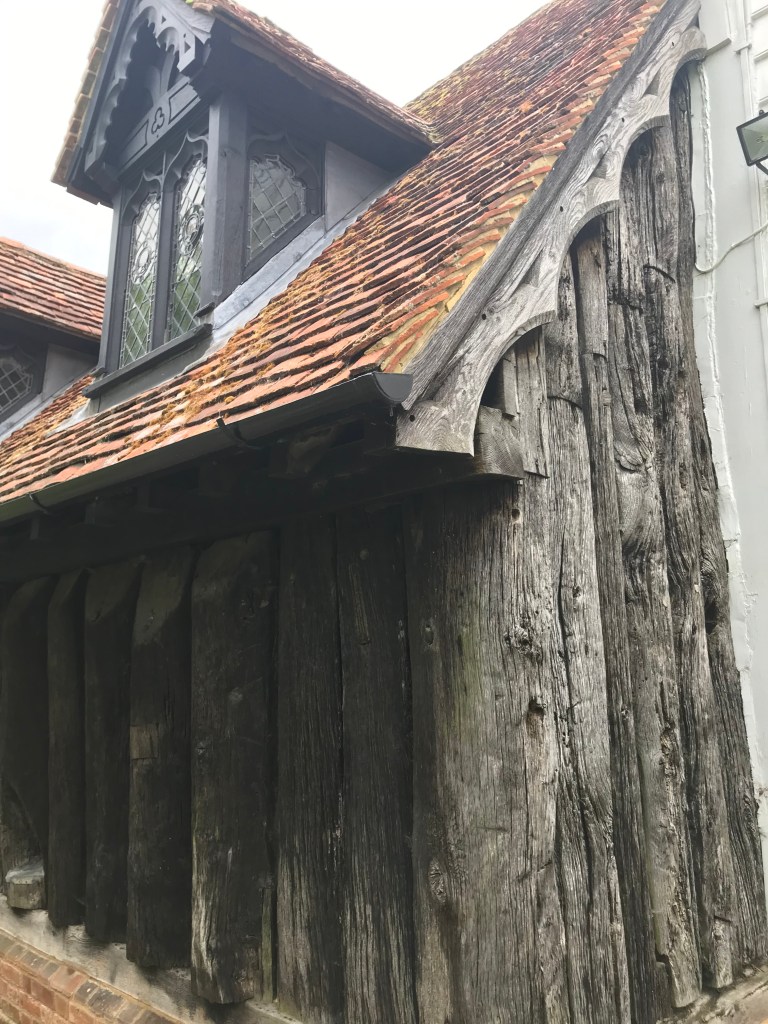
But none of those antiquarian details drew me down narrow country lanes in the remnants of Epping Forest; it was the nave that brought me here. Originally constructed of split tree trunks, each standing on end, Greensted Church is classified as a palisade church — an early version of a construction technique which evolved into the stave churches still found in Scandinavia. Sections of these ancient walls remain in Greensted. These logs can be aged based on dendrochronology.
Old oak log
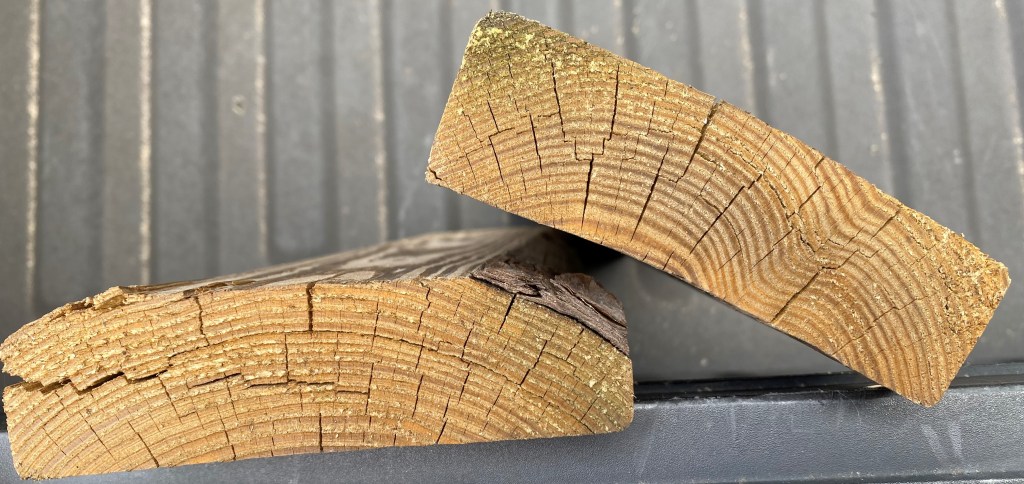
Dendrochronology? Yes, scientists love their Greek and Latin, and in Greek this technical term means “Study of Tree-Time”. Dendrochronology is a way to determine when a log was a living tree, and this works pretty well in temperate zones with distinct growing seasons. Trees grow new wood just beneath the bark, so the trunk gradually expands in diameter. This growth is more rapid early in the growing season, resulting in larger cells. Later in the summer, growth slows and the new wood is denser. Thus, each year’s growth consists of two rings – one pale, one darker. You can count the years of a tree by ticking off the number of dark rings counted on a tree stump. Oak is especially consistent in laying on rings, but other species can be used for dating.
In years where there is favorable moisture and temperatures, trees will put on more wood and the rings will be wider. In dry or cold years, the rings will be narrower. And these climatic variations affect all the trees in a region. Did a given county have a wet year in 1523, followed by several drought years? The wood will show a wide ring, followed by several narrow ones. In some cases, such as when a volcanic event causes planet-wide cooling, forests on several continents mark the event.
How can this be used to determine dates? Humans have built things out of wood for millennia. When you have enough samples, you begin to see overlapping patterns. Imagine a wood panel from a manor house. It was harvested from a 180-year-old oak that was twenty years old when, say, a decade of good weather allowed it to put on wide rings. Elsewhere in the county is a bridge plank that came from a tree already growing for a hundred years when that same weather phenomenon occurred, and then was cut almost immediately. Noting where those ten unusually-wide rings occur on the boards will give you a good idea of when the trees were growing, and when they were cut. In this example, if you have records showing the mansion’s paneling was installed in 1750, you can use that information to estimate when the bridge plank was cut a little after 1590.
This is a simplified example and leaves out some of the obstacles to precise dating. You only know for certain how old the tree was when cut by looking at a complete section of heartwood and sapwood from near the base of the tree (which includes the very oldest wood). Most sawn boards do not include the whole radius of the log, so you don’t know that the last ring you see is the last one the tree put on. Further, one can’t always be sure the wood hasn’t been reused from some other structure – the mantlepiece in my new house was originally part of a barn built in the 1850s. Still, having some of the wood is useful, and by overlapping the recognizable patterns on existing wood samples, scientists can date structures going back hundreds or thousands of years.
Rings in old pine boards. The final tree ring is beneath bark on the lower board
Dendrochronological analysis of the old wood on the Greensted Church suggests a minimum date of 1053, with an allowance of 10-to-55 years added for sapwood that has worn away in the intervening centuries. It may well be that the nave stood before the Norman Conquest; at any rate, the church is a contender for the title of oldest wooden church in the world, and the oldest wooden building in Europe.
Evidence points to a much older building, as is often the case on holy sites; excavations in the 1960s revealed timber structures dating to the 6th and 7th centuries — in the years when the East Saxons were newly-converted.
In a trip that saw structures both grander and far older, why spend time in an out-of-the-way little church? Because I have a historical interest in the Anglo Saxon period of Britain; I wanted to rest my hands on this timber that was likely felled and worked by Saxon craftsmen. It was coup-counting, pure and simple. But what historical enthusiast would not do the same, given the chance?
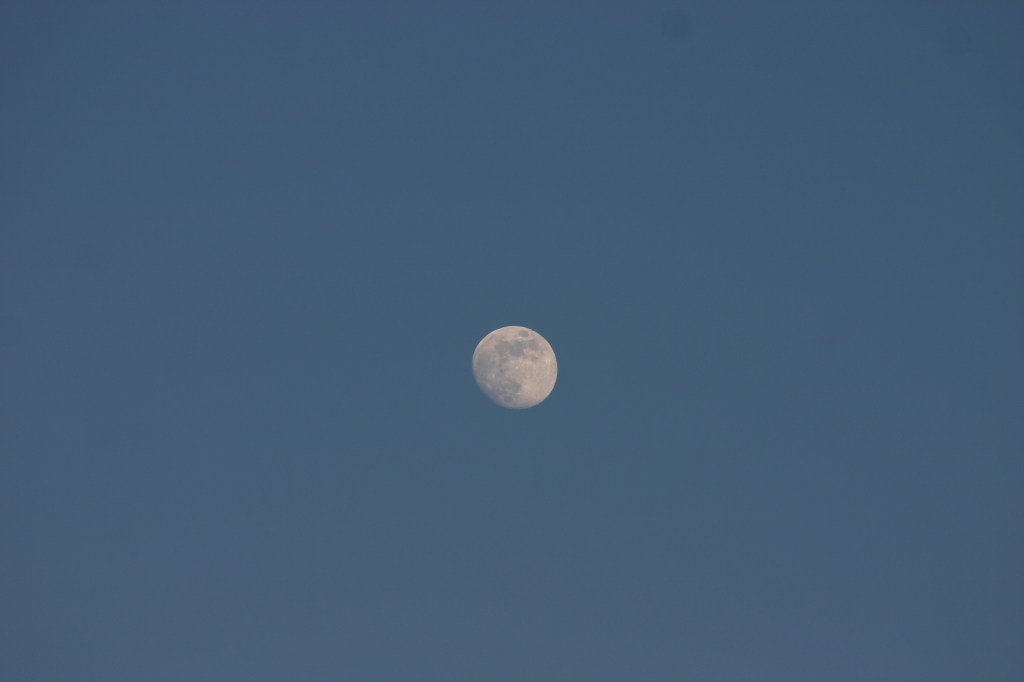
As I greeted the rising moon before going to bed a few nights ago, I heard birdsong far off in the woods. It triggered a distinct memory of sitting in a pickup truck on a red-dirt gravel road, late on a warm summer night. I was supposed to be snoozing while my Dad listened in vain for running foxhounds. All I heard was the distant, rolling song of a whip-poor-will.
A couple of nights later, the whip-poor-will’s repetitive cry had been supplanted by the closer and more staccato call of the Chuck-will’s-widow.
Onomatopoetically-named, both the whip-poor-will and its larger cousin are member of a group of birds called nightjars (reportedly because their call at night is “jarring”). As far back as ancient Greece, nightjars were called “goatsuckers” for the erroneous belief that they would sneak into barns and steal milk from the livestock. An odd belief to be sure, but when one sees the small beak pop open to reveal a disproportionately large mouth, it might not be as far a stretch for an ancient pastoralist with a wild imagination. The myth may never be forgotten; the scientific Order of these birds, Caprimulgiformes, is from the Latin Caprimulgus, or “goat sucker”.
Nightjars don’t in fact drink milk. Their diet consists of insects taken on the wing, supplemented with worms and other ground crawlies. When swooping on a moth, the whip-poor-will’s deceptively minute beak snaps open, revealing a horror-show mouth that seems to split the bird’s skull wide. Their maws are edged with whiskers that prompt the birds to snap their beaks shut when their prey brushes them.
Not that you are likely to see a nightjar. From twilight until full dark – and longer if the moon cooperates – these birds haunt the woodlines and fields. They are ground nesters, but with such complete camouflage that you are likely to pass right by the unassuming pile of leaves unless your light happens to catch the bright red reflection of their eyes.
Eastern whip-poor-wills lay their eggs in phase with the lunar cycle, so that they hatch, on average, 10 days before a full moon. Perhaps this allows them more hunting light to feed their chicks.
Folks have attached quite a bit of lore to the whip-poor-will. To some, the monotonous call portended imminent death or approaching danger. For others, it foretold marriage prospects. Whip-poor-wills were nature spirits, ghosts of children, or the traveling form for shapeshifters.
Poets and singers laud or curse the calls, including Hank Williams: “Hear that lonesome whippoorwill/ he sounds too blue to fly. / The midnight train is whining low/ I’m so lonesome I could cry”
I’d be blue too if someone called me a goat sucker.
Such melancholy connotations are undeserved, as there is nothing mournful in the bird’s rapid flute-like tattoo. I suspect all the feelings of sorrow and loneliness ascribed to these night birds are merely unhappy poets projecting their own misery onto unsuspecting avians.
For many country folk, the distant lulling call is pleasant night music, while a nearby maddening shrilling banishes all hope of sleep. However you perceive the songs of nightjars, you won’t hear them as frequently as in decades past. We can probably lay the lion’s share of the blame for this on the alarming decline of insects over the last century. Less food means less night song.
Last night, I heard the dueling calls of the nightjar cousins. The whip-poor-will’s infinite loop swallowed up the Chuck-will’s-widow’s more discrete song, but with concentration I could just make out the larger bird’s contribution to the night sounds. I hope I will never have a spring or summer without these two nightjars to accompany the evenings.
I committed a small paperwork error a couple of months ago. Having neither looked at a paper calendar nor run through that old rhyme (you know, “Thirty days hath September…”), I scheduled a trip into the woods for a day when I should have been filling out timesheets. No big deal. But it did spur the question of why the months vary when the original astronomical timer – the lunar cycle – does not.
I quickly realized that the history of calendars is a rabbit hole I don’t wish to go too far down. A couple of links led me to more queries, and more links. Just going to the Wikipedia article on calendars showed a slew of hyperlinks waiting to keep me up until dawn. But I’m not writing a book on the subject, so if I can provide enough information to whet your thirst for knowledge, that will suffice.
The lunar month, when measured from new moon to new moon, is around 29.5 days long (there are at least 4 other ways to measure a lunar month, but I think this is probably the most relevant for most people). The cycle of moon phases as it waxes and wanes in the sky is both consistent and spans a useful length of time, making the cycle a natural point of reference for measuring time. Not surprisingly, the word for “moon” and “month” are closely related or even identical in a number of language groups; in English, “month” derives from Old English monað, which is cognate to mōna, “moon.”
A lunar-based calendar has the benefit of being applicable to anybody with eyes—you see where you are in a cycle and know how long until you reach a different moon phase. When measuring longer spans such as seasons or years, however, there are disparities.
The solar year…okay, there are a couple of different ways to measure this, too. You will likely be familiar with the Gregorian calendar – the modern western standard – which uses the tropical solar calendar. By this measure, the solar year is roughly 365.24 days long. Twelve lunar months fit within a solar year with 11 days to spare. The discrepancy of a few days per year adds up, so that after a decade, a given lunar cycle in a 12-month year has crept into another season. The lunar cycles and solar cycles take some 33 years to match up.
Natural cycles don’t care about conforming to our need for whole numbers.
People across the world have developed different ways of organizing a year. Going beyond the lunar calendar, we’ve developed several versions of a lunisolar calendar, which marries the lunar and solar timekeeping systems. Months still follow the lunar cycle. Generally speaking, some years have 12 months and others have 13. Determining when to apply these “leap months” requires some calculation to determine and a certain level of education to understand.
Finally, the solar calendar follows the sun’s apparent cycle through the heavens with no concern for lunar position. There are several, but the aforementioned Gregorian calendar should be most familiar to you. It still uses months, and the months are similar in length to a lunar month, but lunar cycles drift through our Gregorian months with no real connection. Well, with one exception: Christian churches overlay a lunar algorithm to determine the dates of certain movable feasts – Easter chief among them.
There are probably over a dozen calendars – solar, lunar, and lunisolar — in use today, and many, many more during the course of human history. But I’d wager that the basis for each of them lay in one or both of our most prominent celestial bodies: the moon and the sun.
Lighter wood. Fatwood. Fat lighter’d. Heart pine. The woodsman’s friend, a natural fire starter. Burns hot, even when wet.
What is it?
There are a number of pine species under the umbrella of “southern yellow pine.” They tend to be more resinous than other pines, and much more than most hardwoods. This quality was of great value in the 18th-19th centuries and was used to produce oils, pitches, and resins for caulking planks and waterproofing ropes and canvas. So valuable were these products that they were termed “naval stores” and considered a strategic resource critical for maintaining ships of war in the Age of Sail. While wooden navies are a thing of the past, these pine-based compounds are still used in a variety of products from cleaning oils to varnish.
Log of solid fatwood
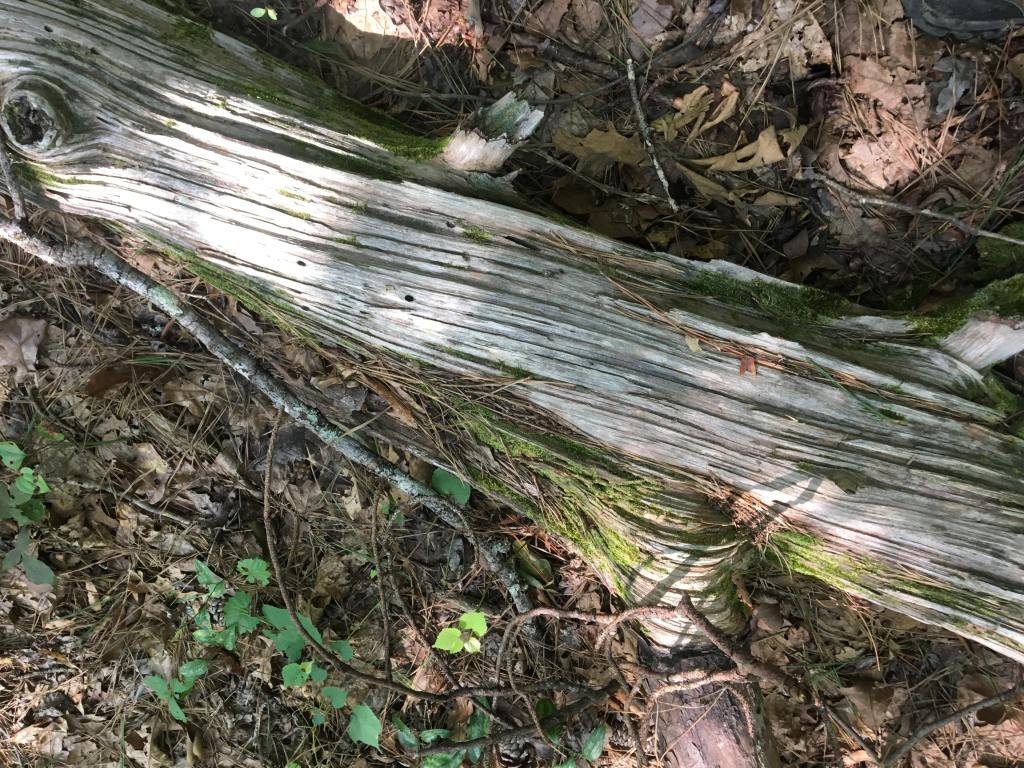
As pines grow, they add sapwood beneath the bark, expanding the girth of the tree. The cells in the interior die, forming the heartwood of the tree. In yellow pines, the heartwood is impregnated with the resin, making it very hard, rot-resistant, and highly flammable. When a mature pine dies, the sapwood will decay over time, leaving the gray bones of the heartwood. Often, the base of early limbs will remain as pine knots or “lighter knots.” Slice open the scabrous surface, and you’ll see golds and reds of tree rings soaked in resin. Smell the cut – that’s the scent of turpentine, and very distinctive.
Longleaf pine log– the darker wood is the heartwood
Here in Georgia, longleaf and slash pines were the best producers of lighter wood; they were largely found in the Coastal Plain. In the Piedmont, shortleaf, while not as prolific of a sap producer, also creates fatwood. And loblolly can now be found all over the state, although rarely is it left to grow long enough to develop lighter except in its stump.
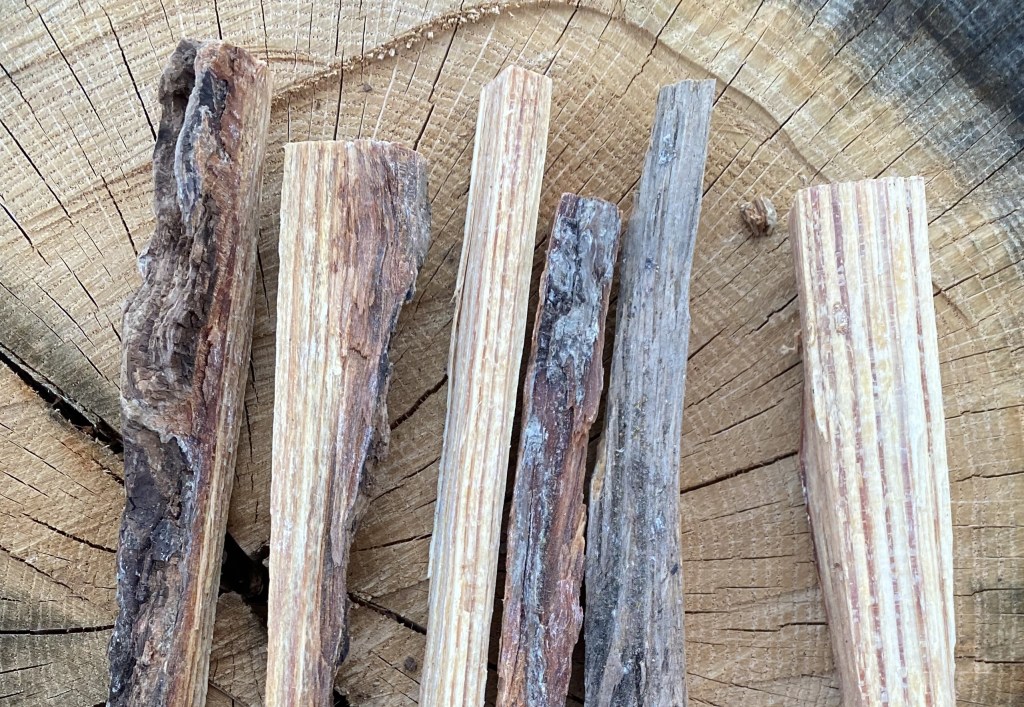
Lighter log split into sticks
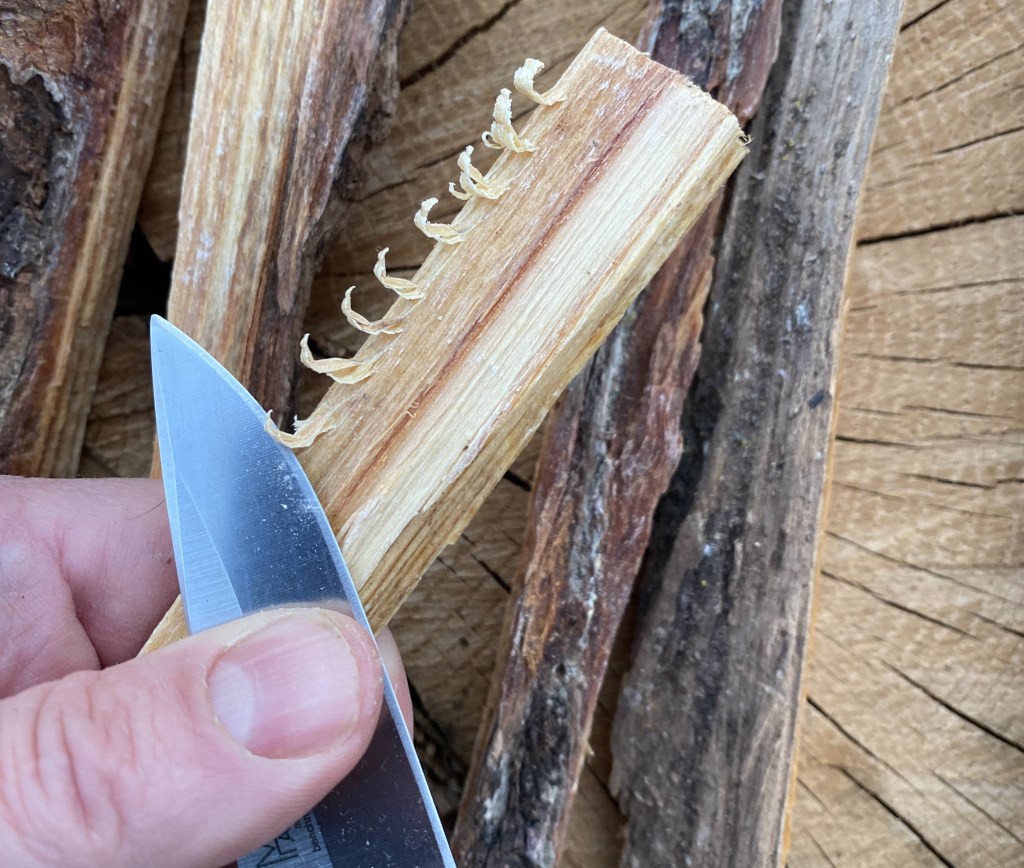
Fatwood burns hot — hot enough to set larger logs on fire. That’s what makes it a prime kindling wood, even when damp. However, use it with caution and sparingly. Shavings from a piece of lighter wood will be set alight by tinder and in turn burn other kindling. Larger pieces will light larger branches directly. Fatwood is commercially available in small sticks, maybe ½” on a side. You do not want to toss a large chunk on the fire. You certainly don’t want to put large pieces in a wood stove – seriously, the intense heat could damage the stove. Also, the pine resins exude thick, oily smoke when burned, so you don’t want to cook over a fire until all the lighter has burned away – unless you like using turpentine and soot for seasoning.
“Feathering” the wood to make it catch fire faster.
Lighter wood has been part of the fire kit since I was old enough to be trusted with matches. But not everyone is familiar with it (otherwise, why would I write this?). I’ll close out with a story from the time my Dad took some students on a field trip. He asked one of them to find some lighter wood to start the fire. The young man returned with an armload of punky old branches. “Couldn’t you find any lighter wood?” he asked the student; newbie hefted the dry, rotten sticks and replied, “Well, I couldn’t find wood any lighter than this!”
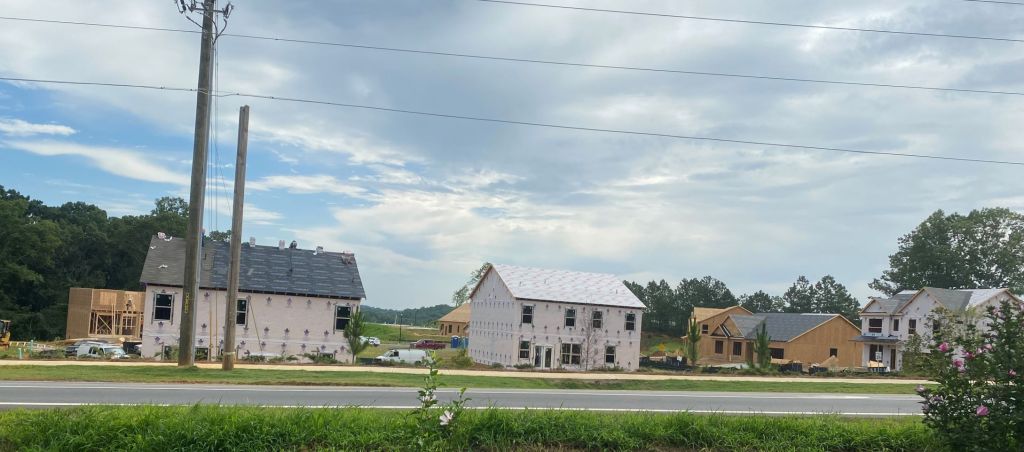
Development. For some, the word promises increased opportunity and convenience – jobs at the new factory, or a new grocery store half the distance of the old one. For others, it signifies loss and an unwelcome change to the landscape.
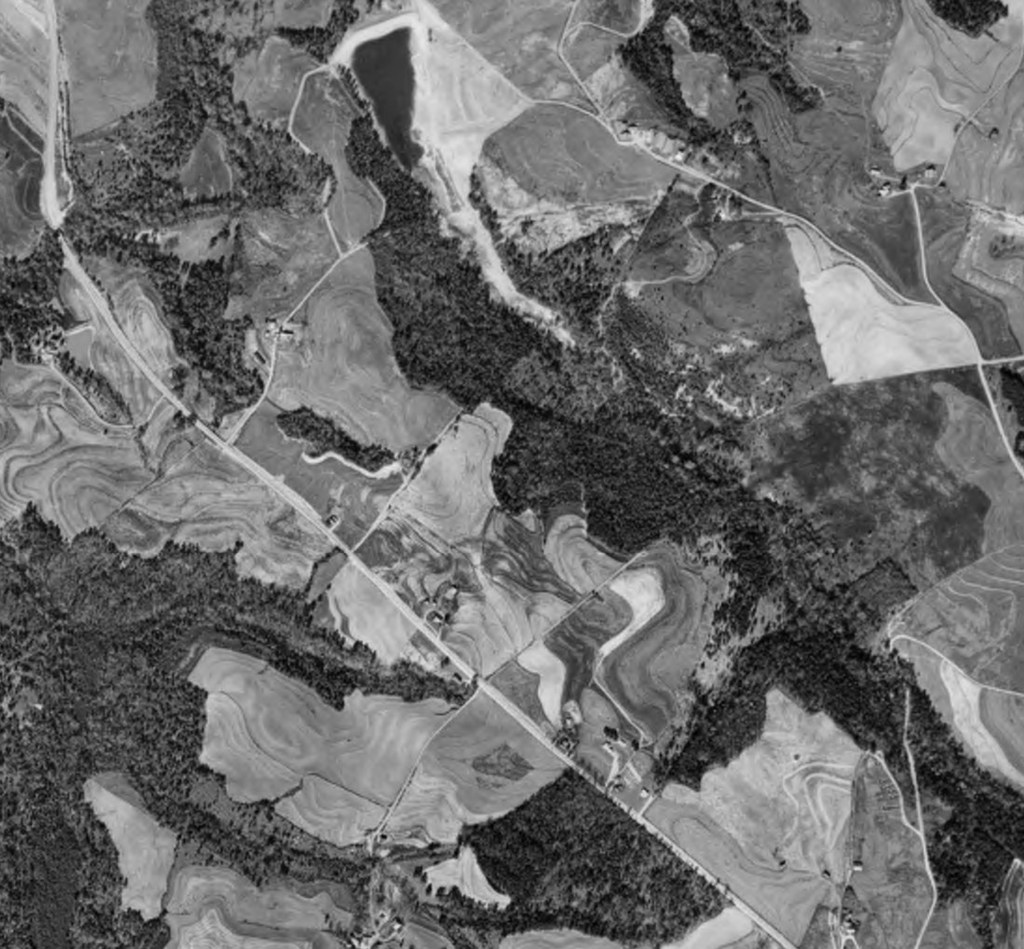
I grew up in a fairly rural area: a landscape of pastures, cropfields, and pine plantations. Great white oaks, red oaks, hickories and beeches mantled the hillsides and bottomlands where agriculture wasn’t practical. I know these forests were second-growth; most of the landscape was altered by land worked, paupered, and abandoned outside of living memory. Small communities vanished over time, leaving fields to lie fallow and return to forest. Aerial photos attests that the woods I wandered in the 70’s and 80’s were open agricultural lands just a handful of decades prior. Piles of bricks obscured by leaf mould, rusted wire curling off gnarled fenceposts, old wells capped by rotten boards, and fragments of barrels at forgotten still sites attest to homes and lives long vanished.
You may be familiar with the movie The Fox and the Hound. In typical Disney fashion, the film has very little in common with the source material. Written in the 1960s, the novel The Fox and the Hound illustrates the rise and eventual dominion of human development in a valley. At the beginning of the novel, the valley contains quiet, bear-haunted woods, small farms, and a lone, empty highway. As the story continues, the human population grows, fueling encroaching development in the story’s background. By novel’s end the forests are replaced by houses, motors have exiled the quiet, and the air is filled with the stench of factory smoke and diesel fumes. The transformation is subtle and largely in the background, but in the final chapter the message comes to the fore. The heartbreaking book ends with the words, “…and in this miserable, fouled land there was no longer any place for fox, hound, or human being.”
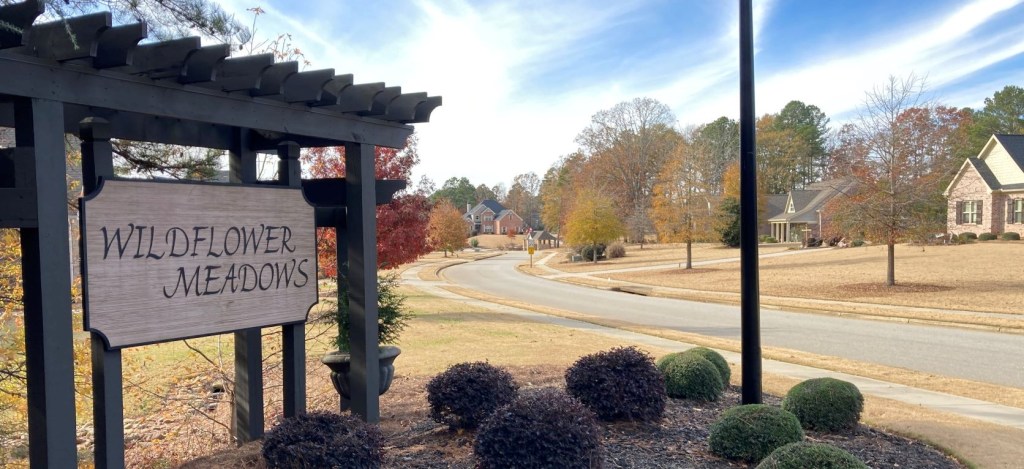
A subdivision name or memorial to what was lost?
My own landscape’s change has been neither so rapid (the book encompasses the lifespan of an improbably venerable fox) nor so complete, but it is much altered from my childhood. As a teen sitting in the deepest part of our woods on a cold November Saturday, I could guess if the university was playing a home game by the volume of traffic noise on the highway 1.5 miles away. Traffic was barely audible most days, but pilgrims trekking to see the Bulldogs would raise the volume to a steady rumble. The two-lane is now a four-lane, and the noise is both clear and constant regardless of the day. Soybean fields that fattened our deer are now planted pines over-ripe for harvest. Pastures on the hill have sprouted dozens of homes on turfgrassed acre-lots, and the formerly-graveled road fronting our land is both paved and lined with houses on twelve-acre wooded tracts.
Near Watkinsville, 1955
Same, 1980. Fewer fields, a few more buildings
Same, 2021. Housing developments galore.
But the majority of people who live here now are “from somewhere else,” and neither know nor care about local history. They are looking for land that is pretty, or at least pretty cheap compared to properties closer into town. Their last names aren’t on the tombstones at the century-old Baptist church. My family only set down roots here in the 1960s, but with the county population quadrupling in that time, few could consider us newcomers.
I’ve never known bears on our land, but I remember where I saw my final covey of bobwhite quail on the farm. I remember the deer stand where I encountered our last fox squirrel. Both encounters were over three decades ago, and I have no expectation of these critters ever returning.
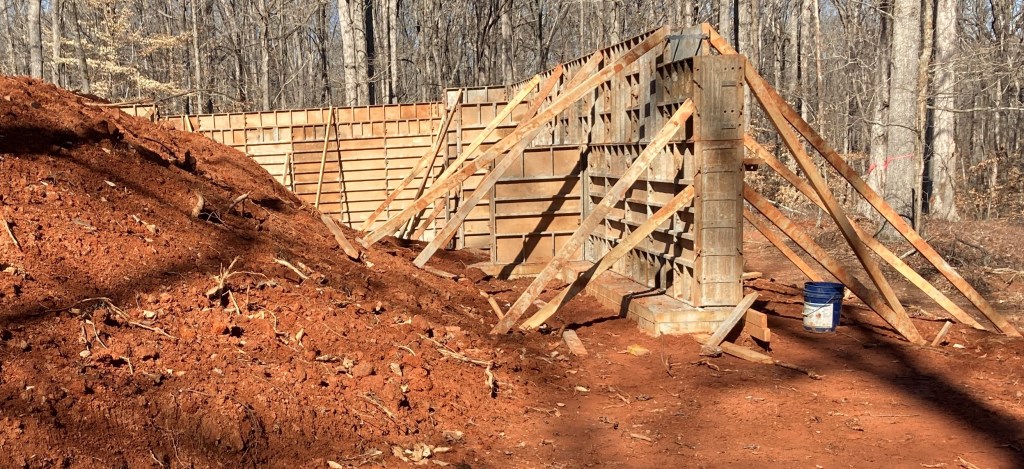
It is not without a sense of irony and perhaps a touch of shame that I have cleared a patch of forest and planted a house in the heart of the family property, land which reclaimed the last homestead over a century ago. But I carved out one acre for a house to guard many acres immediately surrounding it. This is where I’ve always wanted to be, and here I hope to protect this patch of woods for as long as I can.
In his world of Middle Earth, J.R.R. Tolkien referred to “The Long Defeat,” where the world is in a gradual but inevitable decline; the slide towards ruin may be slowed but never arrested or reversed by the small victories that the heroes strive for. To the ecologically-minded, it seems to be the path we chose as we struggle against the forces of hungry economies and burgeoning populations. To those who don’t want their corner of the world to alter from the memories of youth, every clearcut, new house site or NO TRESPASSING sign strikes a blow for the forces of progress as they march along the path of “The Long Defeat.”
Last month I saw a flash of movement beside the road — the first red fox I’ve seen on the farm in years. Encounters like this give me hope that we are not as far into decline as I feared. A fool’s hope maybe, but I’ll take the small victory.
As we are a few days from Halloween and thus well into the Scary Season, I write of a vine of legendary horror. No, it isn’t Audrey II, the alien plant that devours people, but it’s close. It is kudzu, the Vine that Ate the South! <cue ominous chords>
Okay, that’s slightly overdramatic, but you can safely add it to the list of imports that “seemed like a good idea at the time.” Like many inspired catastrophes of good intention, importing this rampant leguminous vine from Asia was intended to be an easy fix for another human-caused calamity, soil erosion. And it certainly covers up the gullies and bare slopes like nobody’s business. The problem is, kudzu isn’t that great at holding soil. True, its vines lengthen at the stunning rate of a foot per day, but the thick taproots don’t spread wide and fine to hold soil as those of grass might. Once rainwater collects under the vines, there is little to keep the soil from washing away.
The climate in the South is substantially different than that of Japan, where shorter growing seasons and colder winters moderates the growth of the vine. In the land of hot summers and mild winters, the plant turns invasive, flowing over fields, over trees, over buildings…anywhere a vine can go. Kudzu crowding vines deprive everything beneath them of sunlight, killing forb, grass, shrub and tree.
Kudzu has been put to various uses in an effort to make a positive out of such an overwhelming negative. The leaves make a highly digestible cattle forage. Some people make compost; others craft baskets or wreaths from the vines. But the usage of kudzu is negligible compared to the sheer productivity of the plants. This menace has covered millions of acres across the Southeast, and as far north as Nova Scotia and westward to the Pacific coast.
Apart from seeing blankets of the weed, covering field and forest, from the safety of the family truck, my first experience with kudzu came when I was eight or nine. My Mom and I tramped through a pine stand one night, trying to connect with some foxhounds that had strayed from the pack. We lit the forest floor with wheat lamps (a powerful light used by miners and coon hunters alike) to guard against entanglement or envenomation. As we progressed, I gradually noticed a change in the vegetation around me. There were fewer briers, and most of the abundant saplings were dead and leafless. Then, our lights picked what appeared to be a fuzzy wall fifty yards ahead, stretching in either direction as far as our lights would shine. We looked up and saw the unnerving ceiling of the same gray-brown material, held up by dead pine trees like tent poles.
We reached the wall of vine and dead leaves, and I looked to Ma to see what to do. The vine tangle stood between us and the truck, and there was no telling how far we’d have to follow this dead barrier before we struck another open trail. Finally, she put down her light and reached into the wall, pushing the vines apart just enough to form a tunnel. She directed me to climb up into it and continue to dig through. I remember the dead mass supporting my weight and being thick enough that I was completely encased in dry leaves before reaching the first green ones. I broke through to the open air and tumbled out the other side before turning and helping Ma crawl through. With the green wall at our backs, we waded through a smothered field before reaching the dirt road.
My encounter with the backside of kudzu occurred a couple of weeks ago when I visited a newly-purchased hunting property. It had many of the common invasives – Chinaberry, stiltgrass, tree-of-heaven, sericea, and so on – but by far the most visible issues were the mounds of kudzu, topping the smaller trees and coiling upwards towards the tallest oaks. I think the landowner is aware that the land he bought is a “fixer-upper.” I’ll tell him the options: burning or mowing to reclaim conquered territory, followed by herbicide to strike at the roots, the only way to permanently kill this scourge. But I’ll warn him to be prepared for a multi-year campaign. And I won’t say what I’m thinking: Better you than me.
You must be logged in to post a comment.