On the Open Road

There’s an old joke about the difference between Americans and the British: “Americans think 100 years is a long time, and Britons think 100 miles is a long way.” 

Early on during our recent vacation, my wife asked where we would recommend a traveler from the United Kingdom (where we’ve traveled several times) go to get a true taste of America.  She thought a list of 10 cities – including Boston, Washington, and New Orleans – would be ideal. I countered that if a “true” taste was the goal, small towns – including the moribund ones with more churches than active businesses – should be included.  By the end of the trip, we both agreed that, wherever the journey led, it should be conducted by road.  

The country of England could fit inside the state of Georgia — the 24th largest state out of 50 United States. The lower 48 states stretch across four of the regular 24 time zones.  The distance from “sea to shining sea” measures some 2800 miles (4500 km). In 2019 we traveled in a meandering path from Woodbridge (near Ipswitch) to Boscastle in Cornwall — a trip of some 400 miles; the outward leg of this month’s trip — to Gillette, Wyoming — sent us at least 1700 miles down the road from our front porch near Athens.  The United States is so large and diverse it has been suggested that it is culturally nine or even 11 cultural and economic nations in one.  This doesn’t count the actual sovereign nations scattered across the land.  Common customs, foods, and laws vary considerably as one travels from region to region, often within a single state.

I don’t think one can conceive of the scale of the continent by hopping from airport to airport.  Our dependence on the automobile and the subsequent restructuring of cities for car travel, the sprawling nature of municipalities, the colloquial use of hours rather than miles as the measure of distance…and the only way to understand the American obsession with the Freedom of the Open Road is to experience it.  The rush of miles passing underneath your wheels. The vistas.  The loneliness.  The boredom. Praying that the first gas station in 100 miles is still open. Standing on top of your car with your arm raised in hopes of getting a signal. Crawling along in bumper-to-bumper traffic, or to drive all night with no headlights but your own. These must be experienced to get a feel for the country, because the scope of the land shaped, and continues to influence, the history, economics, culture, and politics of the nation.

The Fall and Rise of the Whitetail

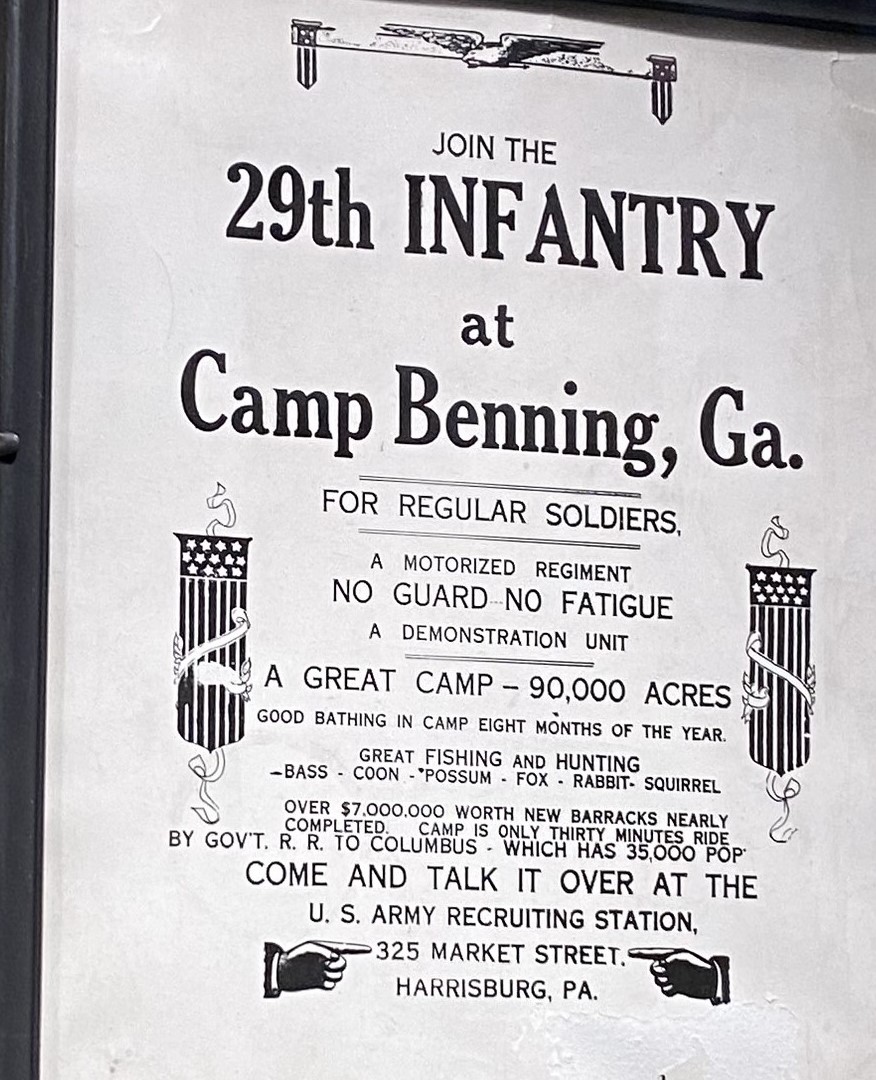
A couple of months ago, I attended a prescribed fire conference at the National Infantry Museum in Fort Moore, just outside of Columbus, Georgia.  After finishing the official part of the meeting, we were allowed to wander through some of the exhibits.  Among the relics was a recruiting poster from the 1920s – back when the post was known as Camp Benning.  The spiel suggests an easy life, good weather, new barracks (“nearly completed”) and “Great fishing and hunting”.  But what caught my eye was the list of game species: raccoon, opossum, fox, rabbit, and squirrel.  One conspicuous omission: white-tailed deer.  Why wouldn’t they advertise a game animal that is so plentiful today?

Deer were plentiful all across the Southeast when the first Europeans arrived.  As the colonies established and spread, hunting for food and for trade items (deerskin was a premium leather for exportation to Europe) decimated the population.  In the 19th century, the growing cities demanded meat of all kinds, and market hunters were happy to add venison to the menu. The loss of forests to logging and agricultural expansion made the problem that much worse. Laws to protect deer, such as a hunting season enacted in 1840, were largely ineffectual.   By the first decade of the 20th century, fewer than a third of the counties in Georgia claimed to have any deer left.  I presume Muscogee and Chattahoochee counties, where Camp Benning stood, were not among the fortunate third. 

The return of whitetails to Georgia comes down to three things.  First, the reforesting of Georgia: in many places, old fields were abandoned, and old cutovers regrew. Governments acquired land for wildlife protection, especially after the Pittman-Robertson Act in 1937. 

The second factor was the restocking effort.  A U.S. Forest Service ranger named Arthur Woody began the process by himself with half a dozen deer released in the mountains in the late 1920s. Federal funds in the ‘30s allowed for a more systematic approach. For some six decades, deer were brought in from a number of other states (including Texas, Wisconsin, Kentucky, and Maryland), and coastal islands of Georgia to be released around the state.     

The third factor in the recovery was protection.  More regulation, coupled with more rigorous enforcement and public education, allowed the deer herd to expand.  Once the state reopened a hunting season, scientific monitoring allowed biologists to assess and adjust management of the deer population.

When I was a child in the early 1970s, seeing a deer was a pretty big deal.  Coming home this evening, I saw half a dozen does feeding on the shoulder of the road. This season I’ve put four deer in the freezer.  We now have a million, give or take, white-tailed deer in Georgia, and the most liberal harvest opportunities of my life.

I heard tell they can even hunt deer on Fort Moore.

Additional Resources:

Deer Restocking Program in Georgia: 1928-1974

Meet the New Orb-Weaver…

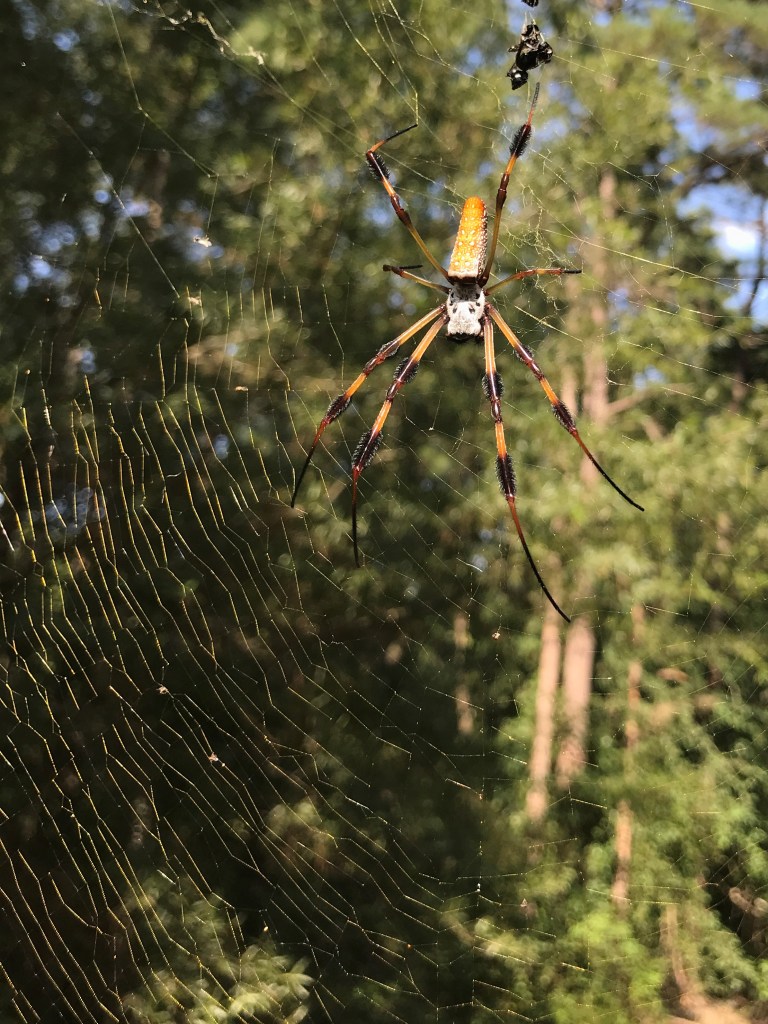
This weekend I received texted photo of a spider, with the question: “Friend or Foe?”  What she meant, of course, is whether the arachnid posed a danger to her.  The picture she sent was that of a Joro spider (Trichonephila clavate). I told her it wasn’t dangerous, but in truth it requires a more complex answer. 

Fat and Happy Joro

Until recently, I could comfortably identify the big spiders around my house as either the garden or writing spider (Argiope aurantia) or the golden silk orb weaver (Trichonephila clavipes).  When late-summer spider season hit and webs were being spun in every available tree and porch pillar, the usual suspects aren’t in attendance.  Instead, the Joro spider, an Asian native, has set up shop all over Athens and throughout our woods in a neighboring county. 

In the Fall of 2014, a fellow in Madison County, Georgia, sent photos of a strange spider to the Department of Entomology at the University of Georgia.  This is the first record of the Joro spider in North America. They probably arrived, as so many invasives do, in packing material for goods shipped across the ocean. Since then, they have expanded their range across the Piedmont of Georgia and South Carolina.  Given that the spiders lay egg sacks with hundreds of eggs (up to 1500!), it is easy to see how they overwhelm the other large orb weavers in the ecosystem.

My ecologically-aware friend was incensed.  “…are we just meant to let them naturalize, or are we supposed to be coming up with ways to get rid of them?”

Golden Silk Orb Weaver

Good question.  If one species takes over a niche from another species, that is cause for a naturalist’s concern.  Unfortunately, unless the usurper causes some economic harm, you aren’t likely to have any of the Powers That Be care enough to devote resources to it.  Not that there is likely to be a way to combat this species that doesn’t threaten all other spider species. 

No, I think we will see the Joro continue to spread and naturalize.  They will capture insects with as much efficiency as their predecessors, and their bites are just as harmless to humans. Whether the transition of arachnid power will impact the ecosystem beyond displacing some species remains to be seen. 

Links:

Spiders in Georgia: Identify the spiders you find.