Ground Cedar

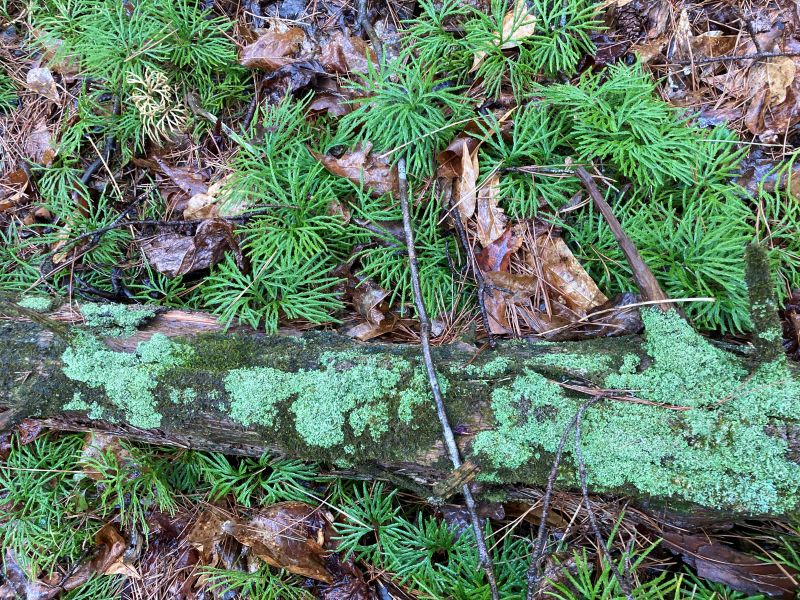
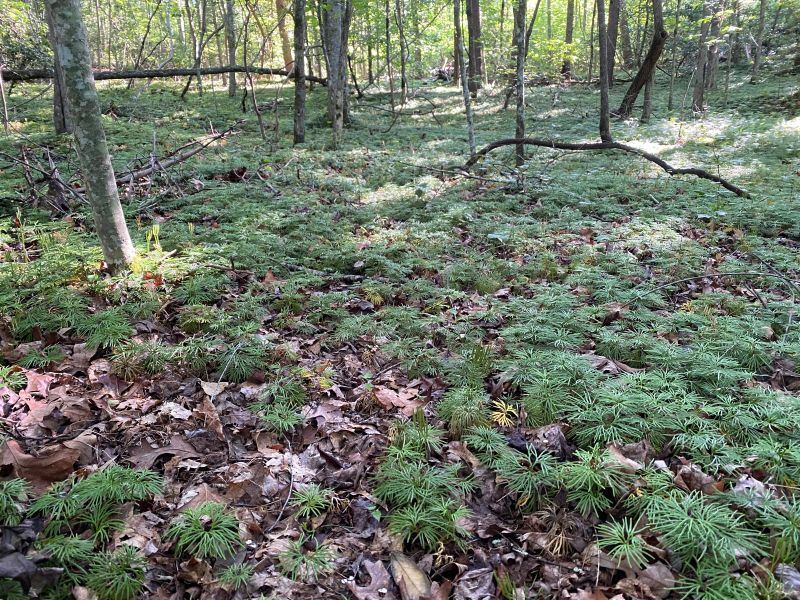
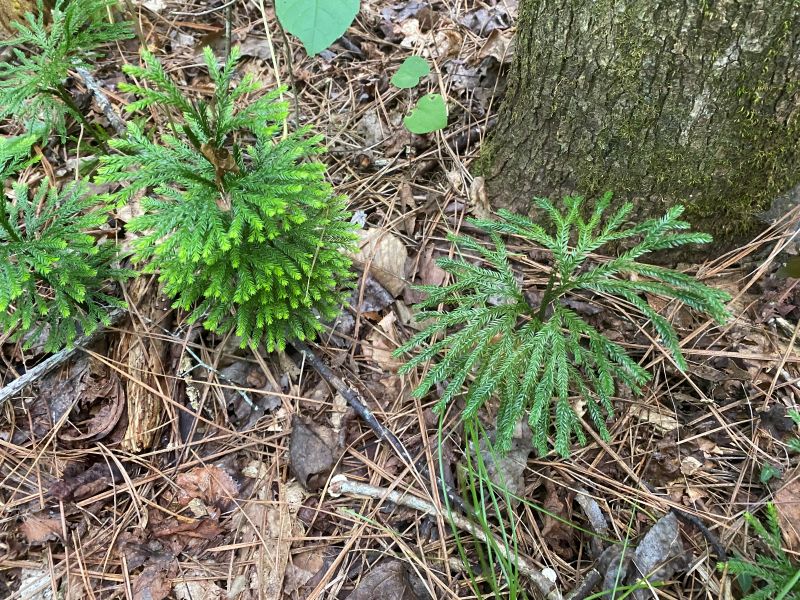
If you wander through the foothills after the leaves have fallen and the ground is dressed in shades of brown and gray, you find that a line or patch of green is liable to stand out. These tiny fan-shaped branches covered in shiny scale-like leaves stand only a few inches high, and look similar to cedar boughs; in fact, that appearance gives the plant several of its common names.

Ground cedar (Diphasiastrum digitatum), also known as running cedar, is a club moss – a type of plant more closely related to ferns than mosses.  They are diminutive relatives of the extinct tree-like Lepidodendrales that grew over a hundred feet tall in forests during the Carboniferous Period (which are interesting in themselves, for reasons I’ll relate in another post), and kin to lycophytes (also called lycopods) around the world.  Found in well-drained woodlands and pine forests, ground cedar spreads through runners along the soil’s surface or rhizomes just below the surface, with the fan-shaped leaves popping up every few inches.

The largest ground cedar stand I’ve seen was on private land in the northeastern corner of Georgia, where it covered perhaps a quarter of an acre.  Apart from that extravagant specimen, I rarely see patches more than a few feet in diameter.

Is it useful for wildlife? I haven’t seen evidence that animals consume it, and since it produces spores rather than seeds, there are no flowers to interest pollinators.  However, humans have found a number of uses for the plant.  The oily spores burn brightly but too briefly to set anything alight, making it useful for magicians’ dramatics, fireworks, and 19th century flash photography.  Spores were also used in baby powders, wound treatment, pill coatings, and as mordants for dyes.  The plant itself was used in teas and medicinal preparations. Probably its most common use in the last few generations has been as a Christmas decoration.  Being evergreen and in easy reach, it provides welcome greenery for decking the halls at a time when other foliage is brown and down.

Here’s the problem.  Ground cedar grows slowly. Spores may lie dormant for many years before germinating.  It requires the presence of certain species of fungi to thrive. A transplanted runner will almost certainly die (as I discovered some years ago).  Every runner you pull up will take a while to regrow. Decades of being harvested commercially for holiday decorations and gardens have made ground cedar scarce, and the practice continues.

Enjoy it where it lives, but leave it there, please.

Ground cedar (right), with a relative, princess pine (Dendrolycopodium obscurum)

On the Open Road

There’s an old joke about the difference between Americans and the British: “Americans think 100 years is a long time, and Britons think 100 miles is a long way.” 

Early on during our recent vacation, my wife asked where we would recommend a traveler from the United Kingdom (where we’ve traveled several times) go to get a true taste of America.  She thought a list of 10 cities – including Boston, Washington, and New Orleans – would be ideal. I countered that if a “true” taste was the goal, small towns – including the moribund ones with more churches than active businesses – should be included.  By the end of the trip, we both agreed that, wherever the journey led, it should be conducted by road.  

The country of England could fit inside the state of Georgia — the 24th largest state out of 50 United States. The lower 48 states stretch across four of the regular 24 time zones.  The distance from “sea to shining sea” measures some 2800 miles (4500 km). In 2019 we traveled in a meandering path from Woodbridge (near Ipswitch) to Boscastle in Cornwall — a trip of some 400 miles; the outward leg of this month’s trip — to Gillette, Wyoming — sent us at least 1700 miles down the road from our front porch near Athens.  The United States is so large and diverse it has been suggested that it is culturally nine or even 11 cultural and economic nations in one.  This doesn’t count the actual sovereign nations scattered across the land.  Common customs, foods, and laws vary considerably as one travels from region to region, often within a single state.

I don’t think one can conceive of the scale of the continent by hopping from airport to airport.  Our dependence on the automobile and the subsequent restructuring of cities for car travel, the sprawling nature of municipalities, the colloquial use of hours rather than miles as the measure of distance…and the only way to understand the American obsession with the Freedom of the Open Road is to experience it.  The rush of miles passing underneath your wheels. The vistas.  The loneliness.  The boredom. Praying that the first gas station in 100 miles is still open. Standing on top of your car with your arm raised in hopes of getting a signal. Crawling along in bumper-to-bumper traffic, or to drive all night with no headlights but your own. These must be experienced to get a feel for the country, because the scope of the land shaped, and continues to influence, the history, economics, culture, and politics of the nation.

Screaming Trees

I was early for a meeting in Wilkes County. With some time to kill, I followed the distant but pervasive sound of (pardon the geek reference) a phaser pistol overloading.  I parked where a neighborhood met a wooded drain, and from a roadside swamped by wisteria, I heard the steady, whining drone of untold numbers of cicadas, all looking for love.

Like many insects, cicada adulthood is merely a fraction of the insects’ total lifespan.  After hatching from eggs drilled into tree twigs, the nymphs fall to the ground. They burrow in and live in the earth for from as little as one to as many as 17 years, surviving by drinking sap from tree roots.  When the time comes, the nymphs climb up trees, poles, grass, or whatever they find to get a little elevation.  They split the back of their exoskeletal skin and molt.  Once the new exoskeleton hardens and the wings straighten and dry, they fly off to find a mate.  The males do all the calling; I can’t fathom how a female chooses one among the cacophony.  Cicadas do take time to feed, drinking plant juices, but don’t do much damage considering their numbers. They don’t bite or sting, although the deep buzz of a low-flying cicada can be startling.

Georgia is home to 20 or so “annual” species of cicada, so called because adults appear every year. After spending less than half a dozen years in the darkness, these large insects appear in the heat of the summer, buzz around in their millions for a few weeks, and then die.  They are often dull-colored or camouflaged, and more likely to be heard than seen until we find them dead on the ground at the end of their final sprint. 

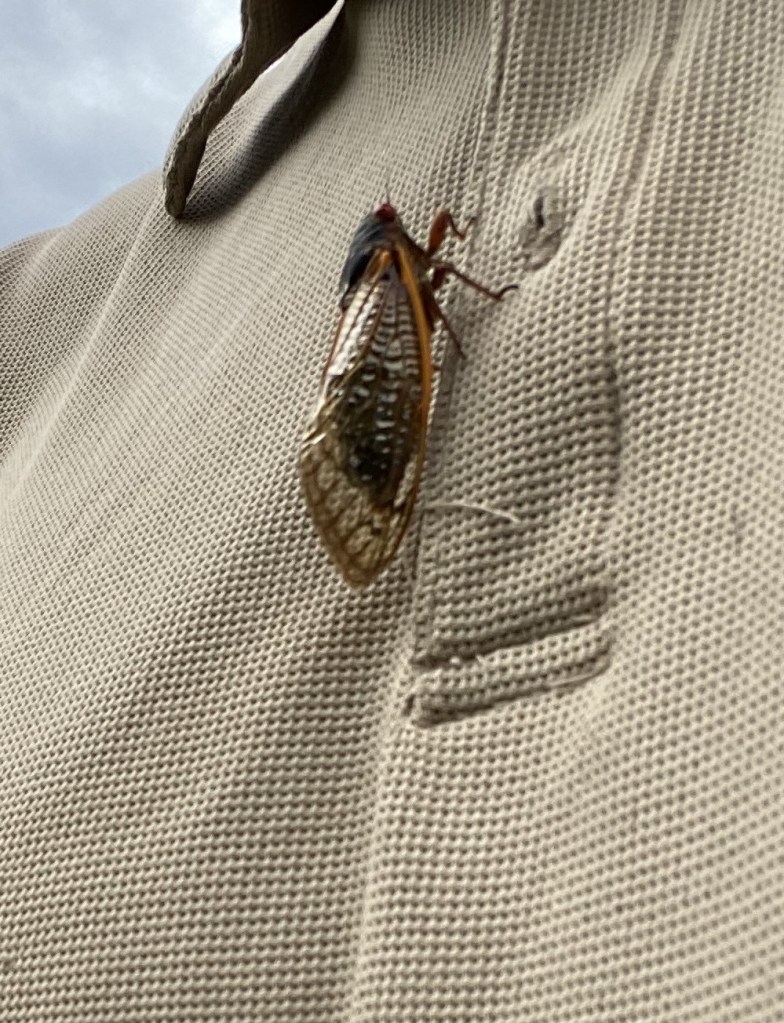
There are also six species known as “periodic” cicadas.  These black and orange insects spend 13 to 17 years as nymphs before rising to deafen the neighbors.  While some annual cicadas appear every year, the periodic cicadas all rise together in tremendous broods.  This year, the trillions of members of 13-year Brood XIX are keeping folks awake from Virginia to Louisiana and up into the Midwest (Broods are multi-state masses of periodic cicadas that all rise in the same summer. A 17-year group known as Brood XIII has also risen this year in the upper Midwest).

My first close contact took place just as I stepped from the truck; an orange-eyed critter landed on my shirt and stayed put for a couple of minutes before getting spooked and flying off.  Once I started looking, I saw the empty husks everywhere – dozens on a branch, sometimes one on each side of a leaf!  And while the trees ahead of me housed the vast majority of cicadas, there were several specimens amongst the shells at my feet, mostly unbothered by me even at close range. 

How many husks can you see here?

And the air was full of the wailing siren of cicada courtship. Did they reach the estimated one million per acre in these woods? All that noise suggested it was a possibility. At close range, cicada calls can reach 90-100 decibels, or as loud as a power drill! I was as close as I needed to be to the unearthly courting cries.

After a while, I set about collecting some of the exoskeletons (because that’s the sort of thing I do). A 15-foot strip of roadside netted me several dozen husks, and there were others in view that I didn’t harvest.

I took my collection back to the truck; it was time for my meeting, and the cicadas had their own business to attend.

4H student shows off her collection of exoskeletons

Further Information

Cicadas recorded at this roadside

Common Cicadas in Georgia