In one corner of the sparsely-peopled state of Wyoming, a long road leads you through the Black Hills to a singularly impressive sight. Blue with distance, a dark stone column stands stark against the sky, towering over its surroundings. It has as many names as there were cultures to encounter it, based on its appearance (“Tree Rock”) or the legends associated with its creation (“Bear’s Lodge”); the current stewards of the place, the National Park Service (NPS), use the name Devils Tower.
As a child, my first awareness of this magnificent butte came in 1977 with the release of Close Encounters of the Third Kind. My appreciation for the site grew in later years as I learned more about the geology of the place. Tens of millions of years ago, magma intruded through sedimentary formations; cooling, the igneous rock fractured into geometric columns. In the intervening epochs, erosion bared and shaped the structure to what it is today. There are several similar structures — the Missouri Buttes — a few miles away, but none are as striking as this lone pillar.
When my family journeyed westward this spring, I put it on the list of “Things I’d Like to See.” Even by western travel standards (where the goal of a day’s drive was a motel rather than a point of interest), it was out of the way, but there was enough interest among the fam that it made it on the itinerary: a five hour drive north, followed by an hour-long backtrack to Gillette for the night.
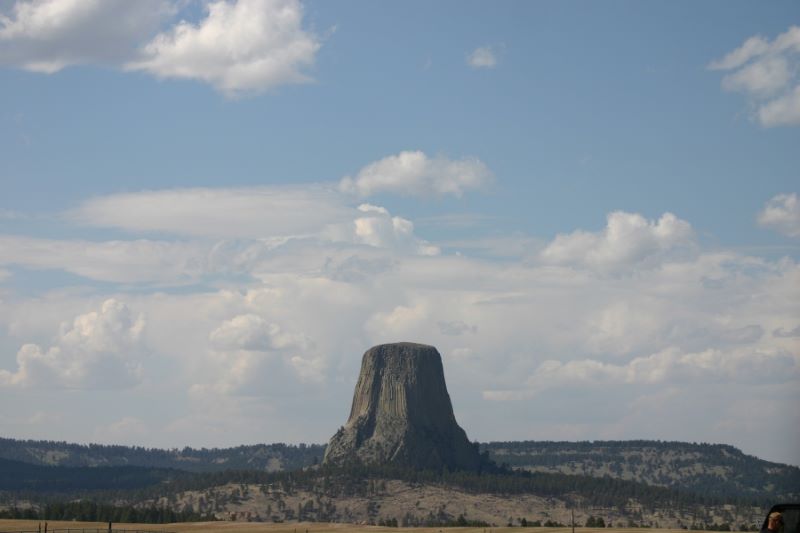

By mid-afternoon on the appointed day, we caught a first a brief glimpse of the pillar of Devils Tower, many miles away. Over the next half hour, it graced us with a few more teasing views, gradually growing in size with each glimpse. Then we entered the valley of the Belle Fourche River, where the butte loomed far above us from our spot in the line at the park entrance. I waited with growing impatience as we followed the park road around and up – and had to wait until someone freed up a parking space so we could continue to the visitors center. Finally parked, we were ready to follow the 1.3 mile trail around the base of the 860 ft butte.

One could accuse me of coup-counting — laying eyes on a celebrated place or view merely for bragging rights. I hope that was not the case, but I can say that, from the very first moment I beheld the tower, I felt a sense of awe. To provide contrast: some years ago when I visited Stonehenge, I was impressed on an intellectual level – the effort to conceive of and then build this enigmatic stone structure certainly fires the imagination. But Devils Tower is on a different scale entirely. Sixty million years of erosion unearthed the tower, which is a sacred site for over two dozen tribes. It is just…massive. Sheer. Over a tenth of a mile in the air. Composed of fused columns that gave rise to the stories of giant bears clawing at the stone.
So many details, so much to hear and see. I took over a hundred photos of the butte, from all angles, including a climber in a painstaking descent, vultures wheeling around the summit, and the remains of a ladder put in place over a century ago.

The ponderosa pines clustering around the base showed signs of fire. I read the interpretive sign talking about the NPS using periodic prescribed burning to simulate lightning fires. Good on them! Another sign said the top of the tower is about the size of a football field, and includes sagebrush, grass, and cactus, as well as, somehow, rodents and snakes. The signage was excellent, explaining (for those who would stop to read) the natural and cultural history, and the Park Service’s role in maintaining the U.S’s first national monument.

Of course, many breezed by the signs. not everyone felt reverence for the site. There were some stereotypical loud Americans, prattlers and coup-counters. Halfway through the circuit, some middle-aged women passed by, complaining about the rigors of walking the uneven, unpaved trail. On the other end of the spectrum, a native man and woman passed by us silently, solemnly, purposefully. Although attempts to change the name of the monument to something closer to a Native moniker have failed, the NPS doesn’t provide climbing permits for the butte during June, out of respect for ceremonies held during that month.

A few hours was not enough time to fully experience a place, but in this case it was enough to awe.
Additional Information:
National Park Service’s page for Devils Tower


 Towards the Moon or To the Sun
You must be logged in to post a comment.