I remember getting off the school bus after a long day at elementary school. Ma was sitting on the front steps, waiting for me. She said that they had taken Booger, our old yellow cur, to the vet. He was sick, and they put him to sleep. I knew enough about doctors to understand about anesthesia during operations, so I wasn’t perturbed. “When will he wake up?” It was at this point that I learned about euphemisms, and about loss.
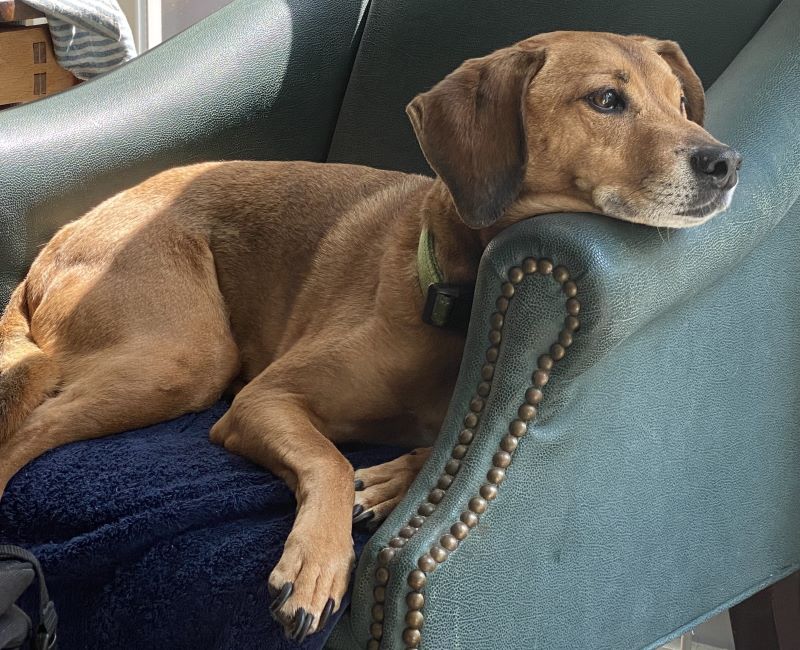
Since then, I have seen many, many dogs come and go. A few have gone on their own, suddenly and without warning. Most have been hard decisions. Maybe it’s a product of my own age and experiences, but I am always cognizant that my time with these dogs is finite. When I assume responsibility for a dog, be it a stray like Rufus or a pound pup like Hazel, I am aware that I will one day dig a hole for that friend. Three of our dogs are ten or older; seniors are still in good health, still eating well, still moving well. The voice in the back of my head whispers “one day…” Eventually, for each dog, the whisper will become “soon…”
I’m terribly sentimental when it comes to dogs. A sad story about a lost pup or bereaved old hound will bring a lump to my throat and send me rushing to find the nearest of my own dogs to pet. A suffering dog tears at my heart. But when it comes to my own hounds, as hard as it gets, I’m always there until the end. I can’t abide the cowards who leave their pets alone at the vet’s – or worse, take their senior dogs to a shelter or dump them on the side of the road when the animal’s infirmity becomes inconvenient.
I love my dogs more than I love most people.
And grief is the price of love.
“Having a dog will bless you with many of the happiest days of your life, and one of the worst.” –Unk.
Additional:
“The Good Death”, an essay by a veterinarian about the hardest decision the pet owner has to make. Should be required reading for any owner.
In the autumn of 1914, armies gathered, pushed, and blocked, in an effort to outflank each other. Instead, they ran into the sea. The forces were more lethal than in previous wars, producing withering rates of fire against which no amount of bravery could prevail. Standing invited death, so the men dug into the earth in order to move about with some amount of safety. Thus began the Great War, or as we would unfortunately come to call it: World War One.
For years, the armies pounded the trenches, occasionally charging across the deadly ground at great cost attempting to drive to foe back a mile or so. During this time, humanity at its most inhumane leveraged the power of chemistry, engineering, and the might of industry to create weapons that rendered the individual soldier nearly powerless to control his fate. Artillery could reach over the horizon to render the exposed man into pink mist, collapse dugouts and smother, or pummel with concussion until soldiers went punch-drunk or mad. Poison gasses could burn lungs, eyes, and exposed skin, and might persist in trenches or shell holes to blind or kill the unwary. Machine guns could send a stream of death hundreds of yards, showering bullets upon victims as they struggled to navigate the tangles of barbed wire on the churned fields of No Man’s Land. In its deadliest day, France suffered 27,000 killed, while over 19,000 Britons fell in their worst day. The war also saw the birth of tanks and fighting aeroplanes, which would only reach their deadly potential during the next world war.
This dehumanizing meatgrinder continued until the last survivor of the Triple Alliance, Germany, began to falter. The “Hundred Days” saw the men leaving the trenches they resided in for years, pushing the German army back. The butcher’s bill for this phase of the war is beyond comprehension: nearly two million dead or wounded. Consider that the current number of active-duty US military personnel, all branches, is just over two million.
November 11th, 1918. German delegates meet with the opposing military leaders in a train car in the middle of a forest, and bullied into signing a cease fire – the Armistice of Compiègne – at 5:45 in the morning. All fighting was to cease at 11:00 that morning, and with a few tragic exceptions it did.
The end of the War to End All Wars. This is where the story usually ends, all neatly tied up, fade to black, roll credits. However, an armistice is not peace, but rather a cessation of fighting for a period of time. In reality, warships remained on blockade stations and troops stayed on frontline guard for months after, while diplomats hashed out the terms of a formal peace treaty. Perhaps a quarter million German civilians died in the months between the Armistice and the peace treaty. Soldiers and civilians alike succumbed to diseases, including the so-called Spanish Flu which would kill tens of millions.
Once the ink dried on the Treaty of Versailles in June 1919, troops slowly returned to their home countries. But the impact on society went far beyond the territorial shifts or financial burdens from crippling war debts. Many millions had died; many more carried the physical and mental damage resulting from industrialized modern warfare. Some towns lost all of their fighting-aged men. The shock to societies worldwide as families lost siblings, fathers, husbands, sisters, wives, and children to the Great War can be guessed at by those have experienced such a loss personally, but at this scale the shared trauma is beyond imagination. Naturally, certain times and places would become focal points for remembering, reflecting, and grieving anew. The date and time of the Armistice became one such point in time; the Cenotaph in London and similar memorials around the world served as the places. From November 1919, many nations chose November 11 to hold Armistice Day commemorations honoring the fallen and celebrating the cause of world peace. With the onset of a new global war, Britain and the Commonwealth moved the commemoration to the nearest Sunday, reframing it as Remembrance Day (though Armistice Day is still recognized).
“The Treaty was all a great pity. We shall have to do the same thing all over again in 25 years at three times the cost.” –Lloyd George
In the United States, a similar movement to honor all veterans – living and dead – grew out of the Second World War. In 1954, Armistice Day became Veterans Day. Unlike some holidays, which are observed on Monday or Friday to extend a weekend, Veterans Day is always the 11th (although it did reside on the 4th Monday of October for a few years in the 1970s). Veterans Day is a federal holiday; apart from U.S. government workers, whether it is a holiday or not is up to individual companies, agencies or states. The nearest weekend is a time for parades and commemorations in many communities.
You smug-faced crowds with kindling eye/Who cheer when soldier lads march by,/Sneak home and pray you’ll never know/The hell where youth and laughter go. –Siegfried Sassoon, “Suicide in the Trenches”
I have my own commemoration, first enacted when there were still some veterans of the Great War living. Every year on the morning of November 11, I read poetry from the Great War or accounts from the soldiers. I listen to a playlist ranging from Arthur Fields singing “Over There” to three by Eric Bogle: “No Man’s Land,” “And the Band Played Waltzing Matilda,” and “The Gift of Years,” with a few relevant poems interspersed. Every year, on the eleventh hour of the eleventh day of the eleventh month, I pause for a silent toast to the strains of “The Last Post” and “Taps.”
I do not forget the men and women in uniform, now and in the past. But I commemorate Armistice Day for the sorrow of war and the hope for peace. May that hope not always be in vain.
They shall grow not old, as we that are left grow old:/Age shall not weary them, nor the years condemn./At the going down of the sun and in the morning/We will remember them. —Laurence Binyon, “For the Fallen”
There’s an old joke about the difference between Americans and the British: “Americans think 100 years is a long time, and Britons think 100 miles is a long way.”
Early on during our recent vacation, my wife asked where we would recommend a traveler from the United Kingdom (where we’ve traveled several times) go to get a true taste of America. She thought a list of 10 cities – including Boston, Washington, and New Orleans – would be ideal. I countered that if a “true” taste was the goal, small towns – including the moribund ones with more churches than active businesses – should be included. By the end of the trip, we both agreed that, wherever the journey led, it should be conducted by road.
The country of England could fit inside the state of Georgia — the 24th largest state out of 50 United States. The lower 48 states stretch across four of the regular 24 time zones. The distance from “sea to shining sea” measures some 2800 miles (4500 km). In 2019 we traveled in a meandering path from Woodbridge (near Ipswitch) to Boscastle in Cornwall — a trip of some 400 miles; the outward leg of this month’s trip — to Gillette, Wyoming — sent us at least 1700 miles down the road from our front porch near Athens. The United States is so large and diverse it has been suggested that it is culturally nine or even 11 cultural and economic nations in one. This doesn’t count the actual sovereign nations scattered across the land. Common customs, foods, and laws vary considerably as one travels from region to region, often within a single state.
I don’t think one can conceive of the scale of the continent by hopping from airport to airport. Our dependence on the automobile and the subsequent restructuring of cities for car travel, the sprawling nature of municipalities, the colloquial use of hours rather than miles as the measure of distance…and the only way to understand the American obsession with the Freedom of the Open Road is to experience it. The rush of miles passing underneath your wheels. The vistas. The loneliness. The boredom. Praying that the first gas station in 100 miles is still open. Standing on top of your car with your arm raised in hopes of getting a signal. Crawling along in bumper-to-bumper traffic, or to drive all night with no headlights but your own. These must be experienced to get a feel for the country, because the scope of the land shaped, and continues to influence, the history, economics, culture, and politics of the nation.
We have a tendency to take a proprietary view of things around us. “The deer down the road are a potential nuisance, but the one that feeds on the edge of my yard is okay because it’s familiar.” “That maple by the gate is familiar as an old friend.” “Stray cats are death on toast for birds, but I’ve named the one that creeps around my hedge.” “They can’t do that to our pledges, only we can do that to our pledges.” (Yes, Ma, that last one was a movie reference.)
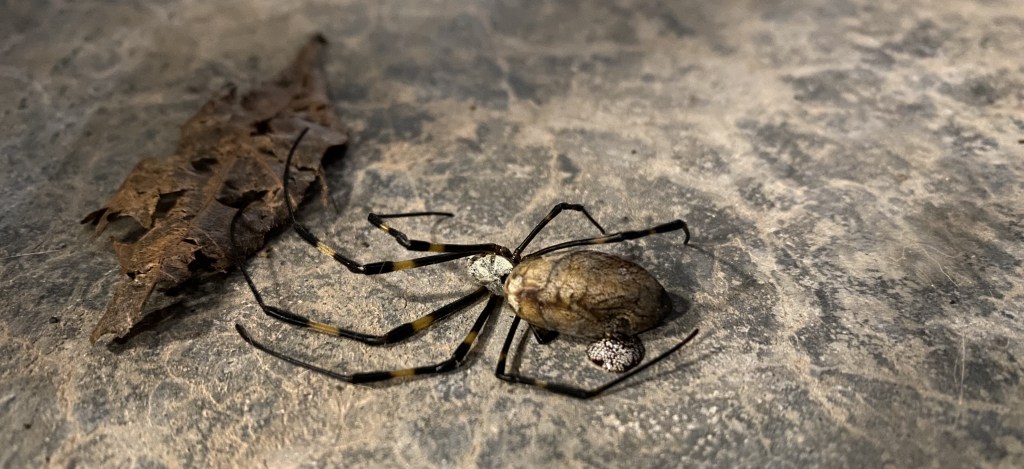
As I mentioned a while back, the Joro spider – an Asian arachnid making itself at home in the Piedmont – fills up the woods in late summer, to the consternation of those who otherwise love the outdoors. As temperatures drop in the late autumn, the multitude of spiders drops away and their haphazard webbing disintegrates.
And then there was the large female residing just outside the garage. I’d see her every day, along with a few smaller Joros inhabiting that corner under the eaves. She was hanging out through the late summer and into the autumn. October…November… December… the spiders on the back porch fell away. Moths, flies, and other flying insects faded out as well. Christmas came, and the large female under the eaves remained, after cold and hunger felled all her neighbors. Was her persistence due to being the largest spider on the south-facing side of the house, protected from the worst of the winds? Regardless, at this point she’d gone from an invasive cluttering up the garage to a dogged survivor. Instead of glares, she earned appreciative glances as I walked by.
The New Year dawned with a near-freezing morning. I expected her corner to be unattended, but there she was: slowly, methodically, doggedly repairing her web with golden-tinted silk. You go, girl.
Now it’s mid-January. Atmospheric disruption at the North Pole sent a shock of subfreezing winds our way. The first morning after the hard freeze revealed a ragged, empty web. Our Joro lay on the cement floor, having finally succumbed. I wouldn’t say I had an overabundance of feeling for that critter (this was a short-lived invasive, not Charlotte), but its passing received far more attention than that of any of its brethren.
Is there a tree, a stone, an animal — any normally-anonymous thing –that you have marked with your attention? Any thing whose absence would be worthy of notice and remark? Drop a comment and let me know.
I met Dr. Walter Cook over three decades ago. In his Forest Engineering course, I learned how to (among other things) properly lay out a trail in the woods; in Forest Recreation, he taught me why these trails were important. He was an important mentor for my Eagle project, which involved constructing a stretch of trail at Sandy Creek Park in Athens.
I reconnected with my professor at his 90th birthday celebration. Fittingly, it was in a park pavilion. During the gathering, nature-lovers lauded his tireless work in developing, coordinating, and building trails and paths on over 130 projects across both private and public lands.
Last week, I went to lunch with Dr. Cook to catch up. He has read this blog, and agreed to share some of his thoughts here. This is the first of his essays which I post with his permission.
The Richest Man in the World
By Dr. Walter Cook
Who among us has not occasionally wished to be rich? As Tevye sang in Fiddler on the Roof, “If I were a Rich Man…” he would no longer have to work. Some people have other reasons for wanting to be rich – to have a big car (or maybe two), to have a big house (or maybe two), to travel the world, to send their children to the best university, or merely not to worry about their monthly bills. Many times in the literature of myth, characters who have unlimited riches are depicted as having large chests overflowing with jewels, surrounded by the utmost beauty of colorful paintings, with everything touched by gold.
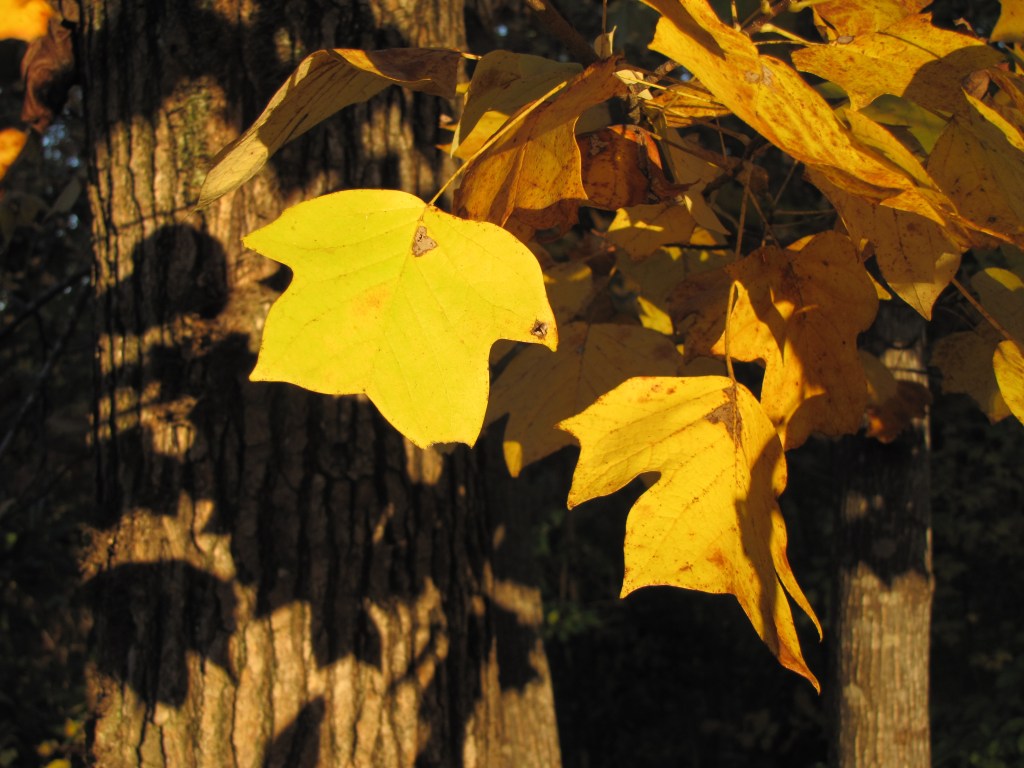
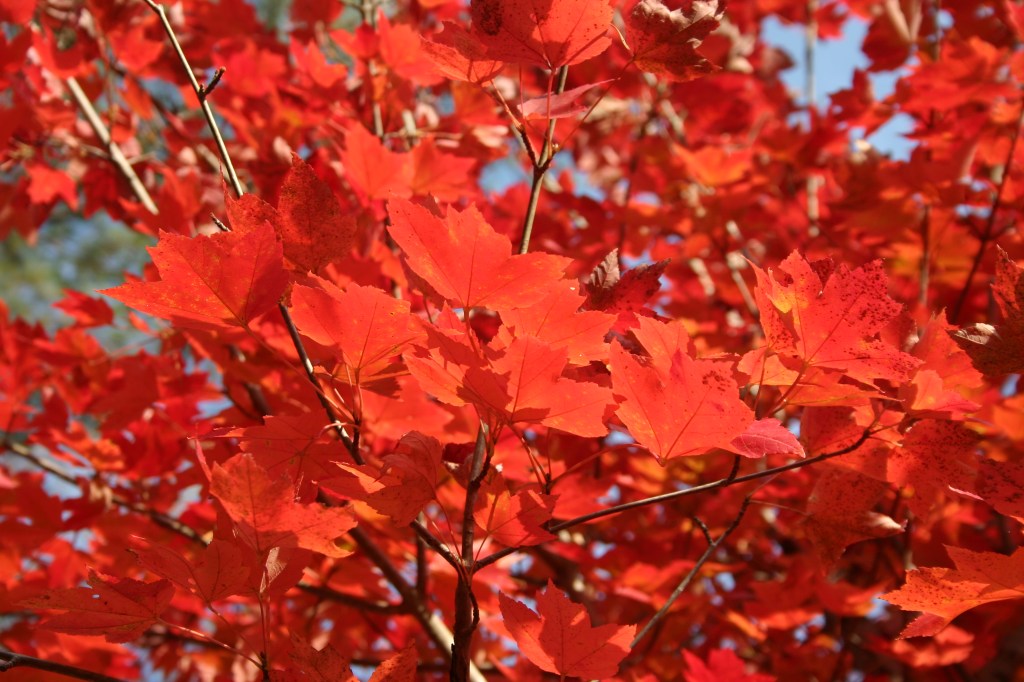
On a fall day several years ago, I discovered that I, too, was rich – not in the sense of Tevye’s longings, not in the sense of a carefree life, but rich in the sense of a mythical king. As I was walking down the Middle Oconee River (near my hometown of Athens, Georgia) I enjoyed the many colorful red and sugar maples, dogwoods, blackgums, and poison ivy along the river’s levee. Many leaves had fallen, and I recalled that when I was a young boy, I would gather a half dozen of the prettiest leaves as I walked home from school to bring home to share their beauty with my mother. But as I looked at the leaves lying ankle-deep on the ground, I realized it would be impossible to choose the six best leaves – there were so many! How could anyone make such a choice. They were like jewels, even better than jewels, for no jewel could match the dazzling spectrum of colors in even one leaf, much less all the leaves. And, as I looked up at the trees that had produced these super jewels, they were like paintings, only far surpassing any human-made work of art.
So, there I was, ankle-deep in the world’s most beautiful jewels, surrounded by superb works of art, and all the while being entertained by the music of songbirds. What more could one possibly wish for? I was a rich man, and I didn’t even have to work for it. Tevye would have liked that.
[Since that long ago day in 1993, I have walked in a lot of forests, along many riverbanks, and in other interesting environments. In the past few years, I have enjoyed exploring the back country while flagging new trails in the Jocassee Gorges in South Carolina. Compared with the quiet beauty of the Oconee River in Georgia, the scenery in Jocassee is simply spectacular. The tremendous cliffs (not all cliffs are in state parks!), the numerous waterfalls, the natural gardens of wildflowers, and the views of endless mountains rolling to infinity, all certainly qualify as beautiful.]
But don’t be fooled!! The nice thing about nature is you don’t have to wait until fall or go to a special place to enjoy its beauty. Nature is, almost by definition, beautiful. We rightly enjoy the special shows of fall colors, spring and summer flowers, winter ice and snow, and the beautiful landscape of the Southern Appalachians. But even without these spectaculars, nature – the undisturbed environment – is beautiful. All we need to enjoy it is to open our minds to its presence. Then we can all be as rich as a mythical king.
Development. For some, the word promises increased opportunity and convenience – jobs at the new factory, or a new grocery store half the distance of the old one. For others, it signifies loss and an unwelcome change to the landscape.
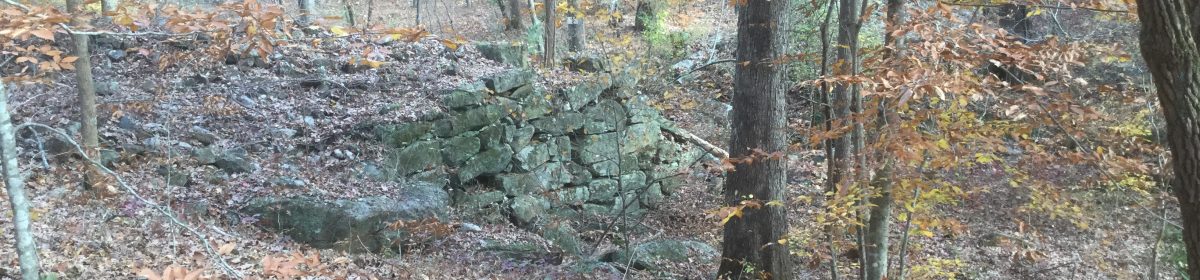
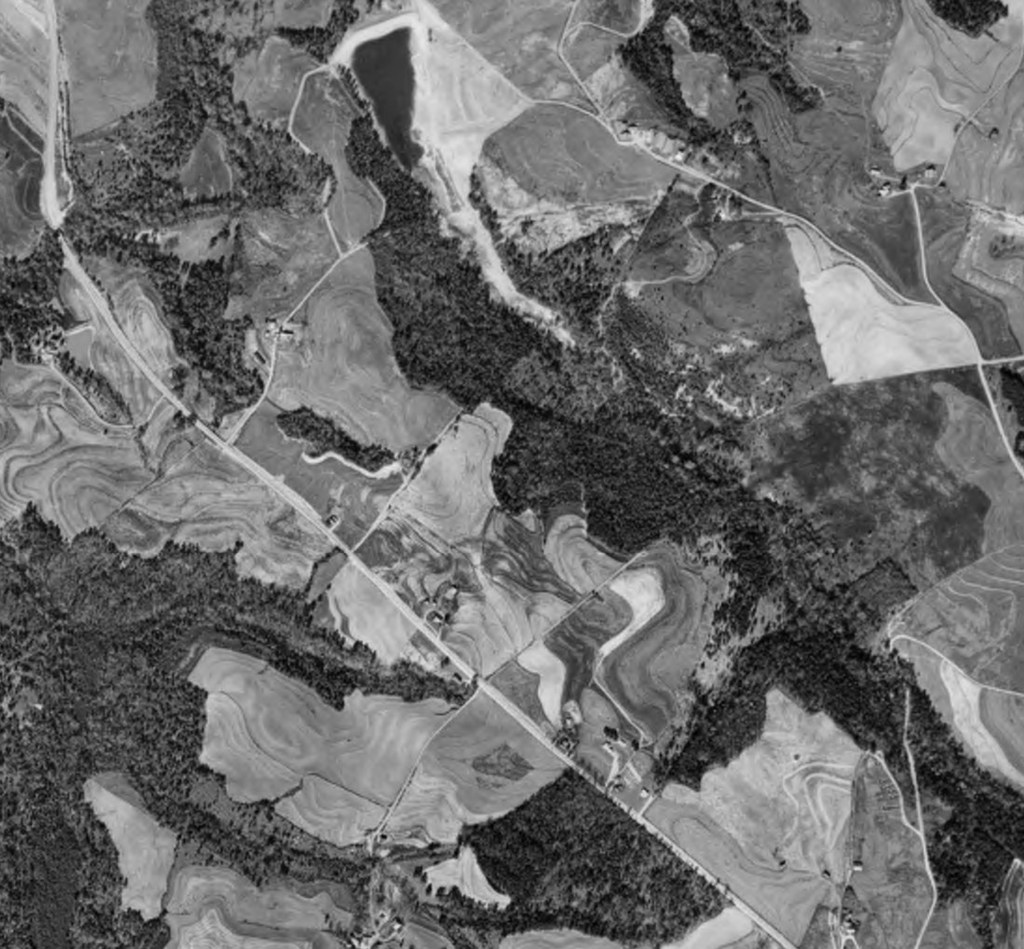
I grew up in a fairly rural area: a landscape of pastures, cropfields, and pine plantations. Great white oaks, red oaks, hickories and beeches mantled the hillsides and bottomlands where agriculture wasn’t practical. I know these forests were second-growth; most of the landscape was altered by land worked, paupered, and abandoned outside of living memory. Small communities vanished over time, leaving fields to lie fallow and return to forest. Aerial photos attests that the woods I wandered in the 70’s and 80’s were open agricultural lands just a handful of decades prior. Piles of bricks obscured by leaf mould, rusted wire curling off gnarled fenceposts, old wells capped by rotten boards, and fragments of barrels at forgotten still sites attest to homes and lives long vanished.
You may be familiar with the movie The Fox and the Hound. In typical Disney fashion, the film has very little in common with the source material. Written in the 1960s, the novel The Fox and the Hound illustrates the rise and eventual dominion of human development in a valley. At the beginning of the novel, the valley contains quiet, bear-haunted woods, small farms, and a lone, empty highway. As the story continues, the human population grows, fueling encroaching development in the story’s background. By novel’s end the forests are replaced by houses, motors have exiled the quiet, and the air is filled with the stench of factory smoke and diesel fumes. The transformation is subtle and largely in the background, but in the final chapter the message comes to the fore. The heartbreaking book ends with the words, “…and in this miserable, fouled land there was no longer any place for fox, hound, or human being.”
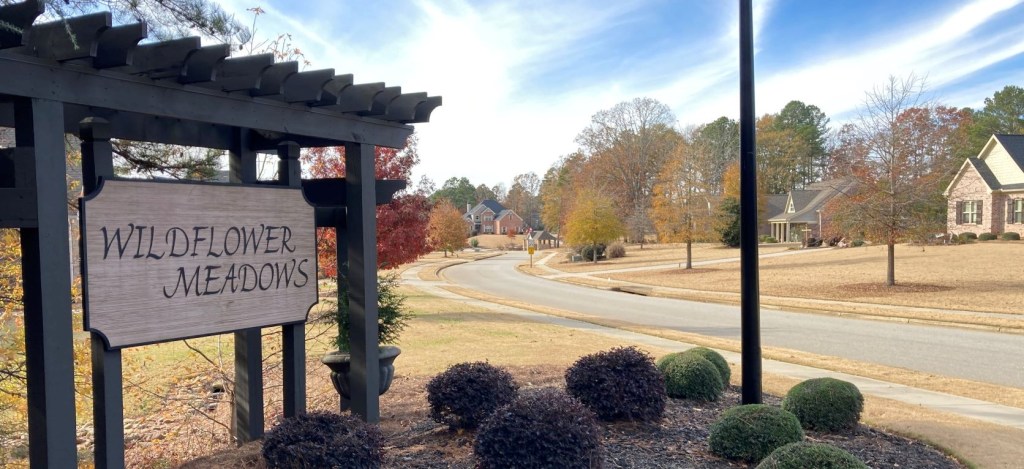
A subdivision name or memorial to what was lost?
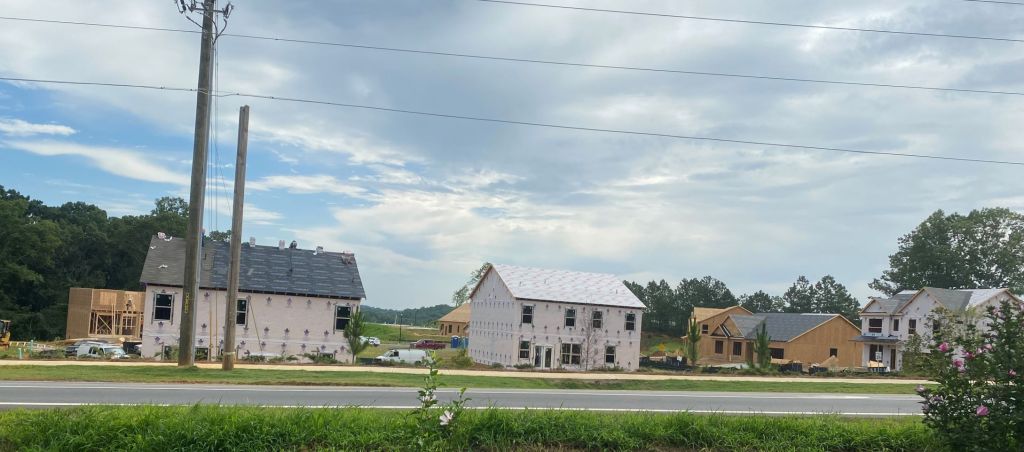
My own landscape’s change has been neither so rapid (the book encompasses the lifespan of an improbably venerable fox) nor so complete, but it is much altered from my childhood. As a teen sitting in the deepest part of our woods on a cold November Saturday, I could guess if the university was playing a home game by the volume of traffic noise on the highway 1.5 miles away. Traffic was barely audible most days, but pilgrims trekking to see the Bulldogs would raise the volume to a steady rumble. The two-lane is now a four-lane, and the noise is both clear and constant regardless of the day. Soybean fields that fattened our deer are now planted pines over-ripe for harvest. Pastures on the hill have sprouted dozens of homes on turfgrassed acre-lots, and the formerly-graveled road fronting our land is both paved and lined with houses on twelve-acre wooded tracts.
Near Watkinsville, 1955
Same, 1980. Fewer fields, a few more buildings
Same, 2021. Housing developments galore.
But the majority of people who live here now are “from somewhere else,” and neither know nor care about local history. They are looking for land that is pretty, or at least pretty cheap compared to properties closer into town. Their last names aren’t on the tombstones at the century-old Baptist church. My family only set down roots here in the 1960s, but with the county population quadrupling in that time, few could consider us newcomers.
I’ve never known bears on our land, but I remember where I saw my final covey of bobwhite quail on the farm. I remember the deer stand where I encountered our last fox squirrel. Both encounters were over three decades ago, and I have no expectation of these critters ever returning.
It is not without a sense of irony and perhaps a touch of shame that I have cleared a patch of forest and planted a house in the heart of the family property, land which reclaimed the last homestead over a century ago. But I carved out one acre for a house to guard many acres immediately surrounding it. This is where I’ve always wanted to be, and here I hope to protect this patch of woods for as long as I can.
In his world of Middle Earth, J.R.R. Tolkien referred to “The Long Defeat,” where the world is in a gradual but inevitable decline; the slide towards ruin may be slowed but never arrested or reversed by the small victories that the heroes strive for. To the ecologically-minded, it seems to be the path we chose as we struggle against the forces of hungry economies and burgeoning populations. To those who don’t want their corner of the world to alter from the memories of youth, every clearcut, new house site or NO TRESPASSING sign strikes a blow for the forces of progress as they march along the path of “The Long Defeat.”
Last month I saw a flash of movement beside the road — the first red fox I’ve seen on the farm in years. Encounters like this give me hope that we are not as far into decline as I feared. A fool’s hope maybe, but I’ll take the small victory.
Back in college, I had a friend that would believe pretty much anything nature-related I told him. I was the biologist-in-training, after all (I didn’t abuse that trust. Honest). When he asked if male white-tailed deer grew a new tine on their antlers every year, I explained how the bone of antlers is covered in fine fur and vascularized, growing from nubbins to full size in the space of half a year. At that point, the soft tissue dries and is rubbed off, leaving the hard bone. The antlers don’t grow any more, but stay on the deer’s head until well into winter, when they fall off. Then the cycle starts anew, and the buck, now a year older, may well grow a larger set of antlers.
Fast forward a decade or so. I was a biologist at some expo or another; the table was decked with bones, tortoise shells, snake skins, and other bits of natural detritus with which to engage the public in conversations about how cool nature is. A woman came by, looking with mild distaste at my display. At last, she pointed at the shed antler I’d picked up in the woods. “Did you kill that deer?” she demanded. I launched into my spiel on the antler growth cycle with the enthusiasm of a young professional naturalist. I ended my micro lecture with a verbal coda indicating how interesting I found the whole process.
“Uh-huh.” Not the reaction I was expecting. She clearly didn’t buy a word that I said, because I was certainly lying to cover up evidence of my Bambicide. Nonplused, I showed her the burr, running my finger over the rough transitional surface where the antler detached from the pedicle on the buck’s head; it was obviously not sawn off a dead deer. Still didn’t matter. I felt the weight of her judging gaze as she proceeded to visit another table featuring less unsavory characters than government biologists like me.
Earlier this week, I was talking with someone about one aspect of my job: advocating for certain suites of native plant species, a process that often involves removing non-natives as well as native species of a different seral community. I went on to say that forest thinning and regular regimes of prescribed burning are standard management tools in the southeastern US. Foresters and wildlife biologists are trying to create openings in forests to bring back endangered animals, but ironically those plans are halted by lawsuits from well-intentioned “nature lovers” who think all forests should be climax forests, and that any tree cutting was only for the profit of the timber industry.
My correspondent suggested, “Maybe the scientists could do some educational outreach and turn the nature lovers into volunteers. When folks understand the science, they become great advocates.”
Oh, one would believe so. And don’t think we don’t do outreach. Here’s a secret about biologists: we are often very knowledgeable introverts. One of the things that draws us to a career in the outdoors is limited contact with people. Further, a biologist often knows that a casual question from a visitor at a booth will have an answer that encompasses an hour’s lecture of foundational background, examples, and counter-examples. They must mentally distill this into a 20-second soundbite that still sounds convincing to the layman.
And even if we were all ecological advocates with the eloquence of Carl Sagan, delivery of the message is only half the battle. The receiver still must accept it, and there are several barriers to overcome.
Let’s start with the power of emotion. Emotion is immediate and viscerally satisfying, while one must be patient and discerning with facts. I can point to a browse line and explain why humans must cull a deer herd, but weighed against a photo of a hunter-killed deer I may well lose the argument. My coworkers can list the plant and animal species endemic to a longleaf savanna ecosystem, but can that compete with the image of the charred, barren forest floor that is periodically necessary to preserve those species?
The next hurdle is the cognitive bias. Certain members of the public dismiss our voices, particularly in the last couple of decades. Is it because they’ve been lied to by dishonest authorities? Because they’ve been trained by fringe news sources to assume anyone coming out of a university has a hidden agenda? We can’t be certain of the reason, but the result – skepticism veering into denial – is evident.
Finally, there is the willingness to change. This seems to be the highest hurdle. The ability to change one’s opinion when presented with new facts seems as rare and as valuable as any superpower. The shed-denier at the beginning of this essay is but one of many I’ve encountered in person or via social media. “I’m entitled to my opinion” is acceptable in matters of personal taste, but too many in today’s society take it to mean, “My ignorance is as valid as your specialized knowledge.”
If you are reading this, likely you are part of the choir I’m preaching to; you’re nodding because you’ve probably had run-ins with the arrogantly ignorant folks who believe their emotional opinion overrules your fact-based assertion. But if I am fortunate enough to capture a pair of fresh eyes linked to an open mind, please believe that I am not getting paid under the table by Big Timber. My interest in nature began with reading about dinosaurs as a toddler and has never waned. If I tell you something about the natural world, it’s what I believe to be true.
I have been around long enough to know there are no simple solutions. Improving habitat for one species may be detrimental for another. One of the more difficult parts of a biologist’s job is to condense this knowledge into an elevator pitch that will enlighten someone who may be happier in the dark.
Many hikers are on a mission. I know I often am. You have to have a determined focus to reach the set goal when your legs suggest now would be a great time to take a long break. But when you reach that summit, stand by that waterfall, get your selfie by that marker – then what? When time allows, I like to spend some time just soaking up the scenery, both distant and at my feet.
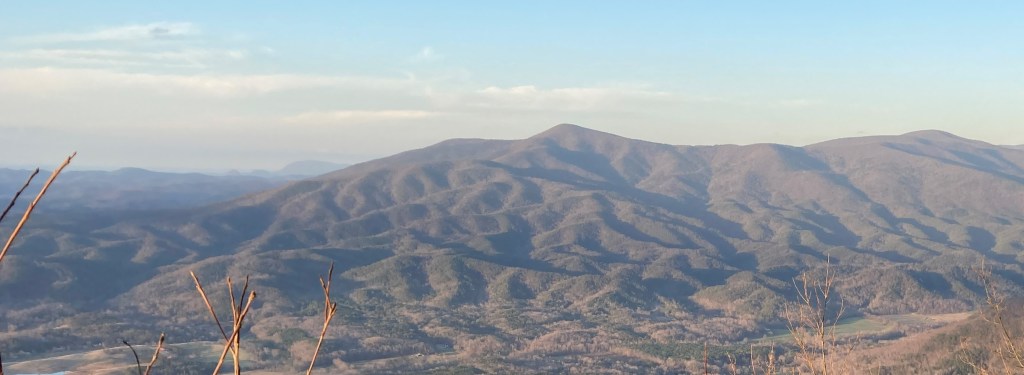
Such is the case at the end of February, as I climb the short trail past the stone fire tower and out to the overlook on Fort Mountain. It is one of the sentinels of the Blue Ridge Mountains, glaring westward at the low wavelike mountain ridges breaking across the wide valley.
The Fort Mountain overlook is a series of stone outcropping on which the parks department built wooden platforms for people to stand and appreciate the view from some 1800 feet above the valley floor. Near the platform is a boulder resembling a rough chair. I fancy it to be my bardic throne, to perch on and ponder whenever I find myself in that corner of the state. I, who fidgets after ten minutes in front of the television, find new reserves of patience in this place amid the stones lichens and briers at the edge of air.
When the wind stills a moment, I hear the soft rush of water hundreds of feet below. I enjoy the novelty of watching a buzzard soaring beneath me. And shadows lengthen.
There were reminders of humanity, of course. The steady roar of the distant interstate and nearer highway carries on the wind. Much closer visitors to the mountain cough and sneeze, and occasionally thump past on the boardwalk between stairs and platform. But they sweep the vista with their eyes, and after five minutes they take their selfies and return the way they came. The disturbances come less often as the evening progresses and dinnertime nears.
To the northeast, Grassy Mountain spreads low and wide with hollows upon hollows and fractalling folds in the mantle of trees. I am content to watch the shadows form in those folds, like the substance of the incipient evening growing in the crevices where the waning sun can no longer reach.
Time passes and the tide of shadow washes across the valley, not as a line on the shore, but in fits and starts. I watch a level field as the light fades all at once, then follow forest-shaped shadows creeping in a jagged line up a hillside clearing. At length, the sun retreats from my chair and the woods behind me, while still lighting the shoulders and summit of Grassy Mountain.
The final moments of daylight are muted as the sun falls behind a hazy cloud cover. Only the very top of Grassy Mountain shows the faintest traces of sunset’s glow. After a good two hours, the curtain has gone down on this act; I will navigate the rocky trail before the light fails and the stars begin their dance.
Only a few moments are necessary to “claim” a view. But I’ve climbed this trail many times and seen this mountain in various moods over the last three decades. There is much more to see if I devoted my time to it. But if I don’t get up this way for a few years, I can be reasonably sure that the trail, the boulder, and the view will still be waiting should I have an hour or two to spare.
The next time you visit some landmark, set aside time to actually be there, to let it sink into your senses and leave a proper impression. If you don’t get to know the spirit of a place, can you really say you’ve been there?
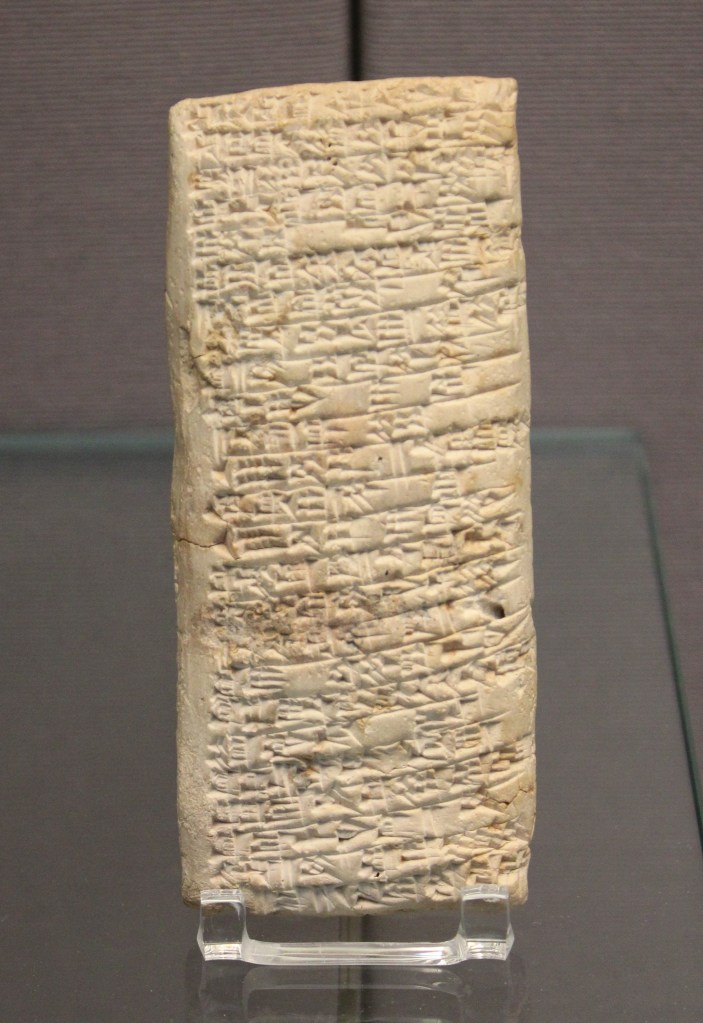
This is a tale of two fellows linked by a letter of complaint: from Nanni the disgruntled customer, and Ea-nasir the merchant. It seems Nanni paid good money for products, and when his assistant went over to collect the items, he was offered third-rate merchandise and treated rudely. The irate customer wrote on every bit of the complaint form, detailing his many injuries at the hands of this shameful purveyor of shoddy goods. He made it absolutely clear that in the future the goods would be brought to Nanni’s own yard, and they’d better be top notch or he wasn’t paying.
The letter was found in Ea-nasir’s house along with some others, but we don’t know if Nanni got satisfaction. We can’t ask him, because Ea-nasir has vanished, along with his business, like dew on a desert breeze.
The letter was written on a clay tablet in Akkadian cuneiform, around 1750 BCE.
My son, who does his best to keep his old man appraised of all the geek things, sent me a meme involving Ea-nasir. It turned out to be but one of many, framed around “The World’s Oldest Complaint Letter”. There are also quite a few videos of variations of the same joke: Customer service hasn’t changed in four thousand years.
While I can appreciate the humor (such that it is), this isn’t what struck me about this artifact. It was the names. The further back you look in time, the fewer individuals can be seen. A thousand years back, we have records of the heads of state or notable churchmen and nobles whose names graced deeds or court records archived in stone buildings. Two thousand years ago, writing was perhaps more common in some locales but still available to a minuscule fraction of the general population, and almost no parchment or papyrus survived the ages; even the names of the mighty which were chiseled on stone are now too often weathered to obscurity.
Farther still, when writing was necessary for civilization to function yet still mystic enough to be wielded by specialists, a powerful man at the apex of a city-state would use some of his power to immortalize his likeness and his name on a stone tablet, or perhaps have the embellished story of his military victories drawn on baked clay; like as not such mementos would be destroyed or lost when the next big man came to power.
Yet the astoundingly short list of identities to survive the rise and fall of kingdoms, countries, languages and cultures, include two folks who were not great warriors, not great lords, not godspeakers. No, they were tradesfolk, strictly middle-tier.
To put it in perspective, imagine that millennia from now the museum talks mention the names of folks known in the North American continent: maybe half a dozen presidents, a few prime ministers, a few military figures and one or two social leaders. And on a shelf in one corner of museum is piece of paper – a miraculous missive to one Crazy Eddie, purveyor of used vehicles, from an angry Frank.
AlbatrossGiftsCo
I was reminded of a scene in the movie The 13th Warrior. Buliwyf, the illiterate leader of a warband, had become intrigued by a civilized fellow’s magical ability to write (or as he put it, “draw words”). As he lies on his deathbed, he hinted to his friend his last request: “A man might be thought wealthy if someone were to draw the story of his deeds, that they may be remembered.” By that mark, Nanni and Ea-Nasir only have loose change in their accounts, but they remain among the richest people of the Bronze Age.
I was on an online forum discussing ownership of property and how to manage the land. One participant, perhaps seeing this as a moment to remind me of my place in the ecosystem (and not knowing I revere Leopold), took the position that one cannot own land; that we are merely stewards of the land.
In a sense, that’s true. But whether I choose to nurture or exploit this pack of dirt is a matter of ethics; whether someone else believes I have treated the land well or poorly is determined by that individual’s personal philosophy. And it wasn’t my point.
I can most definitely own land. I recognize that my ownership is fictive, species-specific, and overlaps uncounted other claims of ownership. The songbird claims territory, but only others of its species care. You can have several different species proclaiming dominion over the same tree, but ignoring each other. Other critters, such as the white-tailed bucks who are pawing the ground and rubbing off the bark of saplings, have home ranges, but their defensible territory seems to be located within sensory distance of wherever they happen to be when another buck is in the vicinity.
I pounded in a stake to mark the invisible line through the woods. If I chose, there would be consequences for any human walking across that invisible boundary. On the other hand, a flock of turkeys can meander back and forth across the same line without any consequence.
So, in the human world, my claim to this acreage is power – the power to protect 20 acres from being turned into a housing development or an unofficial dump. But yes, that power lasts only as long as I maintain my claim– by guarding the border and paying the taxes. When I die, it’s out of my hands. But I can protect it while I’m here. In theory, I can sign an easement to lock away the legal rights to turn the hardwood forest into anything other than a hardwood forest, but that protection is still a piece of paper, and in jeopardy if someone wants to cut or build badly enough.
But for now I am the owner of record, duly recorded in a deed book in the courthouse. And of course, my claim of ownership is irrelevant to the animals that dwell in the same space. But I feel better knowing that the land that has suffered two centuries of abuse can rest for a decade or three.












 Towards the Moon or To the Sun
You must be logged in to post a comment.